When it comes to speaking out, cells wait their turn
September 6, 2011

When it comes to speaking out, cells wait their turn

Enlarge

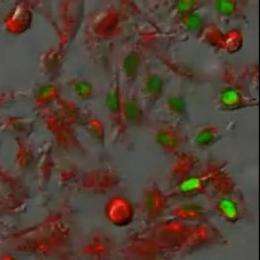
Watching cells communicate: CMO cells in "listening" (red) and "sending" (green) modes, as photographed in Dr. Sprinzak's laboratory. Credit: AFTAU

Cell communication is essential for the development of any organism. Scientists know that cells have the power to "talk" to one another, sending signals through their membranes in order to "discuss" what kind of cell they will ultimately become — whether a neuron or a hair, bone, or muscle. And because cells continuously multiply, it's easy to imagine a cacophony of communication.

But according to Dr. David Sprinzak, a new faculty recruit of Tel Aviv University's Department of Biochemistry and Molecular Biology at the George S. Wise Faculty of Life Sciences, know when to transmit signals — and they know when it's time to shut up and let other cells do the talking. In collaboration with a team of researchers at the California Institute of Technology, Dr. Sprinzak has discovered the mechanism that allows cells to switch from sender to receiver mode or vice versa, inhibiting their own signals while allowing them to receive information from other cells — controlling their development like a well-run business meeting.

Dr. Sprinzak's breakthrough can lead to the development of cancer drugs that specifically target these transactions as needed, further inhibiting or encouraging the flow of information between cells and potentially stopping the uncontrollable proliferation of cancer cells. Dr. Sprinzak's research appeared in the journal PLoS Computational Biology.

Over and out

A cell's communications behavior is mediated by the "Notch signalling pathway," one of the major communication channels between neighboring cells. Information is transferred between cells when Notch receptors from one cell come into contact with Delta molecules, or signals, from another cell. But when the same Delta molecules interact with Notch receptors in the same cell, Dr. Sprinzak found, they shut down their activity and prevent reception of signals from the outside world.

The researchers set out to learn how. In the lab, Dr. Sprinzak and his team attached fluorescent proteins to both Notches and Deltas to track the flow of information. What they found was that the Notch receptors and the Delta signals are actually capable of binding to each other, effectively shutting down each other's activity and forcing the cells into either sender or receiver modes.

"In one state, a cell can send a message and not receive, and in the other it receives and cannot send. They can talk or listen, but they cannot do both at the same time," says Dr. Sprinzak. He compares this communications system to a walkie talkie, in which only one user may be "on the air" at a time.

This switch is crucial to helping the cells make yes-and-no decisions in which neighboring cells adopt distinct fates. Such "cell fate" decisions are responsible for formation of boundaries between developmental tissues, such as those between the vertebrae protecting our spine. They can also account for many patterns of differentiation in the body, such as the pattern of neurons in our brain, or sensory hairs in the inner ear.

Far from enigmatic, this process can actually be seen in the lab. By measuring the fluorescence in real time, it is possible to watch how the levels of a cell's own Delta activity affect the ability of a cell to transfer messages to its neighbors.

Understanding biology through mathematical models

Sender and receiver behavior, says Dr. Sprinzak, not only determines how cells differentiate normally, but also how they differentiate in abnormal situations, such as when cancer cells are growing.

Provided by Tel Aviv University search and more info website

Filter


Move the slider to adjust rank threshold, so that you can hide some of the comments.


Display comments: newest first

hush1
Sep 06, 2011

Rank: 1 / 5 (1)
Up to five thousand dendrites and one axon housed in one neuron.
This cell exhibits the ability to simultaneously send and receive.
Rank 5 /5 (3 votes)
Relevant PhysicsForums posts

More news stories

Scientist: Evolution debate will soon be history

(AP) -- Richard Leakey predicts skepticism over evolution will soon be history. Not that the avowed atheist has any doubts himself.

Biology / Evolution

created 17 hours ago | popularity 3.3 / 5 (17) | comments 54

More plant species responding to global warming than previously thought

(Phys.org) -- Far more wild plant species may be responding to global warming than previous large-scale estimates have suggested.

Biology / Ecology

created May 22, 2012 | popularity 4.6 / 5 (14) | comments 18 | with audio podcast

Thousands of shellfish found dead in Peru

Thousands of crustaceans were found dead off the coast of Lima following the mystery mass death of dolphins and pelicans, the Peruvian Navy said Friday.

Biology / Ecology

created May 26, 2012 | popularity 4.8 / 5 (4) | comments 7

For monogamous sparrows, it doesn't pay to stray (but they do it anyway)

It's quite common for a female song sparrow to stray from her breeding partner and mate with the male next door, but a new study shows that sleeping around can be costly.

Biology / Plants & Animals

created May 22, 2012 | popularity 5 / 5 (2) | comments 7 | with audio podcast

Study uncovers secret to speedy burrowing by razor clams

(Phys.org) -- If you look at a razor burrowing clam sitting in a bucket, you’d never guess that it could burrow itself down into the soil, much less do it with any speed. Razor clams look like fat straws, ...

Biology / Plants & Animals

created May 25, 2012 | popularity 1 / 5 (1) | comments 3 | with audio podcast report


Browser wars flare in mobile space

The browser wars are heating up again, but this time the fight is for dominance of the mobile Internet.

Nvidia trumpets Tegra 3 phone design wins for 2012

(Phys.org) -- Nvidia’s competitive war paint has a name, Tegra 3. On the heels of Nvidia announcements about lowering costs of its Tegra 3 processors and Nvidia-enabled tablets running Android Ice Cream ...

Dell tablet leak: 10.1-inch display, two-battery choice

(Phys.org) -- Headline after headline talks about vendors’ tablets in the wings as likely number-one contenders for the iPad. Such claims have justifiably been taken with a grain of salt, considering ...

Keep food safety in mind this memorial day weekend

(HealthDay) -- Picnics, parades and cookouts are as much a part of Memorial Day weekend as tributes to the United States' war veterans.

Social welfare cuts ultimately come with heavy price, researchers say

(Phys.org) -- Slashing government funding for Medicaid, food stamps and other programs that serve the poor – while politically popular with some lawmakers and many conservatives – may do more harm ...

Is a classical electrodynamics law incompatible with special relativity?

(Phys.org) -- The laws of classical electromagnetism that were developed in the 19th century are the same laws that scientists use today. They include Maxwell’s four equations along with the Lorentz la ...