'Connected' cars new buzzword at IAA fair
Sep 14, 2011 by Caroline Biehl
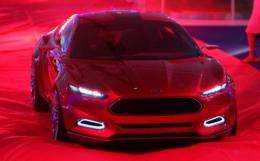
The Evos concept car by Ford is on display at the international car show IAA (Internationale Automobil-Ausstellung) in Frankfurt. Following smartphones and tablet computers, motorists look set to be the next big market for connected devices as automakers wow crowds with the latest Internet-enabled models at the IAA motor show.

Following smartphones and tablet computers, motorists look set to be the next big market for connected devices as automakers wow crowds with the latest Internet-enabled models at the IAA motor show.

The times are long past when car shows reeked of motor oil and fans were obsessed with engine power and sleek designs.

With the aid of cloud computing, automobile makers believe the car of the future will no longer be just a vehicle, but an extension of the home or workplace, where drivers will have access to emails and keep up-to-date on their social networks even on the road.

German top-of-the-range manufacturer BMW already offers an onboard computer with Internet access whereby drivers can locate a restaurant of their preference, the nearest ATM or free parking space in a matter of clicks.

And rival Daimler is not to be outdone, either: its new in-built computer allows drivers to surf the web as long as the vehicle is parked.

In its new on show unveiled at the IAA this week, the Evos, Ford claims it can fine-tune the car to personal preferences, even down to the cabin temperature, and access to the driver's home entertainment systems for listening to favourite news and music programmes.
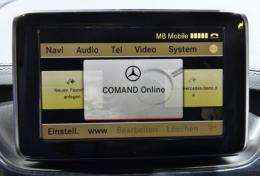
The onboard computer of a Mercedes-Benz B-class displays the name "Comand online", which is the name for Mercedes-Benz's internet connection system for onboard computers, at the international motor show IAA in Frankfurt. Following smartphones and tablet computers, motorists look set to be the next big market for connected devices as automakers wow crowds with the latest Internet-enabled models.

"A successful car must offer lifestyle, comfort and also fit in with people's ecological awareness," said Stephan Reith of the consultancy firm, Booz & Company.

Studies suggest that the number of Internet-enabled vehicles worldwide will soar in the coming years.

According to BITKOM, the German industry association for IT, telecoms and new media, one out of every two drivers in Germany would already like Internet access in the car.

"And if the market says: 'That's what we want', that's what it gets," predicted LBBW analyst Frank Biller.

"Connectivity is a megatrend," the analyst said.

Navigation systems have long become more than just fancy accessories.

And automotive part makers such as Bosch in Germany and Valeo in France are busily investing in state-of-the-art onboard computer technologies, with the French group, for example, unveiling a new system which parks a vehicle without the driver in the car.

Nevertheless, the new services are not without their dangers, such as driver distraction.

The challenge is "to meet customer demands without impinging on traffic safety," said BITKOM board member Martina Koederitz.

And there are other security concerns, too.

US anti-virus software group McAfee warned of possible hacker attacks on vehicle computer systems.

"It's one thing to hack into someone's email account or laptop. But if cars are hacked, that could seriously compromise critical safety systems," said McAfee general manager Stuart McClure.

And data protection specialists warned must be careful about the sheer volume of personal data stored, particularly in electric cars, which could be used to track somebody's whereabouts or movements.

Explore further: Inventor creates Card Beams with 3D printer

add to favorites email to friend print save as pdf

Related Stories

McAfee warns of hacker threat to autos

Sep 07, 2011

Cars made smarter with Internet technology are zooming into perilous hacker territory, according to a report by US computer security giant McAfee.

Adaptive headlamp system introduced

Sep 02, 2010

(PhysOrg.com) -- The independent industrial group Valeo, which is headquartered in France, has introduced a "BeamAtic" adaptive headlight system that enables drivers to keep their lights on high beam without ...

Using your car key as a credit card?

Oct 22, 2008

(PhysOrg.com) -- BMW Group Research and Technology and NXP Semiconductors, the independent semiconductor company founded by Philips, have unveiled a prototype of the world’s first multifunctional car key. The prototype ...

Someday 'talking cars' may save lives

Jan 27, 2011

Could "talking cars" save lives? Auto companies are developing safety systems using advanced WiFi signals and GPS systems that could allow vehicles to communicate with each other on the road. The cars could then send messages ...

Recommended for you

Inventor creates Card Beams with 3D printer

May 23, 2013

What are card beams, you may ask? They are the building toy that allows you to build gravity-defying houses of cards with the help of friction, gravity, and two types of beams - the cap and the connector.

With high-tech guns, users could disable remotely

May 21, 2013

A high-tech startup is wading into the gun control debate with a cellphone controller that would allow gun owners to know when their weapon is being moved—and disable it remotely.

Game system castAR debuts at Maker Faire

May 21, 2013

(Phys.org) —Two tech talents, formerly employees at video game publisher Valve, have been working on their own vision in the form of game-ready glasses. Their company, Technical Illusions, will seek to ...

China police billions spell profit opportunity

May 19, 2013

Mannequins in riot gear, armoured cars and drones line a police equipment and "anti-terrorism technology" trade fair in Beijing as vendors seek to profit from China's huge internal security budget.

User comments : 1

Adjust slider to filter visible comments by rank

Display comments: newest first

Nik_2213
not rated yet Sep 14, 2011
"... as long as the vehicle is parked."
Thank you, thank you, thank you-- Today, I was nearly T-boned *twice* by drivers using their cell-phones instead of watching the road...

More news stories

Drones may violate international law

(Phys.org) —As President Obama gives a speech on national security—including defending U.S. use of drones to combat terrorism—Leila Sadat, JD, international law expert and professor of law at Washington University in ...

Google eyes emerging markets networks

Google has become deeply involved in a series of projects to build and operate wireless networks in emerging markets including sub-Saharan Africa and Southeast Asia, a report said Friday.

Facial-recognition technology proves its mettle

(Phys.org) —In a study that evaluated some of the latest in automatic facial recognition technology, researchers at Michigan State University were able to quickly identify one of the Boston Marathon bombing ...

The long road to the 2000-watt society

The vision of a society in which each inhabitant of the earth manages to consume only 2000 watts has already been around for 15 years. During this time, there has been a steady increase in environmental awareness ...

Galaxies fed by funnels of fuel

(Phys.org) —Computer simulations of galaxies growing over billions of years have revealed a likely scenario for how they feed: a cosmic version of swirly straws.