Carbon nanotube composites for enzymes and cosmetics
Sep 06, 2011 By Adarsh Sandhu
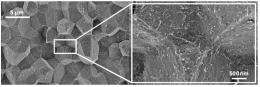
Cross-section of PMMA resin composite material showing the networks of CNTs on the surfaces of the resin particles. The CNTs are added to induce electrical conductivity. Credit: Toyohashi Tech

Japanese researchers have developed a low cost and efficient method for producing electrically conducting composites based on electrostatic adsorption of CNTs onto resin and ceramic particles for applications including enzymes and cosmetics.

Hiroyuki Muto and colleagues at Japan’s Toyohashi University of Technology (Toyohashi Tech) have developed an innovative method for producing CNT (carbon nano-tube) composite material that only requires 1/100 of the conventional amount of CNT additive to produce electrical conductivity in the composite material.

In this method, CNTs were mixed in an electrolyte solution and added to the composite, where the CNTs were adsorbed onto the surfaces of the resin particles due to electrostatic adsorption. This innovative procedure enabled the production of electrical conducting composites by the addition of a small quantity CNTs.

Importantly, the electrical conductivity of the composite material was easily controlled by changing the amount of electrolyte added to the composite; namely, the concentration of onto the resin particles.

Notably, this approach enables significant reductions in both the production costs and the production time compared with conventional methods for manufacturing conductive resins.

The researchers are confident that adding particles with charged surfaces will enable the production of a wide range of composite materials such as metals, ceramics, and polymers. This method is expected to find applications in the production of enzymes and cosmetics.

Explore further: Scientists develop cheaper, more efficient fuel cells

Provided by Toyohashi University of Technology

not rated yet
add to favorites email to friend print save as pdf

Related Stories

Reinforced racquets and heated wallpaper

May 18, 2006

Extremely conductive, stronger than steel and lighter than aluminum – these are only a few of the amazing properties of carbon nanotubes. An innovative method now enables the "miracle material" to be processed ...

Recommended for you

Scientists develop cheaper, more efficient fuel cells

9 hours ago

(Phys.org) —Using the Canadian Light Source (CLS) synchrotron, researchers have discovered a way to create cheaper fuel cells by dividing normally expensive platinum metal into nanoparticles (or even single ...

User comments : 0

More news stories

Scientists develop cheaper, more efficient fuel cells

(Phys.org) —Using the Canadian Light Source (CLS) synchrotron, researchers have discovered a way to create cheaper fuel cells by dividing normally expensive platinum metal into nanoparticles (or even single ...

Weird science: Crystals melt when they're cooled

(Phys.org) —Growing thin films out of nanoparticles in ordered, crystalline sheets, to make anything from microelectronic components to solar cells, would be a boon for materials researchers, but the physics ...

Controlling mood through the motions of mitochondria

(Medical Xpress)—Regulating the distribution of power in neurons is done by a system that makes the national electric grid look simple by comparison. Each neuron has several thousand mitochondria confined ...