Canadian Arctic nearly loses entire ice shelf
September 30, 2011 By CHARMAINE NORONHA , Associated Press

Canadian Arctic nearly loses entire ice shelf (AP)

Enlarge

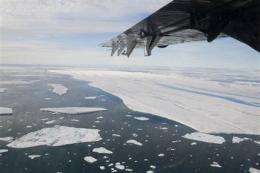
In this July 27, 2008 file photo, a chunk of ice is shown drifting after it separated from the Ward Hunt Ice Shelf off the north coast of Ellesmere Island in Canada's far north. This past summer, Ward Hunt Ice Shelf's central area disintegrated into drifting ice masses, leaving two separate ice shelves measuring 87.65 and 28.75 square miles (227 and 74 square kilometers) respectively, reduced from 131.7 square miles (340 square kilometers) the previous year. (AP Photo/The Canadian Press, Sam Soja, File)

Two ice shelves that existed before Canada was settled by Europeans diminished significantly this summer, one nearly disappearing altogether, Canadian scientists say in new research.

The loss is important as a marker of global warming, returning the to conditions that date back thousands of years, scientists say. Floating that have broken free as a result pose a risk to facilities and potentially to . The breaking apart of the ice shelves also reduces the environment that supports and changes the look of Canada's coastline.

Luke Copland is an associate professor in the geography department at the University of Ottawa who co-authored the research. He said the Serson Ice Shelf shrank from 79.15 square miles (205 square kilometers) to two remnant sections three years ago, and was further diminished this past summer.

Copland said the shelf went from a 16-square-mile (42-square-kilometer) floating glacier tongue to 9.65 square miles (25 square kilometers), and the second section from 13.51 square miles (35 square kilometers) to 2 square miles (7 square kilometers), off Ellesmere Island's northern coastline.

This past summer, Ward Hunt Ice Shelf's central area disintegrated into drifting ice masses, leaving two separate ice shelves measuring 87.65 and 28.75 square miles (227 and 74 square kilometers) respectively, reduced from 131.7 square miles (340 square kilometers) the previous year.

"It has dramatically broken apart in two separate areas and there's nothing in between now but water," said Copland.

Copland said those two losses are significant, especially since the Ward Hunt Ice Shelf has always been the biggest, the farthest north and the one scientists thought might have been the most stable.

"Recent (ice shelf) loss has been very rapid, and goes hand-in-hand with the rapid decline we have seen in this decade and the increasing warmth and extensive melt in the ," said Ted Scambos, lead scientist at the National Snow and Ice Data Center at the University of Colorado, remarking on the research.

Copland, who uses satellite imagery and who has conducted field work in the Arctic every May for the past five years, said since the end of July, pieces equaling one and a half times the size of Manhattan Island have broken off. Co-researcher Derek Mueller, an assistant professor at Carleton University's geography and environmental studies department, said the loss this past summer equals up to three billion tons. Copland said their findings have not yet been peer reviewed since the research is new, but a number of scientists contacted by The Associated Press reviewed the findings, agreeing the loss in volume of ice shelves is significant.

Scambos said the loss of the Arctic shelves is significant because they are old and their rapid loss underscores the severity of the warming trend scientists see now relative to past fluctuations such as the Medieval Warm Period or the warmer times in the pre-Current Era (B.C.).

Ice shelves, which began forming at least 4,500 years ago, are much thicker than sea ice, which is typically less than a few feet (meters) thick and survives up to several years.

Canada has the most extensive ice shelves in the Arctic along the northern coast of Ellesmere Island. These floating ice masses are typically 131 feet (40 meters) thick (equivalent to a 10-story building), but can be as much as 328 feet (100 meters) thick. They thickened over time via snow and sea ice accumulation, along with glacier inflow in certain places.

The northern coast of Ellesmere Island contains the last remaining ice shelves in Canada, with an estimated area of 217 square miles (563 square kilometers), Mueller said.

Between 1906 and 1982, there has been a 90 percent reduction in the areal extent of ice shelves along the entire coastline, according to data published by W.F. Vincent at Quebec's Laval University. The former extensive "Ellesmere Island Ice Sheet" was reduced to six smaller, separate : Serson, Petersen, Milne, Ayles, Ward Hunt and Markham. In 2005, the Ayles whittled almost completely away, as did the Markham Shelf in 2008 and the Serson this year.

"The impact is significant and yet only a piece of the ongoing and accelerating response to warming of the Arctic," said Dr. Robert Bindschadler, emeritus scientist at the Hydrospheric and Biospheric Sciences Laboratory at the NASA Goddard Space Flight Center in Maryland.

Bindschadler said the loss is an indication of another threshold being passed, as well as the likely acceleration of buttressed glaciers able to flow faster into the ocean, which accelerates their contribution to global sea level.

Copland said mean winter temperatures have risen by about 1 degree Celsius (1.8 degrees Fahrenheit) per decade for the past five to six decades on northern Ellesmere Island.

©2011 The Associated Press. All rights reserved. This material may not be published, broadcast, rewritten or redistributed.

Filter


Move the slider to adjust rank threshold, so that you can hide some of the comments.


Display comments: newest first

omatumr
Sep 30, 2011

Rank: 1.5 / 5 (15)
Thanks for the story.

Research shows that Earth's climate has changed, is changing, and will always change because Earth is heated by a variable star that is itself evolving with time [1,2] - NOT the constant H-fusion reactor described by the Bilderberg model of the Sun [3].

WikiLeaks "news" suggests that the UNs Clean Development Mechanism (CDM) is but a fig leaf for wealth transfers from industrialized nations to poor developing nations:

www.powerlineblog...arce.php

www.nature.com/ne...20110929

1. "Origin and Evolution of Life" (2011)
http://dl.dropbox...5079.pdf

2. "Neutron Repulsion" (2011)

http://arxiv.org/...2.1499v1

3. "Bilderberg Sun" (1967)

http://adsabs.har....3....5G
Oliver K. Manuel
Former NASA Principal
Investigator for Apollo
http://myprofile....anuelo09
Callippo
Oct 01, 2011

Rank: 1 / 5 (1)
CDM is but a fig leaf for wealth transfers from industrialized nations to poor developing nations
The biggest problem of emissions trading is the fact, it virtualizes the main purpose of carbon tax, i.e. the providing economic incentives for achieving reductions in the emissions of pollutants, the collection of money into introduction of green-house gases free technologies in particular.

Instead of it, the rich companies of western word are sponsoring the introduction of older fossil carbon technologies into the less developed countries via carbon trading and nothing forces them to limit their own production of green-house gases via development of carbon free technologies.
Ethelred
Oct 03, 2011

Rank: 3 / 5 (2)
The Spammer strikes again. How many threads this time?

So just how do Neutron Stars form when neutron repulsion is alleged by you to be so powerful that it stops Black Holes from forming no matter how large the mass?

Ignoring the question won't magically make you right Oliver. The ideas are contradictory and I bet even the Plasma Universe Cranks can see that now that it has been pointed out.

Ethelred
jsdarkdestruction
Oct 04, 2011

Rank: 3 / 5 (2)
Oliver, do you not know of phase 2 of the plan? see kissinger and nixon knew about neutron repulsion and it being the main source of the suns and the universes power but chairman mao did not. as the world all followed their lead in the conspiracy they said it was to prevent nuclear war. however under the guise of that the united states had different reasons. as the climatoligists/scientists destroy our economy and power while funneling money to third world nations for supportung the scam the chinese will soon grow too strong and overpopulated for anyone but the us to even have a chance of stopping the chinese from taking over the world, at that moment neutron repulsion will be officially "discovered" and cheap easy neutron repulsion energy will be used both to power production of weapons and supplies and as weapons of mass destruction themselves in neutron repulsion bombs. saving the united states and allowing us to finally take over the whole world without looking like the bad guys...
Rank 5 /5 (8 votes)
Relevant PhysicsForums posts

More news stories

Sophisticated simulations predict future warming

The chances of our planet being hit by a global warming of 3 degrees Celsius by 2050 is as likely as it being hit by an increase of 1.4 degrees, new research shows. Presented in the journal Nature Geoscience, the British study ...

Space & Earth / Earth Sciences

created May 22, 2012 | popularity 4.4 / 5 (9) | comments 51

Kyoto Protocol architect 'frustrated' by climate dialogue

UN climate talks are going nowhere, as politicians dither or bicker while the pace of warming dangerously speeds up, one of the architects of the Kyoto Protocol told AFP.

Space & Earth / Environment

created May 23, 2012 | popularity 3.7 / 5 (7) | comments 39

Aliens don't want to eat us, says former SETI director

Alien life probably isn’t interested in having us for dinner, enslaving us or laying eggs in our bellies, according to a recent statement by former SETI director Jill Tarter.

Space & Earth / Space Exploration

created May 25, 2012 | popularity 4.4 / 5 (13) | comments 37

Dragon arrives at space station in historic 1st (Update 2)

The privately bankrolled Dragon capsule made a historic arrival at the International Space Station on Friday, triumphantly captured by astronauts wielding a giant robot arm.

Space & Earth / Space Exploration

created May 25, 2012 | popularity 5 / 5 (10) | comments 19

What's the big deal about private space launches?

(AP) -- The first private spaceship is headed to the International Space Station. Some questions and answers about the cargo mission by Space Exploration Technologies, known as SpaceX:

Space & Earth / Space Exploration

created May 22, 2012 | popularity 5 / 5 (6) | comments 35


Browser wars flare in mobile space

The browser wars are heating up again, but this time the fight is for dominance of the mobile Internet.

Nvidia trumpets Tegra 3 phone design wins for 2012

(Phys.org) -- Nvidia’s competitive war paint has a name, Tegra 3. On the heels of Nvidia announcements about lowering costs of its Tegra 3 processors and Nvidia-enabled tablets running Android Ice Cream ...

Scientist: Evolution debate will soon be history

(AP) -- Richard Leakey predicts skepticism over evolution will soon be history. Not that the avowed atheist has any doubts himself.

Dell tablet leak: 10.1-inch display, two-battery choice

(Phys.org) -- Headline after headline talks about vendors’ tablets in the wings as likely number-one contenders for the iPad. Such claims have justifiably been taken with a grain of salt, considering ...

Keep food safety in mind this memorial day weekend

(HealthDay) -- Picnics, parades and cookouts are as much a part of Memorial Day weekend as tributes to the United States' war veterans.

Social welfare cuts ultimately come with heavy price, researchers say

(Phys.org) -- Slashing government funding for Medicaid, food stamps and other programs that serve the poor – while politically popular with some lawmakers and many conservatives – may do more harm ...