Breakthrough technology in identification of prostate cancer cells
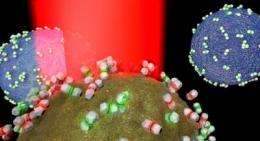
Cancerous and non-cancerous cells are incubated with silver nanoparticle biotags, and then analyzed by shining the red laser on them. The biotags are shown on the cells' surface. Those glowing red in the middle are the cancer biomarkers, and those glowing green are standard biomarkers that bind to many cell types. A high ratio of red to green is found on the cancer cells. Credit: Gary Braun and Peter Allen/UCSB
A team of researchers at UC Santa Barbara has developed a breakthrough technology that can be used to discriminate cancerous prostate cells in bodily fluids from those that are healthy. The findings are published this week in the Proceedings of the National Academy of Sciences.
While the new technology is years away from use in a clinical setting, the researchers are nonetheless confident that it will be useful in developing a microdevice that will help in understanding when prostate cancer will metastasize, or spread to other parts of the body.
"There have been studies to find the relationship between the number of cancer cells in the blood, and the outcome of the disease," said first author Alessia Pallaoro, postdoctoral fellow in UCSB's Department of Chemistry and Biochemistry. "The higher the number of cancer cells there are in the patient's blood, the worse the prognosis.
"The cancer cells that are found in the blood are thought to be the initiators of metastasis," Pallaoro added. "It would be really important to be able to find them and recognize them within blood or other bodily fluids. This could be helpful for diagnosis and follow-ups during treatment."
The researchers explained that although the primary tumor does not kill prostate cancer patients, metastasis does. "The delay is not well understood," said Gary Braun, second author and postdoctoral fellow in the Department of Molecular, Cellular, and Developmental Biology. "There is a big focus on understanding what causes the tumor to shed cells into the blood. If you could catch them all, then you could stop metastasis. The first thing is to monitor their appearance."
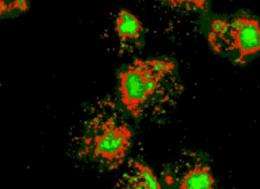
Cells shown in the image are cancerous. The simple color code makes visual identification easy. Red indicates the cancer biomarkers. Credit: Alessia Pallaoro/UCSB
The team developed a novel technique to discriminate between cancerous and non-cancerous cells using a type of laser spectroscopy called surface enhanced Raman spectroscopy (SERS) and silver nanoparticles, which are biotags."Silver nanoparticles emit a rich set of colors when they absorb the laser light," said Braun. "This is different than fluorescence. This new technology could be more powerful than fluorescence."
The breakthrough is in being able to include more markers in order to identify and study unique tumor cells that are different from the main tumor cells, explained Pallaoro. "These different cells must be strong enough to start a new tumor, or they must develop changes that allow them to colonize in other areas of the body," she said. "Some changes must be on the surface, which is what we are trying to detect."
The team is working to translate the technology into a diagnostic microdevice for studying cancer cells in the blood. Cells would be mixed with nanoparticles and passed through a laser, then discriminated by the ratio of two signals.
The two types of biotags used in this research have a particular affinity that is dictated by the peptide they carry on their surface. One type attaches to a cell receptor called neuropilin-1, a recently described biomarker found on the surface membrane of certain cancer cells. The other biotag binds many cell types (both cancerous and non-cancerous) and serves as a standard measure as the cells are analyzed.
In this study, the team mixed the two biotags and added them to the healthy and tumor cell cultures. The average SERS signal over a given cell image yielded a ratio of the two signals consistent with the cells' known identity.
Pallaoro said she believes the most important part of the new technique is the fact that it could be expanded by adding more colors different particles of different colors as more biomarkers are found. The team used a new biomarker discovered by scientists at UCSB and the Sanford Burnham Medical Research Institute.
Provided by
University of California - Santa Barbara
-
From lemons to lemonade: Reaction uses carbon dioxide to make carbon-based semiconductor,
32 comments
-
Thioridazine kills cancer stem cells in human while avoiding toxic side-effects of conventional cancer treatments,
3 comments
-
SpaceX private rocket blasts off for space station (Update),
42 comments
-
Climate scientists say they have solved riddle of rising sea,
31 comments
-
SpaceX capsule has 'new car' smell, astronauts say (Update),
2 comments
-
Gibbs Free Energy Change/Entropy
6 hours ago
-
What's the rule to covalent character
7 hours ago
-
Schwartz reagent-- NMR/MS/IR
May 26, 2012
-
High school chemistry EEI
May 25, 2012
-
oxidation of I- by KMnO4
May 25, 2012
-
Inversion temp
May 25, 2012
- More from Physics Forums - Chemistry
More news stories
New CO2-removing catalyst can take the heat
(Phys.org) -- The current method of removing the greenhouse gas carbon dioxide (CO2) from the flues of coal-fired power plants uses so much energy that no one bothers to use it. So says Roger Aines, principal ...
May 24, 2012 |
5 / 5 (9) |
10
|
High-speed method to aid search for solar energy storage catalysts
Eons ago, nature solved the problem of converting solar energy to fuels by inventing the process of photosynthesis.
May 25, 2012 |
5 / 5 (3) |
4
|
Researchers demonstrate possible primitive mechanism of chemical info self-replication
(Phys.org) -- When scientists think about the replication of information in chemistry, they usually have in mind something akin to what happens in living organisms when DNA gets copied: a double-stranded molecule ...
May 25, 2012 |
5 / 5 (4) |
2
|
Building a better solar panel -- one molecule at a time
(Phys.org) -- One of the fundamental building blocks in modern chemistry, an organometallic chemical compound called ferrocene, has never been structurally defined - until now.
May 25, 2012 |
5 / 5 (3) |
0
|
Discarded data may hold the key to a sharper view of molecules
(Phys.org) -- There's nothing like a new pair of eyeglasses to bring fine details into sharp relief. For scientists who study the large molecules of life from proteins to DNA, the equivalent of new lenses have come in the ...
May 24, 2012 |
4.7 / 5 (3) |
0
|
Browser wars flare in mobile space
The browser wars are heating up again, but this time the fight is for dominance of the mobile Internet.
Nvidia trumpets Tegra 3 phone design wins for 2012
(Phys.org) -- Nvidias competitive war paint has a name, Tegra 3. On the heels of Nvidia announcements about lowering costs of its Tegra 3 processors and Nvidia-enabled tablets running Android Ice Cream ...
Scientist: Evolution debate will soon be history
(AP) -- Richard Leakey predicts skepticism over evolution will soon be history. Not that the avowed atheist has any doubts himself.
Dell tablet leak: 10.1-inch display, two-battery choice
(Phys.org) -- Headline after headline talks about vendors tablets in the wings as likely number-one contenders for the iPad. Such claims have justifiably been taken with a grain of salt, considering ...
Keep food safety in mind this memorial day weekend
(HealthDay) -- Picnics, parades and cookouts are as much a part of Memorial Day weekend as tributes to the United States' war veterans.
Social welfare cuts ultimately come with heavy price, researchers say
(Phys.org) -- Slashing government funding for Medicaid, food stamps and other programs that serve the poor while politically popular with some lawmakers and many conservatives may do more harm ...
