Blazars
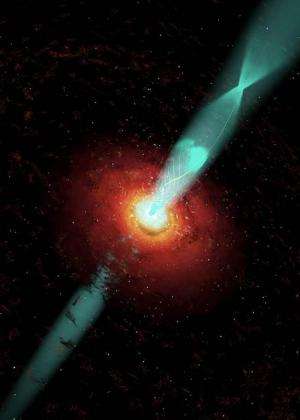
An artist's conception of a blazar, whose powerful jet of high velocity particles is generated around a supermassive black hole and aimed almost directly at Earth. A new CfA study has discovered that the infrared colors of blazars are a distinctive and powerful diagnostic tool. Credit: Marscher et al., Wolfgang Steffen, Cosmovision, NRAO/AUI/NSF
(PhysOrg.com) -- A blazar is a galaxy which, like a quasar, has an intensely bright central nucleus containing a supermassive black hole. In a blazar, however, the emitted light sometimes includes extremely high energy gamma rays, sometimes over a hundred million times more energetic than the highest energy X-rays that the Chandra X-ray Observatory can study. The overall emission has several other unique properties as well, including that its intensity can vary dramatically with time.
Astronomers suspect that this bizarre behavior results when matter falling onto the vicinity of the massive black hole erupts into powerful, narrow beams of high velocity charged particles. The intense X-ray and gamma ray emission we see, and the variability as well, are thought to be the results of our fortuitously staring right down the throats of such cosmic monsters. But blazars are among the rarest of active nuclei, with only about 2700 known, and the physical processes that trigger and sustain such jets are still not known. Although relatively few, their powerful emissions make them major contributors to the overall picture of the cosmos.
CfA astronomers Francesco Massaro, Raffaele D'Abrusco, Josh Grindlay, and Howard Smith, and a colleague, have come up with a new method to find and study blazars. The recently launched NASA Wide Infrared Survey Explorer (WISE) satellite has just completed an infrared survey of the whole sky in four infrared colors. The astronomers matched galaxies known to be blazars with objects measured by WISE in regions of the sky where the data have been reduced and made public. In a new paper in The Astrophysical Journal, the team report their discovery that the infrared bands are remarkably effective at finding blazars. Ninety-seven percent of known blazars were easily picked out from thousands of other WISE sources because their colors in the infrared are different from the colors of other kinds of galaxies. In most galaxies the infrared radiation comes from dust, heated either by star formation or ultraviolet radiation from the vicinity of the massive black hole. In a blazar, however, a completely different mechanism is apparently at work: the ejected beam of charged particles, moving in a powerful magnetic field at nearly the speed of light, radiates infrared light of a distinctly different color than dust emission.
Using this new identification method, the team examines one known, extreme gamma ray source whose character had been mysterious in part because the gamma ray detection could not pinpoint the precise position of the source on the sky. The scientists find an infrared source within the position uncertainty whose distinct colors mark it as a blazar, and conclude that the extreme source is probably a blazar located at the position of the infrared source. In a second paper, the astronomers take advantage of this new method to examine the subset of blazars that are gamma ray emitters. It turns out that the infrared colors of this extreme group are even more distinctly identified, and the team discovered a quantitative relationship between the infrared and gamma ray colors. A future paper will consider the physical mechanism(s) producing the infrared, X-ray, and gamma ray emission. The discovery of the distinct infrared colors of blazars opens a new diagnostic tool in the study of these extreme galaxy nuclei.
Provided by
Harvard-Smithsonian Center for Astrophysics
-
From lemons to lemonade: Reaction uses carbon dioxide to make carbon-based semiconductor,
32 comments
-
Thioridazine kills cancer stem cells in human while avoiding toxic side-effects of conventional cancer treatments,
3 comments
-
SpaceX private rocket blasts off for space station (Update),
42 comments
-
Climate scientists say they have solved riddle of rising sea,
31 comments
-
SpaceX capsule has 'new car' smell, astronauts say (Update),
2 comments
-
revamping general concept and cosmological principle
May 25, 2012
-
Transiting Exoplanet Light Curve
May 25, 2012
-
Math behind Theoretical Physics
May 24, 2012
-
Do we know whats at the center of galaxies yet?
May 23, 2012
-
Structure of the Milky Way?
May 20, 2012
-
What would it take to terraform Pluto and Charon?
May 19, 2012
- More from Physics Forums - General Astronomy
More news stories
Sophisticated simulations predict future warming
The chances of our planet being hit by a global warming of 3 degrees Celsius by 2050 is as likely as it being hit by an increase of 1.4 degrees, new research shows. Presented in the journal Nature Geoscience, the British study ...
Space & Earth / Earth Sciences
May 22, 2012 |
4.4 / 5 (9) |
51
Kyoto Protocol architect 'frustrated' by climate dialogue
UN climate talks are going nowhere, as politicians dither or bicker while the pace of warming dangerously speeds up, one of the architects of the Kyoto Protocol told AFP.
May 23, 2012 |
3.7 / 5 (7) |
39
Aliens don't want to eat us, says former SETI director
Alien life probably isnt interested in having us for dinner, enslaving us or laying eggs in our bellies, according to a recent statement by former SETI director Jill Tarter.
Space & Earth / Space Exploration
May 25, 2012 |
4.4 / 5 (13) |
37
Dragon arrives at space station in historic 1st (Update 2)
The privately bankrolled Dragon capsule made a historic arrival at the International Space Station on Friday, triumphantly captured by astronauts wielding a giant robot arm.
Space & Earth / Space Exploration
May 25, 2012 |
5 / 5 (10) |
19
What's the big deal about private space launches?
(AP) -- The first private spaceship is headed to the International Space Station. Some questions and answers about the cargo mission by Space Exploration Technologies, known as SpaceX:
Space & Earth / Space Exploration
May 22, 2012 |
5 / 5 (6) |
35
Browser wars flare in mobile space
The browser wars are heating up again, but this time the fight is for dominance of the mobile Internet.
Nvidia trumpets Tegra 3 phone design wins for 2012
(Phys.org) -- Nvidias competitive war paint has a name, Tegra 3. On the heels of Nvidia announcements about lowering costs of its Tegra 3 processors and Nvidia-enabled tablets running Android Ice Cream ...
Scientist: Evolution debate will soon be history
(AP) -- Richard Leakey predicts skepticism over evolution will soon be history. Not that the avowed atheist has any doubts himself.
Dell tablet leak: 10.1-inch display, two-battery choice
(Phys.org) -- Headline after headline talks about vendors tablets in the wings as likely number-one contenders for the iPad. Such claims have justifiably been taken with a grain of salt, considering ...
Keep food safety in mind this memorial day weekend
(HealthDay) -- Picnics, parades and cookouts are as much a part of Memorial Day weekend as tributes to the United States' war veterans.
Social welfare cuts ultimately come with heavy price, researchers say
(Phys.org) -- Slashing government funding for Medicaid, food stamps and other programs that serve the poor while politically popular with some lawmakers and many conservatives may do more harm ...
Sep 06, 2011
Rank: 1 / 5 (8)
Like axial jets from ordinary stars and pulsars, . . .
As if axial jets were the way massive neutron-rich central objects release energy from neutron repulsion ["Neutron Repulsion", The APEIRON Journal, in press (2011)].
http://arxiv.org/...2.1499v1
With kind regards,
Oliver K. Manuel
Former NASA Principal
Investigator for Apollo
Sep 06, 2011
Rank: 4.5 / 5 (8)
Sep 06, 2011
Rank: 5 / 5 (2)
It'll make a great tool to identify new blazars, as illustrated by the WISE discovery mentioned in the article. There are a number of unidentified gamma ray sources with blazar-like properties but no corresponding objects can be found at shorter wavelengths. Finding corresponding blazar candidates at IR wavelengths will open up multiwavelength studies of these newfound galaxies. Looking forward to widespread application of this powerful new tool.
Sep 06, 2011
Rank: not rated yet
Sep 07, 2011
Rank: 3.7 / 5 (6)
No not really. Even if there was such a field, it would be way too weak to produce the observed jets.
A SM black hole distorts space-time around it which twists magnetic field lines into a coil that propels material outward.
Observations have been made of such a jet outburst (in galaxy BL Lacertae, using the VLBA, et al) which shows evidence that streams of particles wind in a corkscrew-like path away from the black hole, in accordance with the leading hypothesis.
Sep 07, 2011
Rank: 5 / 5 (2)
The jets from Blazars and Quasars are streaming out from objects much smaller than a galaxy. Also the magnetic fields involved are extremely dense and powerful, nothing like you would observe around a galaxy. Finally the rapid changes in luminosity of these objects indicate a very small active core.
Sep 11, 2011
Rank: not rated yet
Then, wouldn't the intersection of two jets double that first distance? And so on? (of course, I'm probably going out a limb assuming that they don't disperse much.)
Might there, in fact, not be entire galaxies that have been sterilized by these thing's random spray?
Interesting universe.
Sep 11, 2011
Rank: 1 / 5 (1)
-Deesky
Why, just because you say so? Any references to back you up?
Sep 11, 2011
Rank: 5 / 5 (1)
Depends on the size of the galaxy getting hosed (and the width of the jet to some extent). In radio galaxy 3C 321, a jet from the main galaxy's AGN appears to interact with a smaller, infalling companion galaxy some 20,000ly distant, causing a hot spot to appear there: http://chandra.ha...7/3c321/
The jet's interaction with the galaxy appears to bend the jet, which continues outward 850,000ly(!) from the nucleus of 3C 321. A paper on this remarkable system has more details: http://hea-www.ha...c321.pdf