Bird disease spreads from UK to Europe
September 23, 2011 by Deborah Braconnier
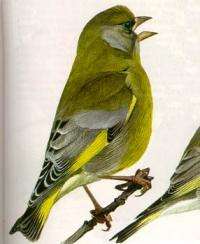
(PhysOrg.com) -- The deadly bird disease trichomonosis, which has been killing off large numbers of greenfinches and chaffinches in Britain since 2005, has spread to Europe according to a new study published in EcoHealth.
Trichomonosis, caused by the parasite trichomonas gallinae, is commonly associated with doves and pigeons, but crossed the species barrier in 2005 and began affecting finches in the UK. Some areas were hit hard by the parasite, with the chaffinch populations declining by 20 percent and the greenfinch by 35 percent.
Trichomonas gallinae cannot survive for long periods outside of the host and transmission between the birds most likely occurs when birds feed their young through regurgitated food or ingest food and water that has been contaminated by a sick birds saliva.
The new study, carried out by the Zoological Society of London, the University of East Anglia, the British Trust for Ornithology and various other organizations across Europe believe it was the chaffinch that carried the disease out of the UK and into Scandinavia. Since 2008, reports of finch death due to trichomonosis have been seen in Finland, Norway and Sweden. Evidence shows that the chaffinches flew from England in the spring of 2008 to a breeding ground in Fennoscandia and delivered the parasite to the area.
Finches are not the only birds that have been affected by this parasite recently. Trichomonosis has also been diagnosed in the already endangered house sparrow and yellowhammer.
The parasite can cause outbreaks at any time, though deaths tend to occur more often during August and October. Researchers are turning to the public and asking them to report signs of sick birds. Symptoms include fluffed up feathers, lethargy, staying near the feeder and having a difficult time eating and may look wet around the bill. In order to help minimize the spread, people are being asked to regularly clean bird feeding areas and bird baths every couple of weeks and if possible, rotate the area in which the feeder are in. This will help to minimize a build-up of food and bird feces in an area.
© 2011 PhysOrg.com
-
From lemons to lemonade: Reaction uses carbon dioxide to make carbon-based semiconductor,
32 comments
-
Thioridazine kills cancer stem cells in human while avoiding toxic side-effects of conventional cancer treatments,
3 comments
-
SpaceX private rocket blasts off for space station (Update),
42 comments
-
Climate scientists say they have solved riddle of rising sea,
31 comments
-
SpaceX capsule has 'new car' smell, astronauts say (Update),
2 comments
-
What would stain as translucent on light-coloured fabric?
18 hours ago
-
How do I identify different bacteria on culture plates?
May 26, 2012
-
Why Do Dogs do Strange things...
May 25, 2012
-
What does exophillic and endophillic mean in terms of mosquito and their control?
May 24, 2012
-
Semen stains glows under black lights (uv light)?
May 23, 2012
-
Question on Human Chromosome 2
May 23, 2012
- More from Physics Forums - Biology
More news stories
Scientist: Evolution debate will soon be history
(AP) -- Richard Leakey predicts skepticism over evolution will soon be history. Not that the avowed atheist has any doubts himself.
17 hours ago |
3.3 / 5 (17) |
54
More plant species responding to global warming than previously thought
(Phys.org) -- Far more wild plant species may be responding to global warming than previous large-scale estimates have suggested.
May 22, 2012 |
4.6 / 5 (14) |
18
|
Thousands of shellfish found dead in Peru
Thousands of crustaceans were found dead off the coast of Lima following the mystery mass death of dolphins and pelicans, the Peruvian Navy said Friday.
May 26, 2012 |
4.8 / 5 (4) |
7
For monogamous sparrows, it doesn't pay to stray (but they do it anyway)
It's quite common for a female song sparrow to stray from her breeding partner and mate with the male next door, but a new study shows that sleeping around can be costly.
May 22, 2012 |
5 / 5 (2) |
7
|
Study uncovers secret to speedy burrowing by razor clams
(Phys.org) -- If you look at a razor burrowing clam sitting in a bucket, youd never guess that it could burrow itself down into the soil, much less do it with any speed. Razor clams look like fat straws, ...
Browser wars flare in mobile space
The browser wars are heating up again, but this time the fight is for dominance of the mobile Internet.
Nvidia trumpets Tegra 3 phone design wins for 2012
(Phys.org) -- Nvidias competitive war paint has a name, Tegra 3. On the heels of Nvidia announcements about lowering costs of its Tegra 3 processors and Nvidia-enabled tablets running Android Ice Cream ...
Dell tablet leak: 10.1-inch display, two-battery choice
(Phys.org) -- Headline after headline talks about vendors tablets in the wings as likely number-one contenders for the iPad. Such claims have justifiably been taken with a grain of salt, considering ...
Keep food safety in mind this memorial day weekend
(HealthDay) -- Picnics, parades and cookouts are as much a part of Memorial Day weekend as tributes to the United States' war veterans.
Social welfare cuts ultimately come with heavy price, researchers say
(Phys.org) -- Slashing government funding for Medicaid, food stamps and other programs that serve the poor while politically popular with some lawmakers and many conservatives may do more harm ...
Is a classical electrodynamics law incompatible with special relativity?
(Phys.org) -- The laws of classical electromagnetism that were developed in the 19th century are the same laws that scientists use today. They include Maxwell’s four equations along with the Lorentz la ...