Aquarius yields NASA's first global map of ocean salinity
September 23, 2011 By Steve Cole and Alan Buis

Aquarius yields NASA'S first global map of ocean salinity

Enlarge

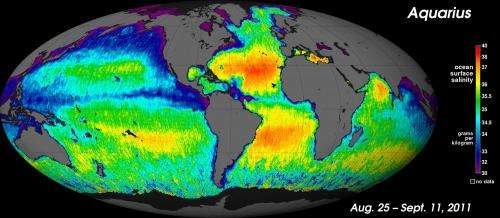
(PhysOrg.com) -- NASA's new Aquarius instrument has produced its first global map of the salinity of the ocean surface, providing an early glimpse of the mission's anticipated discoveries.

Aquarius, which is aboard the /SAC-D (Satelite de Aplicaciones Científicas) observatory, is making NASA's first space observations of salinity variations - a key component of Earth's climate. Salinity changes are linked to the cycling of freshwater around the planet and influence circulation.

"Aquarius' salinity data are showing much higher quality than we expected to see this early in the mission," said Aquarius principal investigator Gary Lagerloef of Earth & Space Research in Seattle. "Aquarius soon will allow scientists to explore the connections between global rainfall, ocean currents and climate variations."

The new map, which shows a tapestry of salinity patterns, demonstrates Aquarius' ability to detect large-scale salinity distribution features clearly and with sharp contrast. The map is a composite of the data since Aquarius became operational on Aug. 25. The mission was launched June 10 from Vandenberg Air Force Base in California. Aquarius/SAC-D is collaboration between and Argentina's space agency, Comision Nacional de Actividades Espaciales (CONAE).

"Aquarius/SAC-D already is advancing our understanding of ocean surface salinity and Earth's water cycle," said Michael Freilich, director of NASA's Earth Science Division at agency headquarters in Washington. "Aquarius is making continuous, consistent, global measurements of ocean salinity, including measurements from places we have never sampled before."

To produce the map, Aquarius scientists compared the early data with ocean surface salinity reference data. Although the early data contain some uncertainties, and months of additional calibration and validation work remain, scientists are impressed by the data's quality.

"Aquarius has exposed a pattern of ocean surface salinity that is rich in variability across a wide range of scales," said Aquarius science team member Arnold Gordon, professor of oceanography at Columbia University in New York and at Lamont-Doherty Earth Observatory of Columbia University in Palisades, N.Y. "This is a great moment in the history of oceanography. The first image raises many questions that oceanographers will be challenged to explain."

The shows several well-known features such as higher salinity in the subtropics; higher average salinity in the Atlantic Ocean compared to the Pacific and Indian Oceans; and lower in rainy belts near the equator, in the northernmost Pacific Ocean and elsewhere. These features are related to large-scale patterns of rainfall and evaporation over the ocean, river outflow and ocean circulation. Aquarius will monitor how these features change and study their link to climate and weather variations.

Other important regional features are evident, including a sharp contrast between the arid, high-salinity Arabian Sea west of the Indian subcontinent, and the low-salinity Bay of Bengal to the east, which is dominated by the Ganges River and south Asia monsoon rains. The data also show important smaller details, such as a larger-than-expected extent of low-salinity water associated with outflow from the Amazon River.

More information: For more information about Aquarius/SAC-D, visit: http://www.nasa.gov/aquarius

Provided by JPL/NASA search and more info website

Filter


Move the slider to adjust rank threshold, so that you can hide some of the comments.


Display comments: newest first

El_Nose
Sep 23, 2011

Rank: 3 / 5 (2)
old article rehashed
El_Nose
Sep 24, 2011

Rank: 1 / 5 (1)
rehashed because though the dates on that salinity picture are a week old that salinity picture has been through around the internet a few time this year for those paying attention... its old news that satellite are observing salinity
omatumr
Sep 24, 2011

Rank: 2.3 / 5 (3)
The map shows several well-known ocean salinity features such as higher salinity in the subtropics; higher average salinity in the Atlantic Ocean compared to the Pacific and Indian Oceans; and lower salinity in rainy belts near the equator, in the northernmost Pacific Ocean and elsewhere.


Congratulations!

Has the satellite observed anything that was not already a well-known feature of ocean salinity?

With kind regards,
Oliver K. Manuel
Former NASA Principal
Investigator for Apollo
http://myprofile....anuelo09
Rank 5 /5 (1 vote)
Relevant PhysicsForums posts

More news stories

Sophisticated simulations predict future warming

The chances of our planet being hit by a global warming of 3 degrees Celsius by 2050 is as likely as it being hit by an increase of 1.4 degrees, new research shows. Presented in the journal Nature Geoscience, the British study ...

Space & Earth / Earth Sciences

created May 22, 2012 | popularity 4.4 / 5 (9) | comments 51

Kyoto Protocol architect 'frustrated' by climate dialogue

UN climate talks are going nowhere, as politicians dither or bicker while the pace of warming dangerously speeds up, one of the architects of the Kyoto Protocol told AFP.

Space & Earth / Environment

created May 23, 2012 | popularity 3.7 / 5 (7) | comments 39

Aliens don't want to eat us, says former SETI director

Alien life probably isn’t interested in having us for dinner, enslaving us or laying eggs in our bellies, according to a recent statement by former SETI director Jill Tarter.

Space & Earth / Space Exploration

created May 25, 2012 | popularity 4.4 / 5 (13) | comments 37

Dragon arrives at space station in historic 1st (Update 2)

The privately bankrolled Dragon capsule made a historic arrival at the International Space Station on Friday, triumphantly captured by astronauts wielding a giant robot arm.

Space & Earth / Space Exploration

created May 25, 2012 | popularity 5 / 5 (10) | comments 19

What's the big deal about private space launches?

(AP) -- The first private spaceship is headed to the International Space Station. Some questions and answers about the cargo mission by Space Exploration Technologies, known as SpaceX:

Space & Earth / Space Exploration

created May 22, 2012 | popularity 5 / 5 (6) | comments 35


Browser wars flare in mobile space

The browser wars are heating up again, but this time the fight is for dominance of the mobile Internet.

Nvidia trumpets Tegra 3 phone design wins for 2012

(Phys.org) -- Nvidia’s competitive war paint has a name, Tegra 3. On the heels of Nvidia announcements about lowering costs of its Tegra 3 processors and Nvidia-enabled tablets running Android Ice Cream ...

Scientist: Evolution debate will soon be history

(AP) -- Richard Leakey predicts skepticism over evolution will soon be history. Not that the avowed atheist has any doubts himself.

Dell tablet leak: 10.1-inch display, two-battery choice

(Phys.org) -- Headline after headline talks about vendors’ tablets in the wings as likely number-one contenders for the iPad. Such claims have justifiably been taken with a grain of salt, considering ...

Keep food safety in mind this memorial day weekend

(HealthDay) -- Picnics, parades and cookouts are as much a part of Memorial Day weekend as tributes to the United States' war veterans.

Social welfare cuts ultimately come with heavy price, researchers say

(Phys.org) -- Slashing government funding for Medicaid, food stamps and other programs that serve the poor – while politically popular with some lawmakers and many conservatives – may do more harm ...