Acidic clouds from large-scale Icelandic volcanoes: a severe public health hazard
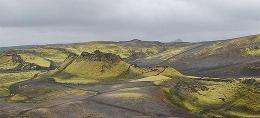
(PhysOrg.com) -- New research from the University of Leeds shows that a large-scale volcanic eruption in southern Iceland, similar to the Laki eruption in 1783, could result in widespread air pollution across Europe.
The study, published today in the Proceedings of the National Academy of Sciences, shows that an event on a similar scale to the eight-month-long Laki eruption in 1783 - 1784 would release huge amounts of sulphur dioxide into the atmosphere. This gas would subsequently form a cloud consisting of tiny sulphate particles, which could be dispersed across the continent potentially creating a severe public health hazard.
The resulting exposure of the population to increased volcanic air pollution could potentially cause around 140,000 premature deaths within a year - many more than the number of people who die from seasonal flu each year. The UK, due to its proximity to Iceland, would be one of the worst affected areas in Europe with an estimated 20,000 extra deaths from heart and lung diseases.
Lead author of the study Dr Anja Schmidt, from the University of Leeds School of Earth and Environment, said: "The two recent Icelandic eruptions of Eyjafjallajökull and Grímsvötn have raised public awareness of the risks posed by volcanic ash to commercial aviation in the UK and beyond.
"But ash clouds are only half the story. The eight-month-long eruption of Laki in 1783 was one of the most devastating volcanic events in Iceland's history. The eruption did not produce significant amounts of ash - but instead emitted about 122 megatons of sulphur dioxide into the atmosphere, more than all global man-made emissions in a year. Laki-style events have occurred several times during the last 1,000 years."
Historical records show that around one-fifth of Iceland's population and up to three-quarters of the country's livestock were killed between 1783 and 1785. Further deaths are thought to have occurred elsewhere in Europe, but it is difficult for scientists to separate deaths caused directly by the eruption from those associated with other contributing factors such as disease, cold and starvation.
Therefore the authors of the PNAS study assessed how a future eruption of the same scale as Laki might affect the modern population in Europe. The researchers used volcanological data to estimate the sulphur released during the 1783 - 1784 Laki eruption together with a sophisticated atmospheric model to estimate the impact on air pollution over Europe.
Dr Schmidt said: "We may never be able to disentangle the individual causes of the increased mortality rates seen in 1783 - 1784. But by using a state-of-the-art atmospheric model we can put such a large-scale volcanic event into a modern societal context by assessing its impact on air pollution, which certainly was a major contributing factor to the increased death rates in 1783 - 1784.
"We know from epidemiological studies that there is a statistical link between air pollution and mortality, so we use that evidence to assess the public health impact that could arise following a future Laki-style eruption."
Co-author Dr Bart Ostro, an epidemiologist with the Centre for Research in Environmental Epidemiology in Barcelona indicated that the study relied on the substantial evidence from the scientific literature that both acute and chronic exposure to tiny particles like sulphate are associated with both mortality and morbidity.
The research showed that a present-day Laki-style Icelandic eruption has the potential to spread a dangerous sulphur-rich cloud as far downwind from the eruption site as southern and eastern Europe. These high levels of volcanic air pollution could subsequently increase the death rate among susceptible individuals, such as the elderly and those with pre-existing health conditions.
Co-author Professor Marjorie Wilson, also from the University of Leeds, said: "If Laki erupts again in the near future, which many volcanologists believe it will, the impact on modern-day society is likely to be severe. Our study strengthens the argument that European governments need to start planning for the impact of sulphur-rich volcanic clouds, as well as volcanic ash clouds."
Co-author Dr Thor Thordarson, a volcanologist from the University of Edinburgh, said: "These sulphurous clouds are potentially more dangerous because they can be dispersed more widely than the contemporaneous ash plumes. Consequently their socio-economic impact can be much greater."
The authors also stress that their results reinforce earlier findings by Dr. Thor Thordarson and Professor Stephen Self that the impact of a present-day Laki-style eruption is unlikely to be confined to human health. Corroborating these previous warnings, the authors of the PNAS paper say high concentrations of sulphur could also interrupt commercial aviation and may affect the wider environment, for example through crop failures, thus the authorities should put in place appropriate mitigation strategies.
Professor Ken Carslaw, also from the University of Leeds said: "Although many thousands of people die prematurely every year due to normal air pollution, such a volcanic event would be immediately visible as a dense haze across much of Europe and would undoubtedly cause public concern. The overall impact of such a low-probability, high-impact event on modern society needs to be assessed."
More information: The paper, Excess mortality in Europe following a future Laki-style Icelandic eruption, is published in Proceedings of the National Academy of Sciences. (www.pnas.org/cgi/doi/10.1073/pnas.1108569108).
Provided by University of Leeds


