A volcanic idea to reverse climate change

August 22, 2011

volcano

Enlarge

The eruption of Mount St. Helens in 1980. Credit: Austin Post, USGS

Scientists believe that our warming world may face catastrophic changes to its natural environment, including droughts, rising oceans and fiercer, more frequent hurricanes.

Theoretically, it may be necessary to act globally to mitigate the damage. Initially, those efforts will probably take the form of limits on or forest preservation. But some scientists and policy makers believe it might be necessary for scientists to take an active hand in engineering a solution to our climate problems.

Those potential solutions, collectively called "geoengineering," would use scientists' knowledge of the Earth's cycles to curb the rise in temperature, the melting of the ice caps and increasing weather volatility. Yet, very few studies have tackled the practical implications of such extreme measures, in part because of the controversy surrounding the prospect of "messing with" the environment.

"It's ground zero right now for understanding the climate response to geoengineering," said Cecilia Bitz, of the University of Washington. Bitz is one of a handful of researchers in the U.S. exploring the impact of geoengineering ideas. "There have only been a couple dozen papers in the literature, and you'll be surprised to know that it's a rarity to have an ocean GCM [general ] in the model."

A volcanic idea

Bitz, working with University of Washington researchers Kelly McCusker and David Battisti, analyzed the impact of the leading geoengineering solution, the release of volcanic aerosols into the .

"The equivalent of Mount Pinatubo going off every year," Bitz said, referring to the eruption in the Philippines in 1991, the largest in recent memory.
A volcanic idea to reverse climate change
Enlarge

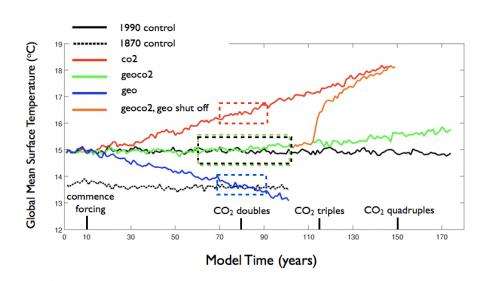
Time series of globally-averaged surface temperatures for various simulations. The green line shows that as a sulfate layer is ramped along with carbon dioxide, global mean temperature can be held close to 1990 values. Additionally, the orange line illustrates the rapid rise in temperature that occurs if geoengineering with a sulfate layer is terminated, but carbon dioxide levels are still high. Credit: Courtesy of Cecilia Bitz, University of Washington

Using the NSF-supported Ranger supercomputer at the Texas Advanced Computing Center, the researchers' simulations explored a range of aerosol implementations, from steady to slowly increasing releases of the aerosols to a sudden cessation of activity, which could lead to dangerously rapid warming.

Regional implications

Though it may be possible to reduce the atmospheric temperature, they found that other aspects of climate change, specifically the melting of the ice caps, may be much more difficult to reverse.

"There are regional issues--there's still warming in the poles and subsurface ocean warming near ice sheets, and there are plenty of unknowns that we can't answer," McCusker said.

Theirs is one of a handful of computational geoengineering studies, and it helps to determine how a drastic human-induced change might interrupt the Earth's environmental systems. The work follows up on other atmospheric studies by Bitz, including a recent publication in Nature that suggests that greenhouse gas mitigation can reduce sea ice loss and increase polar bear survival.

The only planet we have

"We don't know what society would consider an unacceptable level of climate change, but it may happen, and at that point, there may be a demand to geoengineer," Bitz said.
A volcanic idea to reverse climate change
Enlarge

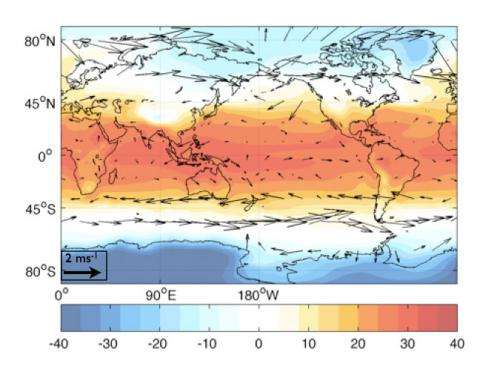
In color is the annually averaged surface temperature over the planet, overlain with the change in winds at 850 millibars due to increased carbon dioxide and a stratospheric sulfate layer. The magnitude of these atmospheric circulation changes, especially over the Southern Ocean, is similar to that induced by just an increase in carbon dioxide. Credit: Courtesy of Cecilia Bitz, University of Washington

A big challenge to studying geoengineering is the lack of a suitable physical environment for experimentation.

"We only have one planet," said Alan Robock, a leading geoengineering researcher at Rutgers University. "Meteorologists and climate scientists do not have laboratories with test tubes or accelerators. And we cannot 'mess with' the only planet we have to test its responses to making stratospheric clouds or brighter oceanic clouds, so we use models of the climate system--computer simulations of how the climate would respond to these forcings."

Bitz hopes the solutions that she's exploring will never need to be tested. But, like an evacuation plan or a bomb shelter, it is comforting to know that if solutions are required, scientists have done the initial research and have a sense of the potential outcomes.

Robock said, "We may discover dangerous consequences we never thought of before. Or, we may find that particular geoengineering scenarios reduce the risk of global warming more than the additional risks they present. This will allow us to make an informed decision some time in the future when we are faced with dangerous ."

Provided by National Science Foundation search and more info website

4.3 /5 (6 votes)  

Filter


Move the slider to adjust rank threshold, so that you can hide some of the comments.


Display comments: newest first

Arkaleus
Aug 22, 2011

Rank: 3.2 / 5 (11)
This article is like those ad campaigns for some fantastic new product that can change the world, only we aren't given the name of it or really any idea of what it is. But we need it, now, or horrible things will happen!

I've always been suspicious of the AGW crowd's need to drum up "market awareness" by appealing to fear. Manipulating public psychology isn't part of the scientific method, it's the tool of politics and fraud.
Vendicar_Decarian
Aug 22, 2011

Rank: 2 / 5 (4)
"Manipulating public psychology isn't part of the scientific method, it's the tool of politics and fraud." - Fraud

Well said Fraud. Well said.
stealthc
Aug 22, 2011

Rank: 4.4 / 5 (8)
geoengineering is a dangerous pursuit and I think our leaders and scientists need some medication to fix that meglomaniacal and narcisstic behaviour they've been exhibiting, especially over this past decade. Their pursuit of geoengineering could really bring about some misery and suffering for all of mankind. There is a bigger chance of a mistake or oversight than there is of an unmitigated success, look at what history has to say on the subject of when scientists and politicians play god.
NotParker
Aug 22, 2011

Rank: 3.6 / 5 (8)
"The equivalent of Mount Pinatubo going off every year,"

Mt Pinatubo dropped temperatures by .5C.

They are going to kill billions of people with this stupid idea.
grosyhpgrosyhpgrosyhp
Aug 22, 2011

Rank: 2 / 5 (4)
@stealthc
By inventing the lightening rod there were those-and they were many-who accused Franklin of "playing God". (Does that sound familiar?) They believed that Franklin, by directing lightening into the ground was adversely affecting divine balances between the heavens and the earth. He was roundly condemned in his time for doing so by many very prominent clergy, including the pastor of Boston's influential South Church, Thomas Prince.
ArtflDgr
Aug 22, 2011

Rank: 3 / 5 (3)
big difference between a lightning rod and krakatoa II the man made experiment
ccr5Delta32
Aug 23, 2011

Rank: 3 / 5 (1)
"messing with" the environment

Intentional or otherwise. Sure dangerous . But thinking about it is not and who knows we may be forced to do something someday .
ArtflDgr
Aug 23, 2011

Rank: 3 / 5 (2)
forced by whom?
ryggesogn2
Aug 23, 2011

Rank: 1 / 5 (3)
There is only one way this can occur, under a socialist world govt. Because when geoengineering starts killing people the govt will need to ban any liability lawsuits.
Cloud seeding was discontinued in the US primarily over legal liability concerns.
ccr5Delta32
Aug 23, 2011

Rank: 5 / 5 (2)
forced by whom?

By circumstances
Rank 4.3 /5 (6 votes)
Relevant PhysicsForums posts

More news stories

Yale study concludes public apathy over climate change unrelated to science literacy

Are members of the public divided about climate change because they don't understand the science behind it? If Americans knew more basic science and were more proficient in technical reasoning, would public consensus match ...

Space & Earth / Environment

created 32 minutes ago | popularity not rated yet | comments 2 | with audio podcast

10 million years needed to recover from mass extinction

It took some 10 million years for Earth to recover from the greatest mass extinction of all time, latest research has revealed.

Space & Earth / Earth Sciences

created 33 minutes ago | popularity not rated yet | comments 0 | with audio podcast

Sophisticated simulations predict future warming

The chances of our planet being hit by a global warming of 3 degrees Celsius by 2050 is as likely as it being hit by an increase of 1.4 degrees, new research shows. Presented in the journal Nature Geoscience, the British study ...

Space & Earth / Earth Sciences

created May 22, 2012 | popularity 4.4 / 5 (9) | comments 51

Aliens don't want to eat us, says former SETI director

Alien life probably isn’t interested in having us for dinner, enslaving us or laying eggs in our bellies, according to a recent statement by former SETI director Jill Tarter.

Space & Earth / Space Exploration

created May 25, 2012 | popularity 4.4 / 5 (13) | comments 39

Kyoto Protocol architect 'frustrated' by climate dialogue

UN climate talks are going nowhere, as politicians dither or bicker while the pace of warming dangerously speeds up, one of the architects of the Kyoto Protocol told AFP.

Space & Earth / Environment

created May 23, 2012 | popularity 3.7 / 5 (7) | comments 39


Change in developmental timing was crucial in the evolutionary shift from dinosaurs to birds: study

At first glance, it's hard to see how a common house sparrow and a Tyrannosaurus Rex might have anything in common. After all, one is a bird that weighs less than an ounce, and the other is a dinosaur that ...

Computer model used to pinpoint prime materials for efficient carbon capture

When power plants begin capturing their carbon emissions to reduce greenhouse gases – and to most in the electric power industry, it's a question of when, not if – it will be an expensive undertaking.

'Unzipped' carbon nanotubes could help energize fuel cells, batteries

Multi-walled carbon nanotubes riddled with defects and impurities on the outside could replace some of the expensive platinum catalysts used in fuel cells and metal-air batteries, according to scientists at ...

T cells 'hunt' parasites like animal predators seek prey, study shows

By pairing an intimate knowledge of immune-system function with a deep understanding of statistical physics, a cross-disciplinary team at the University of Pennsylvania has arrived at a surprising finding: T cells use a movement ...

Manufacturing genes to attack flu virus

An international research team has manufactured a new protein that can combat deadly flu epidemics.

Same gene that stunts infants' growth also makes them grow too big: research

UCLA geneticists have identified the mutation responsible for IMAGe* syndrome, a rare disorder that stunts infants' growth. The twist? The mutation occurs on the same gene that causes Beckwith-Wiedemann syndrome, which makes ...