TRMM satellite sees 4 possibilities for the next Atlantic tropical storm
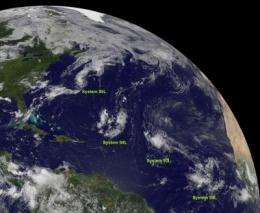
On Friday, August 12th, there were no named tropical cyclones in the North Atlantic Ocean. However, the National Hurricane Center (NHC) is now monitoring four areas in the Atlantic Ocean that have potential for developing into tropical cyclones and the TRMM satellite captured a look at their rainfall at various times in the past few days.
The Tropical Rainfall Measuring Mission or TRMM satellite is managed by NASA and the Japanese Space Agency, and can provide data on rainfall rates occurring in a tropical cyclone as well as estimate rainfall totals. On August 12, TRMM captured rainfall rates in each of the tropical candidates as the satellite flew over each one individually.
An area of disturbed weather (92L shown on the upper left) was seen by the TRMM satellite on 12 August 2011 at 0353 UTC. On August 12, System 92L was located near 17.8 North and 45.3 West, about 1000 miles east of the northern Leeward Islands. It is moving to the west-northwest at 20 mph. It has recently shown better organization, but there are no signs of a surface circulation. However, because the environmental conditions will allow for development (light wind shear and warm sea surface temperatures, System 92L has been given a 50% probability of developing into a tropical cyclone within the next 48 hours.
On August 11, 2011 at 0319 UTC, the TRMM satellite had a good view of an area of disturbed weather called System 93L. On August 12, System 93L was located 450 miles southwest of the southernmost Cape Verde Islands, near 11.3 North and 30.3 West. TRMM's Microwave Imager (TMI) and Precipitation Radar (PR) showed that this area, which has since moved to the southwest of the Verde Islands, contained lines of heavy rainfall. The NHC also gave this area a medium chance (40%) of developing into a tropical cyclone.
Another area low potential (20%) for tropical cyclone development called System 94L, was located 700 miles northeast of the northern Leeward Islands near 24.7 North and 54.7 West. System 94L was seen by the TRMM satellite on August 12, 2011 at 0350 UTC. The NHC noted that this "Slow development is possible during the next couple of days as the low moves west-southwestward or westward at about 10 mph."
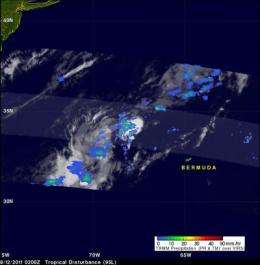
The NHC also gave another area, called System 95L, has a high (60%) chance at developing into a tropical cyclone in the next 24 hours. System 95L was located 200 miles north of Bermuda near 34.8 North and 66.8 West. The TRMM satellite flew almost directly over this low pressure system early on August 12, 2011 at 0208 UTC when it was weak. By 2 p.m. EDT, the thunderstorm activity associated with it had become well-defined. The development of System 95L may be high, but it comes with a caveat. That is, it has a high chance to develop tonight (Aug. 12) or on August 13, but only before it merges with a cold front. If it does become a depression, it would be Tropical Depression 6 in the Atlantic Ocean hurricane season.
The Geostationary Operational Environmental Satellite called GOES-13 captured an image of all four low pressure systems: Systems 92L, 93L, 94L and 95L, on August 12, 2011 at 1445 UTC (10:45 a.m. EDT). Any one of these low pressure areas have the potential to develop into a tropical depression over the weekend. System 95L is closest to the U.S. followed by System 94L, 92L and 93L.
Provided by NASA's Goddard Space Flight Center


