Swarming robots - enhancing the communication in flying robot systems
August 25, 2011

Swarming robots - enhancing the communication in flying robot systems

Enlarge

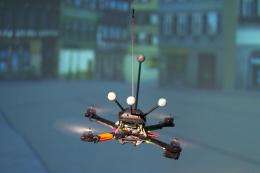
Quadrokopter on tour: In der Wissenschaft bezeichnet man die etwa 40 Zentimeter großen, fliegenden Roboter als Unmanned Aerial Vehicles - UAVs. Credit: MPI für biologische Kybernetik

(PhysOrg.com) -- Wouldn’t it be nice if each household had an electronic helper or if robots could fulfill the tasks that are too dangerous or troublesome for humans? Things that are taken for granted in movies such as the "Bicentennial Man" or "I-Robot" are still very futuristic scenarios in reality. Paolo Robuffo Giordano investigates the fundamental aspects necessary for the relevant technical development at the Max Planck Institute for Biological Cybernetics in Tübingen, Germany. He and his team mainly work with flying multi-robot systems, which receive instructions from a human user and are then able to fulfill the details of the task autonomously.

Paolo Robuffo Giordano is the project leader of the Human Robot Interaction Group in the Department Human Perception, Cognition and Action of Heinrich Bülthoff at the MPI for Biological Cybernetics. His team works with quadrocopters, small flying robots generally referred to as" unmanned aerial vehicles" (UAVs) by scientists. Navigated by a human operator, four or more of these UAVs, which are approximately 40 cm in diameter, perform local tasks maintaining a programmed, spatial configuration.

This video is not supported by your browser at this time.

If the UAVs are instructed to fly forward in a programmed formation, they do so while avoiding obstacles autonomously. While flying, the robots provide the human operator with sensory feedback - visual, proprioceptive, tactile and auditory, depending on the equipment and programming, which maximizes the operator’s awareness. If an object is in the way, the control will be aggravated in that specific direction until the robots have overcome the obstacle. "It's like actually flying against a wall”, Robuffo Giordano explains. The robots autonomously keep track of each other using cameras and regulate their position in relation to one another. The human operator can track the UAVs on his monitor." We are investigating some fundamental aspects of these topics, which are necessary for any possible future applications," the scientist explains." The development and programming of such robots is mainly an application of mathematical theories. That's why we see ourselves as engineers."

Swarming robots - enhancing the communication in flying robot systems
Enlarge

Formationsflug: Mithilfe von Computersimulationen entwickeln die Wissenschaftler die Multi-Roboter-Systeme, aus vier oder mehr Robotern weiter. Normalerweise gehorchen die Flugroboter menschlichen Befehlen, Hindernissen aber weichen sie selbstständig aus. Credit: MPI für biologische Kybernetik

This video shows a human operator using a haptic device to teleoperate a group of 4 UAVs by controlling the velocity of only one leader.

Furthermore, the researchers are also investigating the interactions between remote multiple robots in multi-robot systems and a human operator in order to enhance communication. Some aspects of such multi-robot systems mimic the movement of swarms of birds. This scenario becomes important when modeling big formations in computer simulations, in which the robots do not keep a defined distance to one another, but always need to keep in sight of another within the formation.

The results of the fundamental research done by Robuffo Giordano’s team can be applied in various areas. It is possible, for example, to attach a hand to one or more of the quadcopters and through this to interact with and grasp objects as if the operator’s hands have an unlimited range. Likewise, robots can be equipped with various sensors to collect different environmental data. They can convey the information to a computer or a human operator." These robots might be an extension of our own senses," says Paolo Robuffo Giordano.. Using this approach, unknown or potentially dangerous areas can be explored without endangering any humans. Still in the field of the imagination lie applications in the medical field, where doctors deploy teams of nano robots inside the human body to examine and treat at exact locations.

Provided by Max-Planck-Gesellschaft search and more info website

4.1 /5 (7 votes)  

Filter


Move the slider to adjust rank threshold, so that you can hide some of the comments.


Display comments: newest first

Guy_Underbridge
Aug 25, 2011

Rank: 5 / 5 (2)
cool joystick
macsglen
Aug 25, 2011

Rank: 5 / 5 (1)
Indeed . . . full 3-D movement.
Rank 4.1 /5 (7 votes)
Relevant PhysicsForums posts

More news stories

Nvidia trumpets Tegra 3 phone design wins for 2012

(Phys.org) -- Nvidia’s competitive war paint has a name, Tegra 3. On the heels of Nvidia announcements about lowering costs of its Tegra 3 processors and Nvidia-enabled tablets running Android Ice Cream ...

Electronics / Hardware

created 7 hours ago | popularity 5 / 5 (2) | comments 1 | with audio podcast report

Dell tablet leak: 10.1-inch display, two-battery choice

(Phys.org) -- Headline after headline talks about vendors’ tablets in the wings as likely number-one contenders for the iPad. Such claims have justifiably been taken with a grain of salt, considering ...

Electronics / Consumer & Gadgets

created 19 hours ago | popularity 5 / 5 (3) | comments 9 | with audio podcast report

Nvidia says Kai platform will turn price tide for tablets

(Phys.org) -- In March, Nvidia gave some signs that they were working to lower the cost of their Tegra 3 processors and they suggested consumers might see prices for Android tablets as low as $199. Connect ...

Electronics / Hardware

created May 24, 2012 | popularity 4.3 / 5 (4) | comments 3 | with audio podcast report

OmniVision tops up sensors for cameras, phones

(Phys.org) -- OmniVision has announced two high-resolution image sensors for the digital still and digital video camera market (DS/DVC) and higher end smartphones. In end-user language, it is a claim for superior ...

Electronics / Hardware

created May 25, 2012 | popularity 5 / 5 (6) | comments 3 | with audio podcast report

MIT researchers devise new means to synchronize a group of robots (w/ Video)

(Phys.org) -- For several years, roboticists have been working out ways to get a group of robots to perform synchronized activities as demonstrated most often in dance routines. It’s not just about trying ...

Electronics / Robotics

created May 25, 2012 | popularity 5 / 5 (1) | comments 1 | with audio podcast report


Change in developmental timing was crucial in the evolutionary shift from dinosaurs to birds: study

At first glance, it's hard to see how a common house sparrow and a Tyrannosaurus Rex might have anything in common. After all, one is a bird that weighs less than an ounce, and the other is a dinosaur that ...

Computer model used to pinpoint prime materials for efficient carbon capture

When power plants begin capturing their carbon emissions to reduce greenhouse gases – and to most in the electric power industry, it's a question of when, not if – it will be an expensive undertaking.

'Unzipped' carbon nanotubes could help energize fuel cells, batteries

Multi-walled carbon nanotubes riddled with defects and impurities on the outside could replace some of the expensive platinum catalysts used in fuel cells and metal-air batteries, according to scientists at ...

T cells 'hunt' parasites like animal predators seek prey, study shows

By pairing an intimate knowledge of immune-system function with a deep understanding of statistical physics, a cross-disciplinary team at the University of Pennsylvania has arrived at a surprising finding: T cells use a movement ...

Manufacturing genes to attack flu virus

An international research team has manufactured a new protein that can combat deadly flu epidemics.

Yale study concludes public apathy over climate change unrelated to science literacy

Are members of the public divided about climate change because they don't understand the science behind it? If Americans knew more basic science and were more proficient in technical reasoning, would public consensus match ...