SF cell shutdown: Safety issue, or hint of Orwell? (Update)
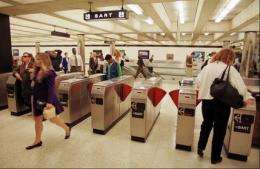
(AP) -- An illegal, Orwellian violation of free-speech rights? Or just a smart tactic to protect train passengers from rowdy would-be demonstrators during a busy evening commute?
The question resonated Saturday in San Francisco and beyond as details emerged of Bay Area Rapid Transit officials' decision to cut off underground cellphone service for a few hours at several stations Thursday. Commuters at stations from downtown to near the city's main airport were affected as BART officials sought to tactically thwart a planned protest over the recent fatal shooting of a 45-year-old man by transit police.
Two days later, the move had civil rights and legal experts questioning the agency's move, and drew backlash from one transit board member who was taken aback by the decision.
"I'm just shocked that they didn't think about the implications of this. We really don't have the right to be this type of censor," said Lynette Sweet, who serves on BART's board of directors. "In my opinion, we've let the actions of a few people affect everybody. And that's not fair."
Similar questions of censorship have arisen in recent days as Britain's government put the idea of curbing social media services on the table in response to several nights of widespread looting and violence in London and other English cities. Police claim that young criminals used Twitter and Blackberry instant messages to coordinate looting sprees in riots.
Prime Minister David Cameron said that the government, spy agencies and the communications industry are looking at whether there should be limits on the use of social media sites like Twitter and Facebook or services like BlackBerry Messenger to spread disorder. The suggestions have met with outrage - with some critics comparing Cameron to the despots ousted during the Arab Spring.
In the San Francisco instance, Sweet said BART board members were told by the agency of its decision during the closed portion of its meeting Thursday afternoon, less than three hours before the protest was scheduled to start.
"It was almost like an afterthought," Sweet told The Associated Press. "This is a land of free speech and for us to think we can do that shows we've grown well beyond the business of what we're supposed to be doing and that's providing transportation. Not censorship."
But there are nuances to consider, including under what conditions, if any, an agency like BART can act to deny the public access to a form of communication - and essentially decide that a perceived threat to public safety trumps free speech.
These situations are largely new ones, of course. A couple of decades ago, during the fax-machine and pay-phone era, the notion of people organizing mass gatherings in real time on wireless devices would have been fantasy.
BART Deputy Police Chief Benson Fairow said the issue boiled down to the public's well-being.
"It wasn't a decision made lightly. This wasn't about free speech. It was about safety," Fairow told KTVU-TV on Friday.
BART spokesman Jim Allison maintained that the cellphone disruptions were legal as the agency owns the property and infrastructure. He added while they didn't need the permission of cellphone carriers to temporarily cut service, they notified them as a courtesy.
The decision was made after agency officials saw details about the protest on an organizer's website. He said the agency had extra staff and officers aboard trains during that time for anybody who wanted to report an emergency, as well as courtesy phones on station platforms.
"I think the entire argument is that some people think it created an unsafe situation is faulty logic," Allison said. "BART had operated for 35 years without cellphone service and no one ever suggested back then that a lack of it made it difficult to report emergencies and we had the same infrastructure in place."
But as in London, BART's tactic drew immediate comparisons to authoritarianism, including acts by the former president of Egypt to squelch protests demanding an end to his rule. Authorities there cut Internet and cellphone services in the country for days earlier this year. He left office shortly thereafter.
"BART officials are showing themselves to be of a mind with the former president of Egypt, Hosni Mubarak," the Electronic Frontier Foundation said on its website. Echoing that comparison, vigorous weekend discussion on Twitter was labeled with the hashtag "muBARTek."
Aaron Caplan, a professor at Loyola Law School in Los Angeles who specializes in free-speech issues, was equally critical, saying BART clearly violated the rights of demonstrators and other passengers.
"We can arrest and prosecute people for the crimes they commit," he said. "You are not allowed to shut down people's cellphones and prevent them from speaking because you think they might commit a crime in the future."
Michael Risher, the American Civil Liberty Union's Northern California staff attorney, echoed the sentiment in a blog: "The government shouldn't be in the business of cutting off the free flow of information. Shutting down access to mobile phones is the wrong response to political protests, whether it's halfway around the world or right here in San Francisco."
On Saturday at a station where cell phone service was disrupted, passenger Phil Eager, 44, shared the opinion that BART's approach seemed exaggerated.
"It struck me as pretty strange and kind of extreme," said Eager, a San Francisco attorney. "It's not a First Amendment debate, but rather a civil liberties issue."
Eager said many of his friends riding BART on Thursday were upset with the agency's actions, some even calling it a "police state."
Mark Malmberg, 58, of Orinda, Calif., believes that BART could've used a different approach instead of shutting down cellphone usage.
"Even though it sounds like they wanted to avoid a mob gathering, you can't stop people from expressing themselves," Malmberg said. "I hope those who protest can do so in a civil manner."
The ACLU already has a scheduled meeting with BART's police chief on Monday about other issues and Thursday's incident will added be to the agenda, spokeswoman Rebecca Farmer said.
But others said that while the phone shutdown was worth examining, it may not have impinged on First Amendment rights. Gene Policinski, executive director of the First Amendment Center, a nonprofit educational organization, said freedom of expression can be limited in very narrow circumstances if there is an immediate threat to public safety.
"An agency like BART has to be held to a very high standard," he said. "First of all, it has to be an immediate threat, not just the mere supposition that there might be one. And I think the response has to be what a court would consider reasonable, so it has to be the minimum amount of restraint on free expression."
He said if BART's actions are challenged, a court may look more favorably on what it did if expression was limited on a narrow basis for a specific area and time frame, instead of "just indiscriminately closing down cellphone service throughout the system or for a broad area."
University of Michigan law professor Len Niehoff, who specializes in First Amendment and media law issues, found the BART actions troublesome for a few reasons.
He said the First Amendment generally doesn't allow the government to restrict free speech because somebody might do something illegal or to prohibit conversations based on their subject matter. He said the BART actions have been portrayed as an effort to prevent a protest that would have violated the law, but there was no guarantee that would have happened.
"What it really did is it prevented people from talking, discussing ... and mobilizing in any form, peaceful or unpeaceful, lawful or unlawful," he said. "That is, constitutionally, very problematic."
The government does have the right to break up a demonstration if it forms in an area where protests are prohibited and poses a risk to public safety, Niehoff said. But it should not prohibit free speech to prevent the possibility of a protest happening.
"The idea that we're going to keep people from talking about what they might or might not do, based on the idea that they might all agree to violate the law, is positively Orwellian," he said.
©2011 The Associated Press. All rights reserved. This material may not be published, broadcast, rewritten or redistributed.


