Scientists grow plants with friendly fungi
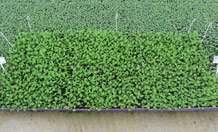
Plant seedlings. Credit: Dr. Chris Thornton, University of Exeter
Dr. Chris Thornton and colleagues at the University of Exeter are examining whether adding a safe and harmless fungus to compost boosts the growth and proliferation of crops' roots, helping them grow with less water. Not only that, trials currently underway with a supplier to a major supermarket are investigating whether the plants exposed to the fungus can also be grown in the absence of fertilizer.
Previous studies have shown that the fungus has properties as a natural biocontrol agent of pathogenic fungi and could reduce the need for synthetic fungicides. The technique also appears to improve drought tolerance.
The method of boosting root growth is simple. The fungus, T. hamatum (GD12 strain), is a free-living soil fungus that feeds on organic matter. The fungus is cultured in wheat bran which is added to the compost in which seedlings are first planted and it is here that root growth flourishes. After a period of growth, the seedlings are transplanted to the field for further growth. This is a common planting technique for many crops resulting in a highly compatible method for growers in the UK and across the world.
The field trial is a collaboration between university, grower and retailer. Manor Fresh Ltd in Lincolnshire supplies Marks & Spencer's with brassicas such as broccoli and sprouts, and M&S has been working closely with Dr. Thornton and its supplier in developing the technique.
A BBSRC Responsive Mode grant awarded to Dr. Thornton and Exeter colleague Professor Murray Grant is now supporting laboratory-based work that will attempt to unravel the molecular basis of the plant-growth-promotion phenomenon.
Dr. Chris Thornton of Biosciences in the College of Life and Environmental Sciences at the University of Exeter said: "This is an excellent example of collaboration between industry and fundamental research back at Exeter. We know the fungus produces a water soluble compound that stimulates plant growth, but why and how does the plant respond to this stimulus?
"There is potential to use it everywhere. With the move to sustainable methods to stimulate crop productivity these organisms are right up the agenda again. This is the first time there's been an interaction between a UK university department and plant growers to replace costly fossil fuel fertilisers with a strain of Trichoderma that boosts plant growth and at the same time acts as a biocontrol agent of root diseases."
The association between the fungus and the plant doesn't appear to be symbiotic because there's nothing in it for the fungus that we can so far see this particular strain of Trichoderma (GD12) does not grow inside the plant's roots, instead it lives around them in a zone called the rhizosphere. But it is apparent that somehow the fungus is changing the way that the plant perceives its environment and causes changes in the plants' chemistry that increase root and shoot growth.
Provided by
University of Exeter
-
From lemons to lemonade: Reaction uses carbon dioxide to make carbon-based semiconductor,
32 comments
-
Thioridazine kills cancer stem cells in human while avoiding toxic side-effects of conventional cancer treatments,
3 comments
-
SpaceX private rocket blasts off for space station (Update),
42 comments
-
Climate scientists say they have solved riddle of rising sea,
31 comments
-
SpaceX capsule has 'new car' smell, astronauts say (Update),
2 comments
-
What would stain as translucent on light-coloured fabric?
19 hours ago
-
How do I identify different bacteria on culture plates?
May 26, 2012
-
Why Do Dogs do Strange things...
May 25, 2012
-
What does exophillic and endophillic mean in terms of mosquito and their control?
May 24, 2012
-
Semen stains glows under black lights (uv light)?
May 23, 2012
-
Question on Human Chromosome 2
May 23, 2012
- More from Physics Forums - Biology
More news stories
Manufacturing genes to attack flu virus
An international research team has manufactured a new protein that can combat deadly flu epidemics.
4 minutes ago |
not rated yet |
0
|
Scientist: Evolution debate will soon be history
(AP) -- Richard Leakey predicts skepticism over evolution will soon be history. Not that the avowed atheist has any doubts himself.
18 hours ago |
3.3 / 5 (18) |
63
More plant species responding to global warming than previously thought
(Phys.org) -- Far more wild plant species may be responding to global warming than previous large-scale estimates have suggested.
May 22, 2012 |
4.6 / 5 (14) |
18
|
Thousands of shellfish found dead in Peru
Thousands of crustaceans were found dead off the coast of Lima following the mystery mass death of dolphins and pelicans, the Peruvian Navy said Friday.
May 26, 2012 |
4.8 / 5 (4) |
7
For monogamous sparrows, it doesn't pay to stray (but they do it anyway)
It's quite common for a female song sparrow to stray from her breeding partner and mate with the male next door, but a new study shows that sleeping around can be costly.
May 22, 2012 |
5 / 5 (2) |
7
|
Change in developmental timing was crucial in the evolutionary shift from dinosaurs to birds: study
At first glance, it's hard to see how a common house sparrow and a Tyrannosaurus Rex might have anything in common. After all, one is a bird that weighs less than an ounce, and the other is a dinosaur that ...
Computer model used to pinpoint prime materials for efficient carbon capture
When power plants begin capturing their carbon emissions to reduce greenhouse gases and to most in the electric power industry, it's a question of when, not if it will be an expensive undertaking.
'Unzipped' carbon nanotubes could help energize fuel cells, batteries
Multi-walled carbon nanotubes riddled with defects and impurities on the outside could replace some of the expensive platinum catalysts used in fuel cells and metal-air batteries, according to scientists at ...
T cells 'hunt' parasites like animal predators seek prey, study shows
By pairing an intimate knowledge of immune-system function with a deep understanding of statistical physics, a cross-disciplinary team at the University of Pennsylvania has arrived at a surprising finding: T cells use a movement ...
Yale study concludes public apathy over climate change unrelated to science literacy
Are members of the public divided about climate change because they don't understand the science behind it? If Americans knew more basic science and were more proficient in technical reasoning, would public consensus match ...
Same gene that stunts infants' growth also makes them grow too big: research
UCLA geneticists have identified the mutation responsible for IMAGe* syndrome, a rare disorder that stunts infants' growth. The twist? The mutation occurs on the same gene that causes Beckwith-Wiedemann syndrome, which makes ...
Aug 08, 2011
Rank: not rated yet
Plants produce organic matter, and the article said the fungus eats organic matter. What more do you need for a happy marriage?
Aug 08, 2011
Rank: not rated yet
Everybody wins!
Aug 08, 2011
Rank: not rated yet
" there's nothing in it for the fungus that we can so far see "
...riiight,...it just likes keeping the plants company,lol.