Making massive stars
August 29, 2011

Making massive stars

Enlarge

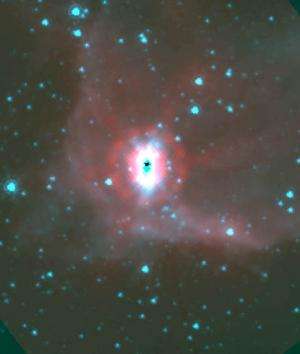
An infrared image of the massive young star IRAS 20216+4104. (It is so bright that the image contains several camera artifacts including the red, bead-like ring and the dark center.) New research shows that some standard aspects of low mass star formation can apply to massive stars. Credit: NASA Spitzer

How do massive stars form? Stars with more than about eight times as much mass as the sun are arguably the most important actors in the universe. Although they live only hundreds of millions of years, they are much hotter and more luminous than the sun, and during their brief lifetimes their nuclear furnaces produce a wide range of chemical elements (the universe was created with primarily hydrogen and helium). In their dramatic deaths as supernovae they disburse these elements into the cosmos. They also can leave behind neutron stars or black holes.

The best understood models of star formation work well with lower mass stars like those the size of the sun -- their birth and maturation are comparatively slow and measured processes, and moreover the various stages can be observed with modern telescopes. By contrast, the physical processes associated with massive star birth are more extreme. A young massive star is so bright, for example, that outward pressure from its radiation retards the accretion of matter; in a smaller star that accretion causes it to continue to grow in mass as it matures. Moreover, massive stars mature very quickly (in less than a few hundred thousand years compared with millions of years for stars like the sun). As a result, there are not many young massive ones around at any given time in which to study the processes associated with their birth.

CfA astronomers Katharine Johnston, Eric Keto, Tom Robitaille, and a colleague, decided to apply their best models of low formation to the case of a massive young star located about 5500 light-years away in the constellation of Cygnus. They wanted to test whether recent infrared and submillimeter observations of the dust around the source (and in its immediate surroundings) could perhaps exclude models of star formation used in low mass cases. Writing in the latest issue of , the scientists report that, to the contrary, the low-mass models work tolerably well. The team is able to determine the mass of the star (about 12 solar-masses) and the accretion rate of material onto the star (about 130 Earth-masses per year). They also find that the star is surrounded by an envelope of about 600 solar-masses of gas and dust, and a large circumstellar disk of radius 9200 astronomical units. Their results indicate that at least the basic process of accretion and disk formation apply to the conditions around , even though maturation happens more quickly.

Provided by Harvard-Smithsonian Center for Astrophysics search and more info website

4.7 /5 (3 votes)  

Filter


Move the slider to adjust rank threshold, so that you can hide some of the comments.


Display comments: newest first

omatumr
Aug 30, 2011

Rank: 1 / 5 (4)
How do massive stars form?


That is an excellent question!

The nebular model of star formation from an interstellar cloud of mostly H,He will probably not answer this question correctly.

It now seems more likely that H,He are waste products from the dense, energetic stellar core that accumulate as a photon-emitting cloud called the "photosphere" [1,2]

1. "Is the Universe Expanding?" The Journal of Cosmology 13, 4187-4190 (2011)

http://journalofc...102.html

2. "Neutron Repulsion", The APEIRON Journal, in press, 19 pages (2011)

http://arxiv.org/...2.1499v1

With kind regards,
Oliver K. Manuel
Former NASA Principal
Investigator for Apollo
Rank 4.7 /5 (3 votes)
Relevant PhysicsForums posts
  • revamping general concept and cosmological principle
    createdMay 25, 2012
  • Transiting Exoplanet Light Curve
    createdMay 25, 2012
  • Math behind Theoretical Physics
    createdMay 24, 2012
  • Do we know whats at the center of galaxies yet?
    createdMay 23, 2012
  • Structure of the Milky Way?
    createdMay 20, 2012
  • What would it take to terraform Pluto and Charon?
    createdMay 19, 2012
  • More from Physics Forums - General Astronomy

More news stories

Yale study concludes public apathy over climate change unrelated to science literacy

Are members of the public divided about climate change because they don't understand the science behind it? If Americans knew more basic science and were more proficient in technical reasoning, would public consensus match ...

Space & Earth / Environment

created 32 minutes ago | popularity not rated yet | comments 2 | with audio podcast

10 million years needed to recover from mass extinction

It took some 10 million years for Earth to recover from the greatest mass extinction of all time, latest research has revealed.

Space & Earth / Earth Sciences

created 33 minutes ago | popularity not rated yet | comments 0 | with audio podcast

Sophisticated simulations predict future warming

The chances of our planet being hit by a global warming of 3 degrees Celsius by 2050 is as likely as it being hit by an increase of 1.4 degrees, new research shows. Presented in the journal Nature Geoscience, the British study ...

Space & Earth / Earth Sciences

created May 22, 2012 | popularity 4.4 / 5 (9) | comments 51

Aliens don't want to eat us, says former SETI director

Alien life probably isn’t interested in having us for dinner, enslaving us or laying eggs in our bellies, according to a recent statement by former SETI director Jill Tarter.

Space & Earth / Space Exploration

created May 25, 2012 | popularity 4.4 / 5 (13) | comments 39

Kyoto Protocol architect 'frustrated' by climate dialogue

UN climate talks are going nowhere, as politicians dither or bicker while the pace of warming dangerously speeds up, one of the architects of the Kyoto Protocol told AFP.

Space & Earth / Environment

created May 23, 2012 | popularity 3.7 / 5 (7) | comments 39


Change in developmental timing was crucial in the evolutionary shift from dinosaurs to birds: study

At first glance, it's hard to see how a common house sparrow and a Tyrannosaurus Rex might have anything in common. After all, one is a bird that weighs less than an ounce, and the other is a dinosaur that ...

Computer model used to pinpoint prime materials for efficient carbon capture

When power plants begin capturing their carbon emissions to reduce greenhouse gases – and to most in the electric power industry, it's a question of when, not if – it will be an expensive undertaking.

'Unzipped' carbon nanotubes could help energize fuel cells, batteries

Multi-walled carbon nanotubes riddled with defects and impurities on the outside could replace some of the expensive platinum catalysts used in fuel cells and metal-air batteries, according to scientists at ...

T cells 'hunt' parasites like animal predators seek prey, study shows

By pairing an intimate knowledge of immune-system function with a deep understanding of statistical physics, a cross-disciplinary team at the University of Pennsylvania has arrived at a surprising finding: T cells use a movement ...

Manufacturing genes to attack flu virus

An international research team has manufactured a new protein that can combat deadly flu epidemics.

Same gene that stunts infants' growth also makes them grow too big: research

UCLA geneticists have identified the mutation responsible for IMAGe* syndrome, a rare disorder that stunts infants' growth. The twist? The mutation occurs on the same gene that causes Beckwith-Wiedemann syndrome, which makes ...