Manipulating light at will
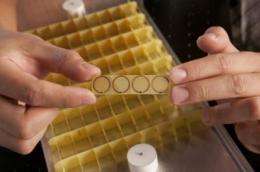
This is the metamaterial device. Credit: Duke University Photography
Electrical engineers at Duke University have developed a material that allows them to manipulate light in much the same way that electronics manipulate flowing electrons.
The researchers say the results of their latest proof-of-concept experiments could lead to the replacement of electrical components with those based on optical technologies. Light-based devices would enable faster and more efficient transmission of information, much in the same way that replacing wires with optical fibers revolutionized the telecommunications industry.
The breakthrough revolves around a novel man-made structure known as a metamaterial. These exotic composite materials are not so much a single substance, but an entire structure that can be engineered to exhibit properties not readily found in nature. The structure used in these experiments resembles a miniature set of tan Venetian blinds.
When light passes through a material, even though it may be reflected, refracted or weakened along the way, it is still the same light coming out. This is known as linearity.
"For highly intense light, however, certain 'nonlinear' materials violate this rule of thumb, converting the incoming energy into a brand new beam of light at twice the original frequency, called the second-harmonic," said Alec Rose, graduate student in the laboratory of David R. Smith, William Bevan Professor of electrical and computer engineering at Duke's Pratt School of Engineering.
As an example, he cited the crystal in some laser pointers, which transforms the normal laser light into another beam of a different color, which would be the second-harmonic. Though they contain nonlinear properties, designing such devices requires a great deal of time and effort to be able to control the direction of the second harmonic, and natural nonlinear materials are quite weak, Rose said.
"Normally, this frequency-doubling process occurs over a distance of many wavelengths, and the direction in which the second-harmonic travels is strictly determined by whatever nonlinear material is used," Rose said. "Using the novel metamaterials at microwave frequencies, we were able to fabricate a nonlinear device capable of 'steering' this second-harmonic. The device simultaneously doubled and reflected incoming waves in the direction we wanted."
The research results were published online in the journal Physical Review Letters. It was supported by the Air Force Office of Scientific Research. Smith's team was the first to demonstrate that similar metamaterials could act as a cloaking device in 2006 and a next generation lens in 2009.
"This magnitude of control over light is unique to nonlinear metamaterials, and can have important consequences in all-optical communications, where the ability to manipulate light is crucial," Rose said.
The device, which measures six inches by eight inches and about an inch high, is made of individual pieces of the same fiberglass material used in circuit boards arranged in parallel rows. Each piece is etched with copper circles. Each copper circle has a tiny gap that is spanned by a diode, which when excited by light passing through it, breaks its natural symmetry, creating non-linearity.
"The trend in telecommunications is definitely optical," Rose said. "To be able to control light in the same manner that electronics control currents will be an important step in transforming telecommunications technologies."
Provided by
Duke University
-
From lemons to lemonade: Reaction uses carbon dioxide to make carbon-based semiconductor,
32 comments
-
Thioridazine kills cancer stem cells in human while avoiding toxic side-effects of conventional cancer treatments,
3 comments
-
SpaceX private rocket blasts off for space station (Update),
42 comments
-
Climate scientists say they have solved riddle of rising sea,
31 comments
-
SpaceX capsule has 'new car' smell, astronauts say (Update),
2 comments
-
Water flow question
2 hours ago
-
[Drift velocity] Factors affecting velocity
5 hours ago
-
does cold gasoline have less energy
6 hours ago
-
distribution of molecules throughout the atmosphere
8 hours ago
-
The Global Positioning System !
9 hours ago
-
A Question relating Power
10 hours ago
- More from Physics Forums - General Physics
More news stories
Is a classical electrodynamics law incompatible with special relativity?
(Phys.org) -- The laws of classical electromagnetism that were developed in the 19th century are the same laws that scientists use today. They include Maxwell’s four equations along with the Lorentz la ...
Landmark calculation clears the way to answering how matter is formed
(Phys.org) -- An international collaboration of scientists, including Thomas Blum, associate professor of physics, is reporting in landmark detail the decay process of a subatomic particle called a kaon ...
May 25, 2012 |
4.3 / 5 (22) |
50
|
Lying in wait for WIMPs: Researchers seek to dramatically increase sensitivity of Large Underground Xenon detector
Although it's invisible, dark matter accounts for at least 80 percent of the matter in the universe. No one knows what it is, but most scientists would bet on weakly interacting massive particles, or WIMPs.
May 23, 2012 |
4 / 5 (7) |
15
|
Hawaii lab turns laser-powered bubbles into microrobots
(Phys.org) -- A team of scientists from the University of Hawaii are working on microrobots created from bubbles of air in a saline solution. The bubbles take on their title of robots as a laser ...
Sound increases the efficiency of boiling
Scientists at the Georgia Institute of Technology achieved a 17-percent increase in boiling efficiency by using an acoustic field to enhance heat transfer. The acoustic field does this by efficiently removing vapor bubbles ...
May 24, 2012 |
5 / 5 (2) |
2
Change in developmental timing was crucial in the evolutionary shift from dinosaurs to birds: study
At first glance, it's hard to see how a common house sparrow and a Tyrannosaurus Rex might have anything in common. After all, one is a bird that weighs less than an ounce, and the other is a dinosaur that ...
Computer model used to pinpoint prime materials for efficient carbon capture
When power plants begin capturing their carbon emissions to reduce greenhouse gases and to most in the electric power industry, it's a question of when, not if it will be an expensive undertaking.
'Unzipped' carbon nanotubes could help energize fuel cells, batteries
Multi-walled carbon nanotubes riddled with defects and impurities on the outside could replace some of the expensive platinum catalysts used in fuel cells and metal-air batteries, according to scientists at ...
T cells 'hunt' parasites like animal predators seek prey, study shows
By pairing an intimate knowledge of immune-system function with a deep understanding of statistical physics, a cross-disciplinary team at the University of Pennsylvania has arrived at a surprising finding: T cells use a movement ...
Manufacturing genes to attack flu virus
An international research team has manufactured a new protein that can combat deadly flu epidemics.
Yale study concludes public apathy over climate change unrelated to science literacy
Are members of the public divided about climate change because they don't understand the science behind it? If Americans knew more basic science and were more proficient in technical reasoning, would public consensus match ...
Aug 01, 2011
Rank: not rated yet
this concept atleast 10 years ago ?