The first kangaroo genome sequence
Aug 19, 2011
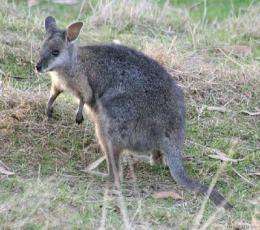
This is a Tammar wallaby. Credit: Geoffrey Shaw

Kangaroos form an important niche in the tree of life, but until now their DNA had never been sequenced. In an article newly published in BioMed Central's open access journal Genome Biology, an international consortium of researchers present the first kangaroo genome sequence – that of the tammar wallaby species – and find hidden in their data the gene that may well be responsible for the kangaroo's characteristic hop.

"The tammar wallaby sequencing project has provided us with many possibilities for understanding how marsupials are so different to us," says Prof Marilyn Renfree of The University of Melbourne. Renfree was one of the lead researchers on the project, which was conducted by an international consortium of scientists from Australia, USA, Japan, England and Germany.

Tammar wallabies have many intriguing biological characteristics. For example, the 12 month gestation includes an 11 month period of suspended animation in the womb. At birth, the young weigh only half a gram, and spend 9 months in the mother's pouch, where the newborn babies reside for protection. Researchers hope that the will offer clues as to how tammar wallaby genes regulate these fascinating features of kangaroo life.

In addition to zeroing in on the "hop" genes, other exciting discoveries from the genome include the 1,500 smell detector genes responsible for the tammar wallaby's excellent sense of smell, and genes that make antibiotics in the mother's milk in order to protect kangaroo newborns from E. coli and other harmful bacteria. As Prof Renfree explains, lessons to be learned from the tammar wallaby genome "may well be helpful in producing future treatments for human disease."
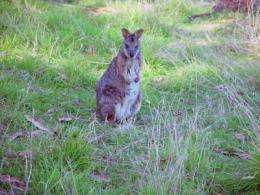
This is a Tammar wallaby. Credit: Geoffrey Shaw

The first kangaroo genome is a key milestone in the study of mammalian evolution. As the ancestors of kangaroos separated from other mammals at least 130 million years ago, it is hoped that the sequence is in some senses a living fossil of the early mammalian species from which humans evolved. To understand this evolutionary journey better, the genome sequence is complemented by the "transcriptome" sequence, which represents a catalogue of how strongly each gene is turned "on" or "off" at different stages of the tammar life cycle and in different parts of the body. Study of the transcriptome will allow many more interesting questions to be asked about how kangaroo genes compare to their counterparts in humans.

The Genome Biology article is accompanied by a series of articles in the journals BMC Genomics, EvoDevo, BMC Immunology, BMC Molecular Biology, BMC Genetics, BMC Developmental Biology and BMC Evolutionary Biology, which collectively examine some of the most appealing biological stories arising from the genome sequence.

The tammar wallaby is only the third marsupial, and only the second Australian marsupial (after the Tasmanian devil), to have its genome sequenced. As the is an icon of Australia, whose image appears on its coat of arms, currency and national airline symbol, the publication of its sequence in stands as a landmark day in Australian science.

Explore further: Rice blast research reveals details on how a fungus invades plants

More information: Marilyn B Renfree, et al., Genome sequence of an Australian kangaroo, Macropus eugenii, provides insight into the evolution of mammalian reproduction and development, Genome Biology (in press)

Related Stories

Tammar wallaby’s clever immune tricks revealed

Jul 11, 2011

(PhysOrg.com) -- Until now, it was a mystery why many marsupials have two thymuses—key organs in the immune system—instead of the one typical of other mammals. Now postdoctoral researcher Dr. Emily ...

New genome sequencing targets announced

Jul 24, 2006

The U.S. National Human Genome Research Institute has announced several new sequencing targets, including the northern white-cheeked gibbon.

Recommended for you

Gene discovery leads to new OPP test

9 hours ago

The discovery of a gene associated with a persistent viral infection that causes an incurable disease—ovine progressive pneumonia (OPP)—in sheep has led to the development of a genetic test that can be ...

Genome sequence for mother of ash dieback survival

Jun 17, 2013

The first sequence data for a survivor of the ash dieback epidemic has been made available by scientists from The Genome Analysis Centre (TGAC) as part of a research collaboration led by the John Innes Centre and The Sainsbur ...

User comments : 7

Adjust slider to filter visible comments by rank

Display comments: newest first

Lino235
1 / 5 (3) Aug 19, 2011
It is incredible that this study had not been carried out until now. The only explanation I can think of is that evolutionists knew ahead of time that the genome of the kangaroo would be problematic for their theorizing. If true, so much for science.
Jaeherys
5 / 5 (3) Aug 19, 2011
It's called funding. And a problem for science.... lol
Lino235
2.3 / 5 (3) Aug 19, 2011
If all it is is funding, then why have so many other organisms been sequenced? Where did that money come from? You would think that the great divide of placental versus marsupial mammals would be of great interest? You would think that the genetic diversity (that's suppose to be there, but which will probably not show up) would be something they would want to sink their teeth into. What's happening in science is anything but funny.
Jaeherys
not rated yet Aug 20, 2011
For a long time it's been about where things belong on the "tree of life" and how is everything related. If you were to come to me and ask for funding to sequence a kangaroos DNA the bottom line is, "How much money will I make in return if I give you X dollars for this?" If that number is greater than X then we have a deal, assuming it's not a horrible risk.

It's been more profitable to work with the DNA of bacteria and other small organisms (drugs, fuels, knowledge, ect) than to sequence something quite large for pure curiosity.

But hey, I'm just an undergrad, I don't know shit :D.
Sinister1811
1 / 5 (2) Aug 20, 2011
I must admit, like Lino235, I was also surprised that this sort of genetic sequencing wasn't done earlier. Science is only beginning to understand where marsupials and placental mammals diverged. You'd think there'd be a lot of curiosity there.
Vendicar_Decarian
not rated yet Aug 20, 2011
And they really are giant hopping mice aren't they?

Fess up.
Ethelred
3.7 / 5 (3) Aug 20, 2011
You would think that the great divide of placental versus marsupial mammals would be of great interest?
It is. And the article pointed out that this is the THIRD marsupial that has been sequenced.

Based on you post I have this sneaking suspicion that you are a Creationist. Could you tell us if you are a Young Earth or Old Earth Creationist or something else entirely.

You would think that the genetic diversity (that's suppose to be there, but which will probably not show up)
Well if the Great Flood was real then it should not show up. However it has shown up. It can be seen in humans.

Ethelred

More news stories

Lonely bees make better guests

Solitary bees are twice as likely to pollinate the flowers they visit as their more sociable counterparts, according to a new study.