Internet takes 'distance-learning' into the Amazon
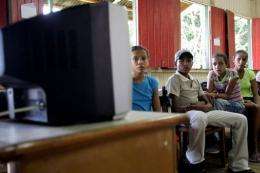
The Internet is letting a school sprout in the Amazon where teachers tend not to linger due to harsh living conditions and a scarcity of students.
Teachers in Manaus, the capital of the Brazilian state of Amazonas, conduct lessons streamed to students in the village of Tumbira using an Internet connection made possible with a generator-powered radio signal.
If not for "distance learning," children from far-flung Amazon river communities would forgo school or endure arduous boat trips to places with traditional schools.
"There was skepticism whether this system would work," Tumbira school director Izolena Garrido told AFP on Friday.
"It seemed like there was a lot of outside maneuvering to keep the school from functioning."
While Internet technology made the school possible, opposition came from traditional schools in cities that saw money spent on distance-learning as eating into government funding for public education.
"So, we established a model for teaching and learning and just got the school going," Garrido said. "With or without students, we were going to get this school going."
A home for the distance-learning school was created by Amazonas Sustainable Foundation (FAS), which built classrooms, a library and even sleeping quarters where students could string up hammocks that serve as bedding in the Amazon.
Garrido enlisted local teachers and invited parents to visit the school, which provides an intimate setting. Children from six Amazon communities aside from Tumbira signed on for the program launched about 18 months ago.
"Technology, in many ways, opens the door for revolution," FAS superintendent Virgilio Viana said during a visit to Tumbira.
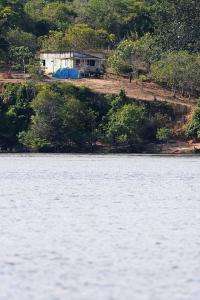
"Here we are only able to do what we are doing with education because of technology, because of the Internet... If not for this, it would not be possible."
Tumbira classes take place in the afternoons and evenings, when the generator runs and there is power for the Internet.
Children intently watch teachers on flat-screen monitors equipped with Web cameras that let distant professors see students, peruse homework or follow exercises in classes.
"It's as if the teacher is in the classroom," said 16-year-old Ednaldo, one of the 76 students at the Tumbira school.
Courses range from math and sciences to first aid, health and exercise.
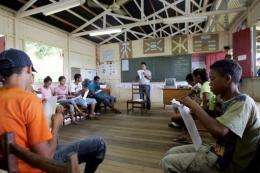
Local teachers sit with students, answering questions and helping with assignments.
"It is a pretty amazing experience," said Tumbira teacher Yolanda de Jesus dos Santos.
"Children really love electronics and the Internet, and this method saves time," she added. "I don't have to plan every class, so I can focus on dance, theater, and other projects for the children."
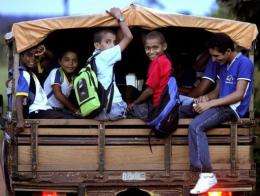
Students pay attention because if they miss anything important, professors won't be around after class to answer questions, according to dos Santos.
Students click icons to virtually raise hands in chat rooms used for questions or comments during classes.
"It is different from other schools, but at the same time it is the same," said 12-year-old student Angeliane. "The teacher teaches."
Homework is done at school, which features a library, Internet and assisting teachers like dos Santos.
"Last year I was in a school with big classes and no organization and it was a mess," Angeliane said. "Now, I have a better class with fewer people and I get involved more."
Students also work in vegetable gardens and learn about sustainably harvesting trees and working with wood.
"The goal is to have students learn skills that they can take back to develop within their communities," Garrido said.
There are also computing and Internet classes, with students required to maintain a "Passion for the Amazon" blog and upload digital photographs. Students boasted email and Facebook accounts.
The school has support from FAS, along with a non-governmental organization devoted to keeping alive the stories and culture of Amazonian people.
The distance school is a boon to local women like Maria do Socorro da Silva Mendonca, who had just a couple of years of schooling before marrying and starting a family.
Mendonca, 40, and her two teenage sons attend classes in Tumbira, where she has lived for 17 years.
"It is a privilege for me to be studying more now," she said outside her small house. "Not just for me, but for other women."
When asked whether she would be back in school without distance learning, she emphatically answered "No."
A cabin with urban amenities was being built by FAS to entice researchers and city teachers to spend time working in the Amazon.
Viana envisioned the two-classroom school accessible only by boat on the Rio Negro becoming a university devoted to living in harmony with the rain forest.
There are already students who finished high school eager to continue learning, he said.
"There is no room to grow out; no more space, so I imagine there will be growth up," said Garrido, who was confident the school would blossom. "I see only positive things going forward."
(c) 2011 AFP


