Humans not the only ones that pass down abusive behavior
August 10, 2011 by Deborah Braconnier report

Humans not the only ones that pass down abusive behavior

Enlarge

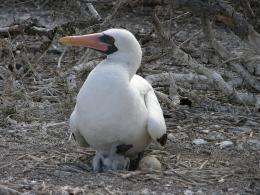
Nazca booby (Sula granti). Image: Wikipedia.

(PhysOrg.com) -- In a recent study published in The Auk, researchers claim they have found evidence that humans are not the only species where child abuse is a socially transmitted behavior.

The study, conducted by Martina Muller, Dr. David Anderson and others from Wake Forest University looked at a colony of Nazca boobies found in the eastern Pacific and nesting on the . They studied the interactions of the birds for three breeding seasons and tagged new birds at birth.

These birds nest in large dense colonies where both parents typically raise a chick each year. But it is when these parents fly away to gather food for the chick that the violence starts. While the parents are away, the chicks are visited by other non-breeding adults. While these interactions can be positive, most of the time they are abusive in nature, with aggressive or sexual acts being taken out on the young chick.

By following these birds for three years, they found a connection between the amount of times these chicks were attacked and the frequency that they then attacked other chicks when they reached adulthood. The researchers believe that these attacks at a young age condition the birds for life and may affect other aspects of their personalities.

The researchers suspect that when the are attacked on a regular basis, their level of stress is increased and are released. These then play a role in triggering .

The scientists believe that this proves that the behavior is not genetic but a behavior that is influenced by the society in which the bird is raised. When looking at this ‘cycle of violence,’ researchers hope this model may be useful in the future in helping other studies looking at this phenomenon.

More information:
via BBC

© 2010 PhysOrg.com

Filter


Move the slider to adjust rank threshold, so that you can hide some of the comments.


Display comments: newest first

Scottingham
Aug 10, 2011

Rank: 4.2 / 5 (5)
This behavior of birds in unacceptable. We need to create an NGO that STOPS the bird on bird cycle of violence!
Isaacsname
Aug 10, 2011

Rank: not rated yet
lol @ Scott. No surprises with this research. Animals imprint on human handlers as readily as they do their own.

Makes one wonder if there are animals out there wondering how to get away from abusive relationships...I think I just saw a seagull with a black eye....sniff
macsglen
Aug 10, 2011

Rank: 5 / 5 (2)
"I couldn't help myself . . . I was abused as a chick . . . "
Rank 5 /5 (4 votes)
Relevant PhysicsForums posts

More news stories

Scientist: Evolution debate will soon be history

(AP) -- Richard Leakey predicts skepticism over evolution will soon be history. Not that the avowed atheist has any doubts himself.

Biology / Evolution

created 17 hours ago | popularity 3.3 / 5 (17) | comments 51

More plant species responding to global warming than previously thought

(Phys.org) -- Far more wild plant species may be responding to global warming than previous large-scale estimates have suggested.

Biology / Ecology

created May 22, 2012 | popularity 4.6 / 5 (14) | comments 18 | with audio podcast

Thousands of shellfish found dead in Peru

Thousands of crustaceans were found dead off the coast of Lima following the mystery mass death of dolphins and pelicans, the Peruvian Navy said Friday.

Biology / Ecology

created May 26, 2012 | popularity 4.8 / 5 (4) | comments 7

For monogamous sparrows, it doesn't pay to stray (but they do it anyway)

It's quite common for a female song sparrow to stray from her breeding partner and mate with the male next door, but a new study shows that sleeping around can be costly.

Biology / Plants & Animals

created May 22, 2012 | popularity 5 / 5 (2) | comments 7 | with audio podcast

Study uncovers secret to speedy burrowing by razor clams

(Phys.org) -- If you look at a razor burrowing clam sitting in a bucket, you’d never guess that it could burrow itself down into the soil, much less do it with any speed. Razor clams look like fat straws, ...

Biology / Plants & Animals

created May 25, 2012 | popularity 1 / 5 (1) | comments 3 | with audio podcast report


Nvidia trumpets Tegra 3 phone design wins for 2012

(Phys.org) -- Nvidia’s competitive war paint has a name, Tegra 3. On the heels of Nvidia announcements about lowering costs of its Tegra 3 processors and Nvidia-enabled tablets running Android Ice Cream ...

Browser wars flare in mobile space

The browser wars are heating up again, but this time the fight is for dominance of the mobile Internet.

Dell tablet leak: 10.1-inch display, two-battery choice

(Phys.org) -- Headline after headline talks about vendors’ tablets in the wings as likely number-one contenders for the iPad. Such claims have justifiably been taken with a grain of salt, considering ...

Keep food safety in mind this memorial day weekend

(HealthDay) -- Picnics, parades and cookouts are as much a part of Memorial Day weekend as tributes to the United States' war veterans.

Social welfare cuts ultimately come with heavy price, researchers say

(Phys.org) -- Slashing government funding for Medicaid, food stamps and other programs that serve the poor – while politically popular with some lawmakers and many conservatives – may do more harm ...

Is a classical electrodynamics law incompatible with special relativity?

(Phys.org) -- The laws of classical electromagnetism that were developed in the 19th century are the same laws that scientists use today. They include Maxwell’s four equations along with the Lorentz la ...