First glimpse into birth of the Milky Way
August 25, 2011

First glimpse into birth of the Milky Way

Enlarge

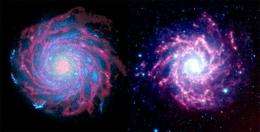
On the left, is an image of our simulated galaxy, with gas in red and stars in blue; on the right, a picture in false colors of the galaxy M74, again with gas shown in red and stars in blue. The spiral arms of the gas are evident in both images. Credit: UZH

For almost 20 years astrophysicists have been trying to recreate the formation of spiral galaxies such as our Milky Way realistically. Now astrophysicists from the University of Zurich present the world's first realistic simulation of the formation of our home galaxy together with astronomers from the University of California at Santa Cruz. The new results were partly calculated on the computer of the Swiss National Supercomputing Center (CSCS) and show, for instance, that there has to be stars on the outer edge of the Milky Way.

The aim of astrophysical simulations is to model reality in due consideration of the physical laws and processes. Astronomical sky observations and astrophysical simulations have to match up exactly. Being able to simulate a complex system like the formation of the Milky Way realistically is the ultimate proof that the underlying theories of astrophysics are correct. All previous attempts to recreate the formation of spiral galaxies like the Milky Way faltered on one of two points: Either the simulated spiral galaxies displayed too many stars at the center or the overall stellar mass was several times too big. A research group jointly run by Lucio Mayer, an astrophysicist at the University of Zurich, and Piero Madau, an astronomer at University of California at Santa Cruz, is now publishing the first realistic simulation of the formation of the Milky Way in the . Javiera Guedes and Simone Callegari, who are PhD students at Santa Cruz and the University of Zurich respectively, performed the simulation and analyzed the data. Guedes will be working on the as a postdoc in Zurich from the fall.

This video is not supported by your browser at this time.

This is a simulation. Credit: UZH

Removing standard matter central to formation of spiral galaxies

For their study, the scientists developed a highly complex simulation in which a spiral galaxy similar to the Milky Way develops by itself without further intervention. Named after Eris, the Greek goddess of strife and discord, because of the decades of debate surrounding the formation of spiral galaxies, the simulation offers a glimpse in time lapse into almost the entire genesis of a spiral galaxy. Its origins date back to less than a million years after the Big Bang. "Our result shows that a realistic spiral galaxy can be formed based on the basic principles of the cold dark matter paradigm and the physical laws of gravity, fluid dynamics and radiophysics," explains Mayer.

The simulation also shows that in an entity that is supposed to develop into a spiral galaxy, the stars in the areas with giant cloud gas complexes have to form. In these cold molecular giant clouds, the gases exhibit extremely high densities. The star formation and distribution there does not occur uniformly, but rather in clumps and clusters. This in turn results in a considerably greater build-up of heat through local supernova explosions. Through this massive build-up of heat, visible standard matter is removed at high redshift. This prevents the formation of a concave disk in the center of the galaxy. The removal of baryonic matter, as the visible standard matter is also known, also reduces the overall mass of the gas present at the center. This results in the formation of the correct stellar mass, as can be observed in the Milky Way. At the end of the simulation, a thin, curved disk results that corresponds fully to the astronomical observations of the Milky Way in terms of the mass, angular momentum and rotation velocity ratios.

Astronomical computing power

For the calculations, the model Mayer and co. developed for the simulation of disk-shaped dwarf galaxies and published in the journal Nature in 2010 was refined. The high-resolution model simulates the formation of a galaxy with 790 billion solar masses and comprises 18.6 million particles, from which gases, dark matter and stars form. The high resolution of the numerical simulations is essential for the groundbreaking new results. For the calculations, the high-performance supercomputers Cray XT5 "Monte Rosa" at ETH Zurich's Swiss National Supercomputing Center (CSCS) and the NASA Advanced Supercomputer Division's Pleiades were used. A regular PC would have needed 570 years for the calculations.
First glimpse into birth of the Milky Way
Enlarge

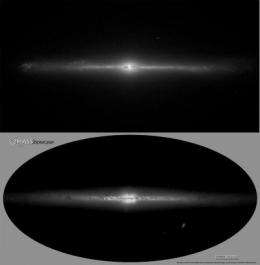
On top, an edge-on image of our simulated galaxy, as an observer would see it if he could enter in the computer and look at the light emitted by our simulated stars. He could clearly see that the galaxy is composed by a thin disk of stars, and a brighter, small bulge at the center. At the bottom, a real image of our Milky Way galaxy as you would see it in infrared, where stars emit most of their light. Here too the Milky Way is seen edge-on, as our solar system lies in the plane of the disk. Credit: Two Micron All Sky Survey (2MASS), University of Massachusetts and the Infrared Processing and Analysis Center/California Institute of Technology

Stars and gases at the outermost edge of the galaxy, hot gases at its center

The new simulation confirms the results for the formation of disk-shaped dwarf galaxies published by Mayer and demonstrates that the model – unlike all previous approaches – can recreate both small and extremely large galaxies realistically. Moreover, from the simulation it an also be deduced that protogalaxies with a large disk made of gases and stars at the center already formed a billion years after the Big Bang, and therefore long before our present galaxies.

Based on the simulation, the ratio of "cold dark matter" (CDM) and standard matter in spiral galaxies can also be adjusted. In order to obtain the correct overall stellar mass in the final stage of the galaxy – until now, one of the main difficulties – it is imperative that standard matter be removed from the center by supernova winds. On the strength of the simulation, it is highly probable that the ratio of standard matter to CDM on the outermost edge of the CDM rings of a is 1:9, not 1:6 as previously assumed.

The simulation also predicts stars and gases for the outer halo of the six hundred thousand light years away. Only the next generation of space probes and telescopes will be able to detect these extremely faint stars. Furthermore, the makes predictions with regard to the radial distribution of hot gases around the galaxy's central disk. Future telescopes that can measure X-rays, as the IXO Mission of the European Space Agency (ESA) is planning, for example, will test these predictions.

Provided by University of Zurich

4.9 /5 (9 votes)  

Filter


Move the slider to adjust rank threshold, so that you can hide some of the comments.


Display comments: newest first

omatumr
Aug 25, 2011

Rank: 1 / 5 (8)
The aim of astrophysical simulations is to model reality


Reality recorded in nuclear rest mass data indicate that the birth of galaxies, planetary systems, and stars are "inside-out" events, powered by "neutron repulsion" - the powerful known source of nuclear energy that releases a greater fraction of rest mass as energy than fission or fusion [1,2].

Those findings falsify:

a.) The nebular model for forming galaxies and stars, and

b.) The 1967 Bilderberg decision that the Sun - Earth's heat source is a steady, homogeneous H-fusion reactor [3] in equilibrium.

Group-think Lysenkoism [4] directed by those who control research funds failed in the old USSR. Lysenkoism will also fail in the West.

1. www.springerlink....6685079/

2.http://arxiv.org/...2.1499v1

3. http://adsabs.har...oPh.3.5G

4. www.skepdic.com/lysenko.html

With kind regards,
Oliver K. Manuel
Former NASA Principal
Investigator for Apollo
hush1
Aug 25, 2011

Rank: 1 / 5 (3)
Lysenkoism is to science what blowback is for covert communities. Lysenkoism. The public version of blowback.

The Germans described the Swiss as being German.
A German raised to the third power (cubed).
Exponentially speaking. Exponentiation is an indispensable ubiquitous tool. Even for the astrophysical society.

We watched thirteen point seven billion years in two minutes and forty seconds representing eight months of pocket calculator time consuming operations. Tweeks allowed.


Shootist
Aug 25, 2011

Rank: 5 / 5 (7)
Bilderburgers? Great jumping Jehoshaphat Oliver, but that is just plain crazy talk. Son, the Jesus nut has come off yer propeller.
hush1
Aug 25, 2011

Rank: not rated yet
lol
yyz
Aug 25, 2011

Rank: 5 / 5 (1)
Still an outstanding problem in models of the formation of the MW is that much larger numbers of faint dwarf galaxies should be present than can be accounted for.

There is the possibility that some of the ultra-faint dwarf galaxies recently discovered by the Sloan Survey (Segue 1, Bootes I & II, etc.) could represent the tip of the iceberg of these extremely dim, dark matter dominated dwarf galaxies current MW formation models predict. Possibly only (telescope) time will tell. ;)
HannesAlfven
Aug 25, 2011

Rank: 2.5 / 5 (4)
Re: "On the strength of the simulation, it is highly probable that the ratio of standard matter to CDM on the outermost edge of the CDM rings of a spiral galaxy is 1:9, not 1:6 as previously assumed."

Did the fudge factor just get bigger? Or, am I reading this wrong?
frajo
Aug 26, 2011

Rank: 5 / 5 (1)
It's a pity these high-end simulations which are relying on assumed properties of the assumed DarkMatter constituents can't produce testable predictions concerning the properties of the DarkMatter constituents.
yyz
Aug 26, 2011

Rank: 3 / 5 (2)
"It's a pity these high-end simulations which are relying on assumed properties of the assumed DarkMatter constituents can't produce testable predictions concerning the properties of the DarkMatter constituents."

Well, in a way, some are providing testable, observable predictions directly relating to DM. See my previous post on the "missing" dwarf galaxies of the Milky Way above. Time and observations should show whether DM theory or observation (or a combination of both) are in error.
omatumr
Aug 26, 2011

Rank: 1 / 5 (4)
Did the fudge factor just get bigger? Or, am I reading this wrong?


Fudge making has been lucrative in government science for four decades!

That is why the Apollo program ended and government funds were poured into global climate change stories.

This has been a disaster for science, and for society. The Sun is NOT a stable H-fusion reactor, and literally billions of dollars and time have been wasted chasing the illusion that future energy needs could be met by building H-fusion reactors that operate like the Sun.

There are NO stable H-fusion reactors.

Group-think Lysenkoism has done great damage to science and to the security of our nation.

With kind regards,
Oliver K. Manuel
Former NASA Principal
Investigator for Apollo
sivdoj
Aug 27, 2011

Rank: not rated yet
OK, I have a much simpler question. In the video starting at 1:07, the arms of the galaxy are turning counter-clockwise while the bar at the center is going clockwise. Is this normal behavior? It seems like everything should be turning the same way...
yyz
Aug 27, 2011

Rank: 5 / 5 (1)
"In the video starting at 1:07, the arms of the galaxy are turning counter-clockwise while the bar at the center is going clockwise. Is this normal behavior? It seems like everything should be turning the same way..."

Counterrotating features in hydrodynamic simulations of galaxy dynamics are a normal occurrence. They are usually temporary manifestations. Do not adjust your set.......
frajo
Aug 28, 2011

Rank: not rated yet
It's a pity these high-end simulations which are relying on assumed properties of the assumed DarkMatter constituents can't produce testable predictions concerning the properties of the DarkMatter constituents.

Well, in a way, some are providing testable, observable predictions directly relating to DM. See my previous post on the "missing" dwarf galaxies of the Milky Way above. Time and observations should show whether DM theory or observation (or a combination of both) are in error.


I'm afraid that any outcome of any dwarf galaxy census will only lead to "better" simulation algorithms. The DarkMatter hypothesis seems to be quite immune to falsification.
yyz
Aug 28, 2011

Rank: 5 / 5 (2)
"I'm afraid that any outcome of any dwarf galaxy census will only lead to "better" simulation algorithms. The DarkMatter hypothesis seems to be quite immune to falsification."

I do see your point and to some extent agree. But I do think the nature of DM will be elucidated through multi-pronged investigations (detection of gamma-rays from the center of the MWG or nearby dwarf galaxies(or not), DM particle searches in labs and accelerators, BAO, SZE and weak lensing surveys, etc.) And, of course, studies of alternatives like MOND and MOG [Pyle, are you channelling that? :^)] may prove to be the solution.

And I'll still be quite interested in the answer, in whatever form it may take. I just want to know soon (i.e. before I pass on).
frajo
Aug 29, 2011

Rank: 5 / 5 (1)
But I do think the nature of DM will be elucidated through multi-pronged investigations (detection of gamma-rays from the center of the MWG or nearby dwarf galaxies(or not), DM particle searches in labs and accelerators, BAO, SZE and weak lensing surveys, etc.) And, of course, studies of alternatives like MOND and MOG may prove to be the solution.

What about Cooperstock and Tieu's approach considering the weak-field regime effects of GR which for single point masses closely match the Newtonian results but possibly not for huge sets of single point masses?
It's inherently the most beautiful suggestion as it doesn't require modifications of ND or GR but only a modification of our GR weak-field approximations.
jems
Sep 06, 2011

Rank: 1 / 5 (2)
And physical in nature and the universe, all around is full and the emergence of a "super-spin sub - domain super-rotation vector field - spin the material into ultra - ultra-rotation of the movement and change." Objects as large as the universe Nebula, Galaxy, small particles of quarks L, D, spin. . . . . , Gravity and relativity, and its internal relations must be an integral and external linkages, "ring" - ultra-roton - super spin vector field games, nature origin, the origin of particles, the origin of the universe, the origin of changes in physical movement. Test the nature of scientific experiments, not tens of thousands of people repeated testing for verification and accurate and can be found from which to extract
Rank 4.9 /5 (9 votes)
Relevant PhysicsForums posts
  • revamping general concept and cosmological principle
    createdMay 25, 2012
  • Transiting Exoplanet Light Curve
    createdMay 25, 2012
  • Math behind Theoretical Physics
    createdMay 24, 2012
  • Do we know whats at the center of galaxies yet?
    createdMay 23, 2012
  • Structure of the Milky Way?
    createdMay 20, 2012
  • What would it take to terraform Pluto and Charon?
    createdMay 19, 2012
  • More from Physics Forums - General Astronomy

More news stories

Sophisticated simulations predict future warming

The chances of our planet being hit by a global warming of 3 degrees Celsius by 2050 is as likely as it being hit by an increase of 1.4 degrees, new research shows. Presented in the journal Nature Geoscience, the British study ...

Space & Earth / Earth Sciences

created May 22, 2012 | popularity 4.4 / 5 (9) | comments 51

Kyoto Protocol architect 'frustrated' by climate dialogue

UN climate talks are going nowhere, as politicians dither or bicker while the pace of warming dangerously speeds up, one of the architects of the Kyoto Protocol told AFP.

Space & Earth / Environment

created May 23, 2012 | popularity 3.7 / 5 (7) | comments 39

Aliens don't want to eat us, says former SETI director

Alien life probably isn’t interested in having us for dinner, enslaving us or laying eggs in our bellies, according to a recent statement by former SETI director Jill Tarter.

Space & Earth / Space Exploration

created May 25, 2012 | popularity 4.4 / 5 (13) | comments 37

Dragon arrives at space station in historic 1st (Update 2)

The privately bankrolled Dragon capsule made a historic arrival at the International Space Station on Friday, triumphantly captured by astronauts wielding a giant robot arm.

Space & Earth / Space Exploration

created May 25, 2012 | popularity 5 / 5 (10) | comments 19

What's the big deal about private space launches?

(AP) -- The first private spaceship is headed to the International Space Station. Some questions and answers about the cargo mission by Space Exploration Technologies, known as SpaceX:

Space & Earth / Space Exploration

created May 22, 2012 | popularity 5 / 5 (6) | comments 35


Nvidia trumpets Tegra 3 phone design wins for 2012

(Phys.org) -- Nvidia’s competitive war paint has a name, Tegra 3. On the heels of Nvidia announcements about lowering costs of its Tegra 3 processors and Nvidia-enabled tablets running Android Ice Cream ...

Browser wars flare in mobile space

The browser wars are heating up again, but this time the fight is for dominance of the mobile Internet.

Scientist: Evolution debate will soon be history

(AP) -- Richard Leakey predicts skepticism over evolution will soon be history. Not that the avowed atheist has any doubts himself.

Dell tablet leak: 10.1-inch display, two-battery choice

(Phys.org) -- Headline after headline talks about vendors’ tablets in the wings as likely number-one contenders for the iPad. Such claims have justifiably been taken with a grain of salt, considering ...

Keep food safety in mind this memorial day weekend

(HealthDay) -- Picnics, parades and cookouts are as much a part of Memorial Day weekend as tributes to the United States' war veterans.

Social welfare cuts ultimately come with heavy price, researchers say

(Phys.org) -- Slashing government funding for Medicaid, food stamps and other programs that serve the poor – while politically popular with some lawmakers and many conservatives – may do more harm ...