Giving fossils a new look
August 25, 2011 By Ryan Heise
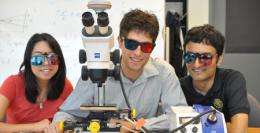
Cindy Wong, Adam Harrison and Dileepan Joseph (right) show off their microscope setup used to capture images of microfossils.
You wouldnt expect studying fossils to be a part of engineering research, but a team in the Department of Electrical and Computer Engineering is applying computer engineering ingenuity to find a new method for digitizing, studying and sharing microfossil samples.
Professor Dileepan Joseph, PhD candidate Adam Harrison, and masters of science student Cindy Wong have developed a new way to digitally capture and display microfossils and other specimens, called Virtual Reflected-Light Microscopy.
The process is achieved by capturing a series of digital images of a microfossil through a microscope. Each image is taken with a light source shifted at different points around the sample, which creates different shadows on its surface. This allows the team to extract a three-dimensional map of the sample, which computer software can further interpret. The result is imagery that is on par with viewing a real microfossil sample. Users can control the angle, intensity, and type of light hitting the sample, and can even view it in 3-D using 3-D glasses.
In the past, researchers might get a few images of a specimen under a few lighting conditions. It would give them the general outline and some other properties, but it was not comparable to actually looking at a specimen, Harrison said. What were doing is like reverse engineering: using multiple images together to extract the shape of samples. And with that we get important properties such as surface reflectance."
Harrison says this imaging technology could facilitate a massive digital library of samples that can be accessed through a web browser. He says this eliminate the need for researchers to travel to view samples that are stored in large repositories all over the world.
You can have the best digital representation in the world, but if you cant share it, it doesnt matter, Harrison said.
For her part in the project, Wong developed a Java applet that allows end users to interact with the samples in a simple, intuitive way.
This is a much closer representation of using an actual microscope, she said. It is also a way to share information with a larger audience easily and more cost effectively.
The method could change the way geoscientists examine the vast quantity of microscopic samples that are collected through projects like the Integrated Ocean Drilling Program. These microfossils provide researchers with information that is crucial for climate study, and oil and gas exploration.
Were interested in ways of accelerating the identification process, Joseph said. This definitely gets us closer to that goal.
While the team continues to refine their system, theyre also looking at other uses. Because it can record data from any opaque material, Joseph says there is the potential for applications in metallurgic study. The team has also been in contact with the Natural History Museum in London, UK, which is providing samples from its large collection of microfossils.
Theres huge potential for educating the public with VRLM, Joseph said. People respond to its interactive nature.
Provided by
University of Alberta
-
From lemons to lemonade: Reaction uses carbon dioxide to make carbon-based semiconductor,
32 comments
-
Thioridazine kills cancer stem cells in human while avoiding toxic side-effects of conventional cancer treatments,
3 comments
-
SpaceX private rocket blasts off for space station (Update),
42 comments
-
Climate scientists say they have solved riddle of rising sea,
31 comments
-
SpaceX capsule has 'new car' smell, astronauts say (Update),
2 comments
-
What would stain as translucent on light-coloured fabric?
19 hours ago
-
How do I identify different bacteria on culture plates?
May 26, 2012
-
Why Do Dogs do Strange things...
May 25, 2012
-
What does exophillic and endophillic mean in terms of mosquito and their control?
May 24, 2012
-
Semen stains glows under black lights (uv light)?
May 23, 2012
-
Question on Human Chromosome 2
May 23, 2012
- More from Physics Forums - Biology
More news stories
Change in developmental timing was crucial in the evolutionary shift from dinosaurs to birds: study
At first glance, it's hard to see how a common house sparrow and a Tyrannosaurus Rex might have anything in common. After all, one is a bird that weighs less than an ounce, and the other is a dinosaur that ...
Other Sciences / Archaeology & Fossils
5 minutes ago |
not rated yet |
0
|
Social welfare cuts ultimately come with heavy price, researchers say
(Phys.org) -- Slashing government funding for Medicaid, food stamps and other programs that serve the poor while politically popular with some lawmakers and many conservatives may do more harm ...
Other Sciences / Social Sciences
May 24, 2012 |
4.3 / 5 (16) |
147
Ancient Bethlehem seal unearthed in Jerusalem
Israeli archaeologists have discovered a 2,700-year-old seal that bears the inscription "Bethlehem," the Israel Antiquities Authority announced Wednesday, in what experts believe to be the oldest artifact ...
Other Sciences / Archaeology & Fossils
May 23, 2012 |
3.5 / 5 (14) |
23
Oldest Jewish archaeological evidence on the Iberian Peninsula
German archaeologists of the Friedrich Schiller University Jena found one of the oldest archaeological evidence so far of Jewish Culture on the Iberian Peninsula at an excavation site in the south of Portugal, ...
Other Sciences / Archaeology & Fossils
May 25, 2012 |
4.3 / 5 (4) |
12
Dollars and sense: Why are some people morally against tax?
As the U.S. presidential election campaigns heat up, the economic debate is dominated by bailouts, austerity and, inevitably, taxation. Now a new study published in Symbolic Interaction asks why tax is such an important issue ...
Other Sciences / Social Sciences
May 23, 2012 |
3 / 5 (2) |
12
Computer model used to pinpoint prime materials for efficient carbon capture
When power plants begin capturing their carbon emissions to reduce greenhouse gases and to most in the electric power industry, it's a question of when, not if it will be an expensive undertaking.
'Unzipped' carbon nanotubes could help energize fuel cells, batteries
Multi-walled carbon nanotubes riddled with defects and impurities on the outside could replace some of the expensive platinum catalysts used in fuel cells and metal-air batteries, according to scientists at ...
T cells 'hunt' parasites like animal predators seek prey, study shows
By pairing an intimate knowledge of immune-system function with a deep understanding of statistical physics, a cross-disciplinary team at the University of Pennsylvania has arrived at a surprising finding: T cells use a movement ...
Manufacturing genes to attack flu virus
An international research team has manufactured a new protein that can combat deadly flu epidemics.
Yale study concludes public apathy over climate change unrelated to science literacy
Are members of the public divided about climate change because they don't understand the science behind it? If Americans knew more basic science and were more proficient in technical reasoning, would public consensus match ...
Same gene that stunts infants' growth also makes them grow too big: research
UCLA geneticists have identified the mutation responsible for IMAGe* syndrome, a rare disorder that stunts infants' growth. The twist? The mutation occurs on the same gene that causes Beckwith-Wiedemann syndrome, which makes ...