How e-mail helped Yeltsin outfox 1991 coup plot

Boris Yeltsin never suspected how a precursor to the Internet helped him foil the August 1991 coup and bring down the USSR until he bumped into a blinking computer and noticed something called e-mail.
A quick presentation by a starry-eyed woman who worked on the Soviet Union's maiden computer communications programme left Russia's first president stunned.
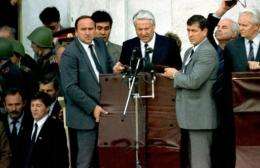
For Yeltsin was peering at an electronic version of his own momentous decree pronouncing the Communist coup attempt illegal and proclaiming himself the country's ultimate leader.
His astonishing gamble of August 19 -- taken as the fate of Soviet Communism hung in the balance -- had paid off only because people managed to hear about it.
The veteran coup plotters seized immediate control of all airwaves and shut the presses in an attempt to appear in full command and make sure that the pride of a unified Soviet Union stood unshaken.
But there was a communications loophole -- one neither the KGB knew how to plug nor which Yeltsin had ever heard about. And it involved a team of geeky technicians and a revolutionary Soviet e-mail system called RelCom.
"He was astounded," former RelCom manager Maria Stepanova said of her sudden encounter with Yeltsin a few months after the late leader's unlikely victory over the Communist hardliners.
"And there I was thinking: the newspapers are closed, the radio is not working, television is down -- and the people still know. So you were the one responsible!" she recalled a visibly-moved Yeltsin as saying.
The story of RelCom -- the Soviet Union's first private computer network and forerunner of what became known as the Internet -- begins in the bowels of the super-secret Kurchatov Institute on the dusty outskirts of Moscow.
Its team of 10,000 nuclear scientists and math whizzes had orders to keep up with the West during the Cold War. The breakthrough came in 1990 when it managed to zip a computer file by phone line to Finland.
The find's importance seemed fleeting at first. RelCom had just 3,000 clients ranging from institutes to a few state organisations by the time tanks rumbled into Moscow that fateful summer.
But that lone Finland link fed RelCom's e-mails into a global forum known as UseNet -- the pre-Internet community's main means of spreading gossip and swapping files.
And this is where excited researchers like Stepanova came in and did their bit to alter the course of history.
"We realised that something big was happening and that people needed to know," Stepanova said in the office of her new private Internet development company.
"Perhaps Yeltsin's decree (of August 19, 1991) reached one of our clients by fax -- we had them in those days -- and then they posted it with us. But either way, Yeltsin's appeal to the people was one of the first things we published."
RelCom went on to open the floodgates and pass each of its posts to UseNet -- an onslaught of e-mails with titles such as "eyewitness account" that were echoed two decades later during the Twitter revolutions of the Arab world.
It was not a move taken without risk. RelCom feared that its cover may have been blown for good when one Western television network attributed a news flash to an e-mail received from Moscow.

"That was horrible. (The Western network) disclosed the source of all this information. That really frightened us," Stepanova said. "But then somehow ... it never happened again."
One of the greatest mysteries of the entire episode is why the KGB security service never shut down the team or tried to arrest its members.
Stepanova recalled how one agent visited the group's office in the weeks preceding the attempted coup only to come away confused by the role a little box called the modem could play in international communications.
"I think the KGB had a suspicion that something untoward was happening," said Stepanova.
"They understood that we were engaged in some sort of international telephone negotiations. That something was happening. And then they saw the modem. But they could not make the link."

Stepanova -- a merry chain smoker who once studied the murky science of how computers can help humans in life -- said she was driving out of Moscow and about to start her summer vacation when she ran into a column of Soviet tanks.
She told her son that their vacation plans were finished and then re-joined the RelCom crew for a three-day spell in which they sent out tens of thousands of e-mails to information-starved readers across the world.
"We did not think that what we were doing was that important. But we all really wanted to be a part of it," she said.
(c) 2011 AFP


