Can you feel the force?
August 15, 2011

Can you feel the force?

Engineering students from the University of Leeds have found a way to let surgeons keep their sense of touch when operating at a distance with ‘keyhole’ techniques.

The system could help cancer surgeons who like to feel the tissue they are cutting out - an important way of double-checking where the tumour is and if it is malignant or benign.

, in which surgeons operate through tiny incisions, has many benefits for patients. It reduces the chance of complications, shortens hospital stays and speeds up recovery times.

But at the moment, surgeons who work 'through the keyhole' cannot feel the tissue they are operating on, as they would during open surgery. This means they are unable to tell the character of a suspicious lump- an important way of diagnosing cancer.

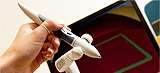
The system devised and tested by the University of Leeds students should give surgeons that hands-on feeling back when they use keyhole techniques.  The students' solution combines a computer-generated environment for virtual surgery and a hand-held device that applies pressure to the users' hand. What the user feels will depend on how hard they are compressing the virtual tissue.

Team members set up the system to simulate keyhole surgery on the liver. They gathered measurements from a soft block of silicon to simulate what surgeons would 'feel' during keyhole procedures and fed these into their hand-held device. They tested the system by embedding hard ball-bearings in the artificial, silicon liver and checking whether users could find them.

"This system might help surgeons to become more accurate in theatre," said University of Leeds engineering student, Earle Jamieson. "Haptic devices that give users sensory feedback are becoming more common in surgery, but none of them quite match that true hands-on feeling. With our system, users can interact with the tissue they are operating on throughout the surgical procedure."

"Judging from the feedback the students have received from practising surgeons, this system has real, clinical potential," said Dr. Peter Culmer, a Senior Translational Research Fellow in Surgical Technologies, who supervised the work. "In the short-term, it could be used as a training tool to help surgeons get a feel for keyhole surgery - quite literally. Looking further ahead, systems such as this could become used in operating theatres on a daily basis."

"The haptic system that these students have developed goes a long way to solving one of the main disadvantages of keyhole surgery, namely the ability of the surgeon to feel the structure they are operating on," said David Jayne, Professor of Surgery at the University of Leeds and a consultant surgeon at Leeds Teaching Hospitals NHS Trust, who tested the system in the laboratory. "If this research can be translated into the clinical setting, then it has the potential to offer benefits to and patients."

Provided by University of Leeds search and more info website


Rank 5 /5 (1 vote)
Relevant PhysicsForums posts

More news stories

Browser wars flare in mobile space

The browser wars are heating up again, but this time the fight is for dominance of the mobile Internet.

Technology / Software

created 7 hours ago | popularity 5 / 5 (1) | comments 3

Probability of contamination from severe nuclear reactor accidents is higher than expected: study

Catastrophic nuclear accidents such as the core meltdowns in Chernobyl and Fukushima are more likely to happen than previously assumed. Based on the operating hours of all civil nuclear reactors and the number ...

Technology / Energy & Green Tech

created May 22, 2012 | popularity 3.6 / 5 (22) | comments 56 | with audio podcast

SpotterRF debuts Radar Backpack Kit (w/ Video)

(Phys.org) -- SpotterRF has announced a special radar backpack kit designed to enhance situational awareness for soldiers on the ground. The company says its special radar is designed for warfighters as part ...

Technology / Hi Tech & Innovation

created May 26, 2012 | popularity 5 / 5 (5) | comments 13 | with audio podcast report

HyperSolar shows dirty water no barrier to power world

(Phys.org) -- The Santa Barbara, California, company, HyperSolar, is set to transparently share the ups and downs of its research experiences toward the company’s ultimate vision, successfully producing ...

Technology / Energy & Green Tech

created May 24, 2012 | popularity 4.8 / 5 (16) | comments 17 | with audio podcast report

Tesla to launch electric sedan in US on June 22

Tesla Motors said Tuesday it would begin deliveries of "the world's first premium electric sedan" on June 22, slightly ahead of schedule.

Technology / Energy & Green Tech

created May 22, 2012 | popularity 4.5 / 5 (12) | comments 18


Nvidia trumpets Tegra 3 phone design wins for 2012

(Phys.org) -- Nvidia’s competitive war paint has a name, Tegra 3. On the heels of Nvidia announcements about lowering costs of its Tegra 3 processors and Nvidia-enabled tablets running Android Ice Cream ...

Scientist: Evolution debate will soon be history

(AP) -- Richard Leakey predicts skepticism over evolution will soon be history. Not that the avowed atheist has any doubts himself.

Dell tablet leak: 10.1-inch display, two-battery choice

(Phys.org) -- Headline after headline talks about vendors’ tablets in the wings as likely number-one contenders for the iPad. Such claims have justifiably been taken with a grain of salt, considering ...

Keep food safety in mind this memorial day weekend

(HealthDay) -- Picnics, parades and cookouts are as much a part of Memorial Day weekend as tributes to the United States' war veterans.

Social welfare cuts ultimately come with heavy price, researchers say

(Phys.org) -- Slashing government funding for Medicaid, food stamps and other programs that serve the poor – while politically popular with some lawmakers and many conservatives – may do more harm ...

Is a classical electrodynamics law incompatible with special relativity?

(Phys.org) -- The laws of classical electromagnetism that were developed in the 19th century are the same laws that scientists use today. They include Maxwell’s four equations along with the Lorentz la ...