Astronomers find ice and possibly methane on Snow White, a distant dwarf planet
August 22, 2011

Astronomers find ice and possibly methane on Snow White, a distant dwarf planet

Enlarge

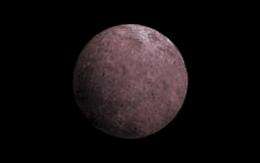
An artist's conception of 2007 OR10, nicknamed Snow White. Astronomers suspect that its rosy color is due to the presence of irradiated methane. Credit: NASA

Astronomers at the California Institute of Technology (Caltech) have discovered that the dwarf planet 2007 OR10—nicknamed Snow White—is an icy world, with about half its surface covered in water ice that once flowed from ancient, slush-spewing volcanoes. The new findings also suggest that the red-tinged dwarf planet may be covered in a thin layer of methane, the remnants of an atmosphere that's slowly being lost into space.

"You get to see this nice picture of what once was an active little world with water volcanoes and an atmosphere, and it's now just frozen, dead, with an atmosphere that's slowly slipping away," says Mike Brown, the Richard and Barbara Rosenberg Professor and professor of planetary astronomy, who is the lead author on a paper to be published in the Astrophysical Journal Letters describing the findings. The paper is now in press.

Snow White—which was discovered in 2007 as part of the PhD thesis of Brown's former graduate student Meg Schwamb—orbits the sun at the edge of the solar system and is about half the size of Pluto, making it the fifth largest . At the time, Brown had guessed incorrectly that it was an icy body that had broken off from another dwarf planet named Haumea; he nicknamed it Snow White for its presumed white color.

Soon, however, follow-up observations revealed that Snow White is actually one of the reddest objects in the solar system. A few other dwarf planets at the edge of the solar system are also red. These distant dwarf planets are themselves part of a larger group of icy bodies called Kuiper Belt Objects (KBOs). As far as the researchers could tell, Snow White, though relatively large, was unremarkable—just one out of more than 400 potential dwarf planets that are among hundreds of thousands of KBOs.

"With all of the dwarf planets that are this big, there's something interesting about them—they always tell us something," Brown says. "This one frustrated us for years because we didn't know what it was telling us." At that time, the Near Infrared Camera (NIRC) at the Keck Observatory—which Caltech professor of physics Tom Soifer and chief instrument scientist Keith Matthews helped design in the 1990s—was the best instrument astronomers had to study KBOs, according to Brown. But NIRC had just been retired, so no one could observe 2007 OR10 in detail. "It kind of languished," he says.

Meanwhile, Adam Burgasser, a former graduate student of Brown's and now a professor at UC San Diego, was helping to design a new instrument called the Folded-port Infrared Echellette (FIRE). Last fall, Brown, Burgasser, and postdoctoral scholar Wesley Fraser used this instrument with the 6.5-meter Magellan Baade Telescope in Chile to take a closer look at 2007 OR10.

As expected, Snow White was red. But to their surprise, the spectrum revealed that the surface was covered in . "That was a big shock," Brown says. "Water ice is not red." Although ice is common in the outer , it's almost always white.

There is, however, one other dwarf planet that's both red and covered with water ice: Quaoar, which Brown helped discover in 2002. Slightly smaller than Snow White, Quaoar is still big enough to have had an atmosphere and a surface covered with volcanoes that spewed an icy slush, which then froze solid as it flowed over the surface.

But because Quaoar isn't as big as dwarf planets like Pluto or Eris, it could not hold onto volatile compounds like methane, carbon monoxide, or nitrogen as long. A couple of billion years after Quaoar formed, it began to lose its atmosphere to space; now, all that remains is some methane. Over time, exposure to the radiation from space turned that methane—which consists of a carbon atom bonded to four hydrogen atoms—into long hydrocarbon chains, which look red. Like the frost that covers a lawn on a cold morning, the irradiated methane sits on Quaoar's icy surface, giving it a rosy hue.

The spectrum of 2007 OR10 looks similar to Quaoar's, suggesting that what happened on Quaoar also happened on 2007 OR10. "That combination—red and water—says to me, 'methane,'" Brown explains. "We're basically looking at the last gasp of Snow White. For four and a half billion years, Snow White has been sitting out there, slowly losing its atmosphere, and now there's just a little bit left."

Although Snow White's spectrum clearly shows the presence of water ice, Brown says, the evidence for methane is not yet definitive. To find out, the astronomers will have to use a big telescope like the one at the Keck Observatory. If it turns out that Snow White does indeed have methane, it will join Quaoar as one of only two dwarf planets that straddle the border between the handful of objects large enough to hold onto volatile compounds, and the smaller bodies that make up the vast majority of KBOs.

Another task, Brown says, is to give the dwarf planet an official name, since "Snow White" was just a nickname he and his colleagues used. Besides, the moniker no longer makes sense for describing this very red object. Before the discovery of water ice and the possibility of methane, "2007 OR10" might have sufficed for the astronomy community, since it didn't seem noteworthy enough to warrant an official name. "We didn't know Snow White was interesting," Brown says. "Now we know it's worth studying."

More information: The research is described in the Astrophysical Journal Letters paper, "The surface composition of large Kuiper Belt Object 2007 OR10."

Provided by California Institute of Technology search and more info website

4.5 /5 (11 votes)  

Filter


Move the slider to adjust rank threshold, so that you can hide some of the comments.


Display comments: newest first

barakn
Aug 22, 2011

Rank: 5 / 5 (4)
Little Red Riding Hood
scidog
Aug 23, 2011

Rank: not rated yet
L double R-H..very nice barakn.
tkjtkj
Aug 23, 2011

Rank: not rated yet
Why not use the criteria based on an objects size: is it able to maintain its atmosphere .. as the definition of 'planet'. Such an approach brings us back to what we know about our own planet which we have no problem calling it such! Further,it's a scientifically reproducible process, i imagine, (not being an astronomer) and easily separates the thousands of smaller KBO's from their larger but much more rare cousins.
Would this finally end the debate as to which is which?

Even if such a body thru the above criteria labeled a 'planet', it might require 'spewing vocanoes' to allow atmosphere perpetuation but the presence of such volcanoes itself requires a certain size. So such a potentially bothersome fact spews into nothingness of importance.

Comments?
tkjtkj@gmail.com
Star_Gazer
Aug 23, 2011

Rank: 5 / 5 (1)
Why not use the criteria based on an objects size: is it able to maintain its atmosphere .. as the definition of 'planet'.


Mars isn't a planet then.. it lost big part of it's atmosphere..
antialias_physorg
Aug 23, 2011

Rank: 5 / 5 (1)
Mars isn't a planet then..

Mercury neither. It has about as much atmosphere as the Moon.
LKD
Aug 23, 2011

Rank: not rated yet
Why not use the criteria based on an objects size: is it able to maintain its atmosphere .. as the definition of 'planet'.


The problem isn't naming them planets, it's when are they not. As stated in the article, if we use the common notion of a round thing going in a circular-ish path around the sun, we have hundreds. That's too many planets for just about everyone.
kevinrtrs
Aug 23, 2011

Rank: 1 / 5 (6)
A couple of billion years after Quaoar formed, it began to lose its atmosphere to space; now, all that remains is some methane. Over time, exposure to the radiation from space turned that methanewhich consists of a carbon atom bonded to four hydrogen atomsinto long hydrocarbon chains, which look red

A definite problem with this assumption right here. Just how long does it take for a dwarf planet to lose it's atmosphere? Certainly not billions of years. Perhaps someone can investigate the rate of loss in a more realistic fashion rather than having this plucked-out-of-the-air statement. I submit that relative to the billions of years, reality would show that the loss of atmosphere is quite quick, or the order of hundreds of thousands of years, if not less.
LKD
Aug 24, 2011

Rank: not rated yet
I'm surprised that you have so many 1's, kevinrtrs. It's actually a fairly good point considering that the planets are formed about the same time that the sun turns on and sends a huge wave of dust out of the solar system, blowing off a lot of gases that can't remain in their respective gravity wells.

It's also possible that the Kuiper belt objects never really had an atmosphere to begin with. Seeing by the time the solar winds reach that far out, much of their energy is dispersed and would have less an effect as they do here on Earth; where solar winds are removing large quantities of our own atmosphere each day.
antialias_physorg
Aug 24, 2011

Rank: 5 / 5 (1)
I submit that relative to the billions of years, reality would show that the loss of atmosphere is quite quick, or the order of hundreds of thousands of years, if not less.

And this assumption is not - to quote your good self - a "plucked-out-of-the-air statement" because ... ?
Magnette
Aug 25, 2011

Rank: not rated yet
A couple of billion years after Quaoar formed, it began to lose its atmosphere to space; now, all that remains is some methane. Over time, exposure to the radiation from space turned that methanewhich consists of a carbon atom bonded to four hydrogen atomsinto long hydrocarbon chains, which look red

A definite problem with this assumption right here. Just how long does it take for a dwarf planet to lose it's atmosphere? Certainly not billions of years. Perhaps someone can investigate the rate of loss in a more realistic fashion rather than having this plucked-out-of-the-air statement. I submit that relative to the billions of years, reality would show that the loss of atmosphere is quite quick, or the order of hundreds of thousands of years, if not less.


The article states that it STARTED to lose it's atmosphere after a couple of billion years not that it took a couple of billion years for it to happen.
Rank 4.5 /5 (11 votes)
Relevant PhysicsForums posts
  • revamping general concept and cosmological principle
    createdMay 25, 2012
  • Transiting Exoplanet Light Curve
    createdMay 25, 2012
  • Math behind Theoretical Physics
    createdMay 24, 2012
  • Do we know whats at the center of galaxies yet?
    createdMay 23, 2012
  • Structure of the Milky Way?
    createdMay 20, 2012
  • What would it take to terraform Pluto and Charon?
    createdMay 19, 2012
  • More from Physics Forums - General Astronomy

More news stories

Sophisticated simulations predict future warming

The chances of our planet being hit by a global warming of 3 degrees Celsius by 2050 is as likely as it being hit by an increase of 1.4 degrees, new research shows. Presented in the journal Nature Geoscience, the British study ...

Space & Earth / Earth Sciences

created May 22, 2012 | popularity 4.4 / 5 (9) | comments 51

Kyoto Protocol architect 'frustrated' by climate dialogue

UN climate talks are going nowhere, as politicians dither or bicker while the pace of warming dangerously speeds up, one of the architects of the Kyoto Protocol told AFP.

Space & Earth / Environment

created May 23, 2012 | popularity 3.7 / 5 (7) | comments 39

Aliens don't want to eat us, says former SETI director

Alien life probably isn’t interested in having us for dinner, enslaving us or laying eggs in our bellies, according to a recent statement by former SETI director Jill Tarter.

Space & Earth / Space Exploration

created May 25, 2012 | popularity 4.4 / 5 (13) | comments 38

Dragon arrives at space station in historic 1st (Update 2)

The privately bankrolled Dragon capsule made a historic arrival at the International Space Station on Friday, triumphantly captured by astronauts wielding a giant robot arm.

Space & Earth / Space Exploration

created May 25, 2012 | popularity 5 / 5 (10) | comments 19

What's the big deal about private space launches?

(AP) -- The first private spaceship is headed to the International Space Station. Some questions and answers about the cargo mission by Space Exploration Technologies, known as SpaceX:

Space & Earth / Space Exploration

created May 22, 2012 | popularity 5 / 5 (6) | comments 35


Nvidia trumpets Tegra 3 phone design wins for 2012

(Phys.org) -- Nvidia’s competitive war paint has a name, Tegra 3. On the heels of Nvidia announcements about lowering costs of its Tegra 3 processors and Nvidia-enabled tablets running Android Ice Cream ...

Browser wars flare in mobile space

The browser wars are heating up again, but this time the fight is for dominance of the mobile Internet.

Scientist: Evolution debate will soon be history

(AP) -- Richard Leakey predicts skepticism over evolution will soon be history. Not that the avowed atheist has any doubts himself.

Dell tablet leak: 10.1-inch display, two-battery choice

(Phys.org) -- Headline after headline talks about vendors’ tablets in the wings as likely number-one contenders for the iPad. Such claims have justifiably been taken with a grain of salt, considering ...

Keep food safety in mind this memorial day weekend

(HealthDay) -- Picnics, parades and cookouts are as much a part of Memorial Day weekend as tributes to the United States' war veterans.

Social welfare cuts ultimately come with heavy price, researchers say

(Phys.org) -- Slashing government funding for Medicaid, food stamps and other programs that serve the poor – while politically popular with some lawmakers and many conservatives – may do more harm ...