The universe may have been born spinning, according to new findings on the symmetry of the cosmos
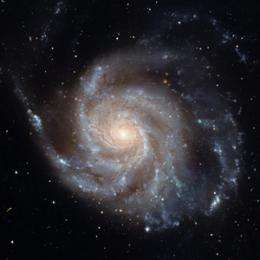
A new study found an excess of counter-clockwise rotating or "left-handed" spiral galaxies like this one, compared to their right-handed counterparts. This provides evidence that the universe does not have mirror symmetry. Credit: NASA, ESA
(PhysOrg.com) -- Physicists and astronomers have long believed that the universe has mirror symmetry, like a basketball. But recent findings from the University of Michigan suggest that the shape of the Big Bang might be more complicated than previously thought, and that the early universe spun on an axis.
To test for the assumed mirror symmetry, physics professor Michael Longo and a team of five undergraduates catalogued the rotation direction of tens of thousands of spiral galaxies photographed in the Sloan Digital Sky Survey.
The mirror image of a counter-clockwise rotating galaxy would have clockwise rotation. More of one type than the other would be evidence for a breakdown of symmetry, or, in physics speak, a parity violation on cosmic scales, Longo said.
The researchers found evidence that galaxies tend to rotate in a preferred direction. They uncovered an excess of left-handed, or counter-clockwise rotating, spirals in the part of the sky toward the north pole of the Milky Way. The effect extended beyond 600 million light years away.
"The excess is small, about 7 percent, but the chance that it could be a cosmic accident is something like one in a million," Longo said. "These results are extremely important because they appear to contradict the almost universally accepted notion that on sufficiently large scales the universe is isotropic, with no special direction."
The work provides new insights about the shape of the Big Bang. A symmetric and isotropic universe would have begun with a spherically symmetric explosion shaped like a basketball. If the universe was born rotating, like a spinning basketball, Longo said, it would have a preferred axis, and galaxies would have retained that initial motion.
Is the universe still spinning?
"It could be," Longo said. "I think this result suggests that it is."
Because the Sloan telescope is in New Mexico, the data the researchers analyzed for their recent paper came mostly from the northern hemisphere of the sky. An important test of the findings will be to see if there is an excess of right-handed spiral galaxies in the southern hemisphere. This research is currently underway.
A paper on the findings, Detection of a Dipole in the Handedness of Spiral Galaxies with Redshifts z~0.04 is published in Physics Letters B.
More information: http://www.science … 269311003947
Provided by
University of Michigan
-
From lemons to lemonade: Reaction uses carbon dioxide to make carbon-based semiconductor,
32 comments
-
Thioridazine kills cancer stem cells in human while avoiding toxic side-effects of conventional cancer treatments,
3 comments
-
SpaceX private rocket blasts off for space station (Update),
42 comments
-
Climate scientists say they have solved riddle of rising sea,
31 comments
-
SpaceX capsule has 'new car' smell, astronauts say (Update),
2 comments
-
revamping general concept and cosmological principle
May 25, 2012
-
Transiting Exoplanet Light Curve
May 25, 2012
-
Math behind Theoretical Physics
May 24, 2012
-
Do we know whats at the center of galaxies yet?
May 23, 2012
-
Structure of the Milky Way?
May 20, 2012
-
What would it take to terraform Pluto and Charon?
May 19, 2012
- More from Physics Forums - General Astronomy
More news stories
Yale study concludes public apathy over climate change unrelated to science literacy
Are members of the public divided about climate change because they don't understand the science behind it? If Americans knew more basic science and were more proficient in technical reasoning, would public consensus match ...
32 minutes ago |
not rated yet |
2
|
10 million years needed to recover from mass extinction
It took some 10 million years for Earth to recover from the greatest mass extinction of all time, latest research has revealed.
Space & Earth / Earth Sciences
33 minutes ago |
not rated yet |
0
|
Sophisticated simulations predict future warming
The chances of our planet being hit by a global warming of 3 degrees Celsius by 2050 is as likely as it being hit by an increase of 1.4 degrees, new research shows. Presented in the journal Nature Geoscience, the British study ...
Space & Earth / Earth Sciences
May 22, 2012 |
4.4 / 5 (9) |
51
Aliens don't want to eat us, says former SETI director
Alien life probably isnt interested in having us for dinner, enslaving us or laying eggs in our bellies, according to a recent statement by former SETI director Jill Tarter.
Space & Earth / Space Exploration
May 25, 2012 |
4.4 / 5 (13) |
39
Kyoto Protocol architect 'frustrated' by climate dialogue
UN climate talks are going nowhere, as politicians dither or bicker while the pace of warming dangerously speeds up, one of the architects of the Kyoto Protocol told AFP.
May 23, 2012 |
3.7 / 5 (7) |
39
Change in developmental timing was crucial in the evolutionary shift from dinosaurs to birds: study
At first glance, it's hard to see how a common house sparrow and a Tyrannosaurus Rex might have anything in common. After all, one is a bird that weighs less than an ounce, and the other is a dinosaur that ...
Computer model used to pinpoint prime materials for efficient carbon capture
When power plants begin capturing their carbon emissions to reduce greenhouse gases and to most in the electric power industry, it's a question of when, not if it will be an expensive undertaking.
'Unzipped' carbon nanotubes could help energize fuel cells, batteries
Multi-walled carbon nanotubes riddled with defects and impurities on the outside could replace some of the expensive platinum catalysts used in fuel cells and metal-air batteries, according to scientists at ...
T cells 'hunt' parasites like animal predators seek prey, study shows
By pairing an intimate knowledge of immune-system function with a deep understanding of statistical physics, a cross-disciplinary team at the University of Pennsylvania has arrived at a surprising finding: T cells use a movement ...
Manufacturing genes to attack flu virus
An international research team has manufactured a new protein that can combat deadly flu epidemics.
Same gene that stunts infants' growth also makes them grow too big: research
UCLA geneticists have identified the mutation responsible for IMAGe* syndrome, a rare disorder that stunts infants' growth. The twist? The mutation occurs on the same gene that causes Beckwith-Wiedemann syndrome, which makes ...
Jul 08, 2011
Rank: not rated yet
Jul 08, 2011
Rank: 2.4 / 5 (8)
I must be missing something.
The apparent handedness of a galaxy depends on the side from which it is viewed (galaxies viewed edge-on have no handedness). Since all the observations reported in this article were presumably made from Earth, and since there is no preferred location in the Universe (it has no edges), the apparent handedness of any galaxy is completely random.
Therefore, the entire article seems to be nonsensical.
Even if we could detect the actual spin direction of a galaxy (such as by observing its structure for hundreds of years), it would still be random, because spin directions are only relative, since there is no preferred direction in the Universe or in any underlying aether or medium, should one happen to exist.
Jul 08, 2011
Rank: 2.3 / 5 (6)
Just to make this clear: the Earth is located at a random place in a Universe that has no edges. Therefore, any catalog of galaxy spin directions must be random. Since random sets of two-valued observations are almost never equal (by basic probability), it is expected that a good enough catalog of spin observations will show one handedness as being more common than another.
Therefore, unlike the handedness of protein molecules in living things, this fact is insignificant.
Finally, even if all galaxies were "left handed", that would still indicate nothing about whether the Universe itself were born spinning, since these two types of spins are independent.
Jul 08, 2011
Rank: 1.5 / 5 (8)
If it began spinning, it would of course still be spinning. Where would the angular momentum go? It would just be spinning slower.
Jul 08, 2011
Rank: 3.5 / 5 (2)
Though now I think of it, does anyone know if slight irregularities in the shape of a charge of conventional explosive impart any rotation to the debris?
Jul 08, 2011
Rank: 1.7 / 5 (3)
Does this not depend on your point of view or is it the same result no matter where you are? I'm not sure now that I chew this over in my mind. I guess visualizing 3D spinning galaxies around a center point of universal rotation while taking into account expansion rates and moving mentally around this point of rotation requires a computer - not my poor attempt to see this relationship my head. So, I dunno!
Jul 08, 2011
Rank: 3.8 / 5 (10)
Jul 08, 2011
Rank: 4.9 / 5 (15)
Jul 08, 2011
Rank: 1 / 5 (9)
What a waste of 5 undergraduates....the work and data already exist on galaxyzoo...just sneak a peek at their database of images and call it a day...
Jul 08, 2011
Rank: 1.3 / 5 (29)
If it doesn't make sense from an Isotropic universe model, then perhaps the model needs to be changed. Raygunner has mentioned the apparent solution to the mystery: "Unless we are in the center of the Universe...". Well, it turns out that if one uses redshift as a means of location/distance, one can calculate that we are within one million light years of the center of the Universe. AND that the universe is rotating about an axis. To get to this result one has to let go of the "non-special" place idea. Here you have additional evidence that suggest that we are indeed in a special place. The other evidence is the non-uniform distribution of galaxies. It's clearly time to move away from the homogeneous Big Bang model and start figuring out another.
Jul 08, 2011
Rank: 3.3 / 5 (6)
If this article is nonsense, how did the work get by reviews by Prof. Longo, their publishing institution, and this website? Seems strange. Good reviewing is at the heart of good science.
Jul 08, 2011
Rank: 5 / 5 (9)
Jul 08, 2011
Rank: 5 / 5 (6)
They DID find, though, that humans have a preference for choosing "anti-clockwise" when looking at blurry and fuzzy pictures of distant galaxies:
http://blogs.zoon...eholder/
On the other hand, maybe both groups are right, insofar as there might be a LOCAL "handedness" of galaxies, which equals out over when looking at a bigger part of the sky and galaxies at different distances.
Jul 08, 2011
Rank: 4.7 / 5 (3)
Jul 08, 2011
Rank: 1 / 5 (1)
Jul 08, 2011
Rank: 1 / 5 (3)
One last observation, assuming for a moment that the universe IS rotating at x rotational rate, could this help explain the expansion acceleration taking place? Could the universal rotational velocity and centrifugal forces be causing accelerated expansion speeds being measured in different regions? Could this explain away dark matter (as in get rid of it)? I'm just a layman before anyone starts in on me!
Jul 08, 2011
Rank: 5 / 5 (8)
Cite a source.
Jul 08, 2011
Rank: 5 / 5 (9)
SteWe, Longo does mention the earlier paper by Lintott et al and the work by Galaxy Zoo, but claims differences in the galaxy criteria used make the two studies difficult to compare: http://arxiv.org/...2815.pdf
But after reading this current paper and a similar 2007 paper by Longo ( http://arxiv.org/...3793.pdf ) I'm still unconvinced by his arguments, especially in light of the incompleteness of the surveys used.
I agree with your remark on the LOCAL handedness of galaxies.
Jul 08, 2011
Rank: 5 / 5 (2)
Jul 08, 2011
Rank: 2 / 5 (4)
Without a frame of reference talking about the universe's rotation is nonsense.
If the universe had some initial vorticity during the big bang, it would have had a scale and an orientation, which could only carry over to galaxy rotation with a specific rate of expansion so as to crush the small and large scale angular momentum and preserve only the vorticity at galaxy scales. If true it's another instance of the anthropomorphic principle.
Jul 08, 2011
Rank: not rated yet
This way it would not be like some "towards left of centerpoint" versus "towards right of centerpoint" which would be dependent on the side from which it is viewed.
Jul 08, 2011
Rank: 1.3 / 5 (15)
What fraction of the infinite universe is represented by these observations?
See "Is the Universe Expanding?" [The Journal of Cosmology 13, 4187-4190 (2011)]
http://journalofc...102.html
With kind regards,
Oliver K. Manuel
Former NASA Principal
Investigator for Apollo
Jul 08, 2011
Rank: 5 / 5 (9)
My initial reaction was the same. Then I realized that with a random distribution of galaxies, exactly half of them would be spinning one way and the other half spinning the other direction. While it's meaningless to say that the universe has a left- or right-handed spin, it is meaningful to say that it has a spin, and that more than half of the galaxies are spinning that way.
Imagine you have a big bag of clear plastic discs, like poker chips. Each disc has an arrow inside representing a direction of spin. From one side, the arrow points clockwise, but if you flip it over the arrow goes counter-clockwise. You throw all the discs into the air and let them scatter on the ground. You'd expect to find exactly half of them with clockwise arrows. But if 57% of them are clockwise, you have to explain why. This analogy is imperfect because the arrows themselves don't determine which way the discs will fall, but it should point you in the right direction (pun intended).
Jul 08, 2011
Rank: 4.6 / 5 (10)
yyz, sounds like the Galaxy Zoo project had a lot more thought behind it regarding biases. I don't understand why the bias is less in the current study. Smaller sample so less bias? Huh? maybe his grad students, or the way they only identified "easy" ones (<15% of looked at) makes it less biased? How would Longo's study avoid the "human pattern recognition effect that was shared by all their volunteers" in the Galaxy Zoo project?
Look at me, idiot commenter on a website second guessing peer reviewed research!!! Note that I still hit Submit.
Jul 08, 2011
Rank: 1.3 / 5 (16)
That's okay, we are all trying to figure out the the great Reality that surrounds and sustains us - Bountiful Earth, Cosmos, God, Higher Power, Truth, Universe -What is revealed by cause and effect, coincidence, destiny, experimentation, fate, insight, karma, meditation, observation, prayer, providence, etc
Jul 08, 2011
Rank: 4.4 / 5 (7)
Jul 08, 2011
Rank: 2.5 / 5 (2)
Jul 08, 2011
Rank: 5 / 5 (1)
A disturbance of this magnitude, especially with rotation factored in, should be readily detectable by measured galaxy motions. That is if we can see enough of the universe from our local viewpoint.
Jul 08, 2011
Rank: 1.3 / 5 (3)
i think you guys should define what you mean by 'the universe'. Some here believe its 'space' .. without end, infinite. Others are saying it refers to the distribution of matter, starting at the BB and propelled out to the distance that light can travel in 13.7 billion years. These are not congruent ideas!!!
Jul 08, 2011
Rank: 1 / 5 (17)
Professor Michael Longo's finding confirms that the "Big Bang" is an illusion, a failed attempt to define the universe as finite.
It is not finite, but neutron repulsion causes the infinite universe to expand during the current expansive phase.
See "Is the Universe Expanding?" [The Journal of Cosmology 13, 4187-4190 (2011)]
With kind regards,
Oliver K. Manuel
Jul 08, 2011
Rank: 3.4 / 5 (5)
I enjoyed Yourgrau's book "A World Without Time: The Forgotten Legacy of Gödel and Einstein". But it is more a biographical piece with broad reaching philosophical ideas than a technical book digging into the Godel universe and CTCs.
Jul 08, 2011
Rank: 1.6 / 5 (8)
If the universe were uniform then planets, galaxies and people would be identical and arranged in a perfect grid and we wouldn't ever have opinions about anything..........
Jul 09, 2011
Rank: 2.9 / 5 (8)
I seem to remember reading somewhere that CP violation is why there is more matter than anti-matter in the universe.
Could a spinning big bang and the resultant angular momentum account for the "preference" of matter over anti-matter? Do particles and anti-particles "prefer" to display angular momentum in any way? Did matter "steal" some of this momentum to get an edge over it's opposite manifestation?
Jul 09, 2011
Rank: 5 / 5 (9)
_
"Even if we could detect the actual spin direction of a galaxy (such as by observing its structure for hundreds of years), it would still be random"
@david534, astronomers can determine the direction of rotation in suitable galaxies (in a timely manner) through spectroscopy, as it will reveal which portions of a galaxy are approaching or receding from us WRT the rest velocity of the galaxy. This was not done for the ~200k galaxies in this current study AFAIK.
In addition, some galaxies are known to be rotating "backwards"; that is, the spiral arms seem to 'lead' instead of 'follow' the direction of rotation. Tidal interactions/mergers are thought to be responsible.
NGC 4622 is a well known example: http://bama.ua.ed....08.html
NGC 4622 paper: http://arxiv.org/...02v1.pdf
Jul 09, 2011
Rank: 1 / 5 (1)
Jul 09, 2011
Rank: 5 / 5 (2)
I didn't know that - thanks yyz!
Jul 09, 2011
Rank: 2 / 5 (3)
The Universe is not an object as you are used to objects (it is too large to conform to common sense). In spite of this article, no one yet knows much about its birth, if any. The "hot early Universe in the first few seconds" is speculation based on models and observations of a young science. Speculations about its overall spin are just that--there is nothing known for the Universe to be spinning within.
The Universe is all there is, by Occam's Razor and all our knowledge so far. In fact, the apparent diameter of just under 14 billion light years might be an illusion caused by relativity (the actual diameter might be infinite, especially if the Universe is actually steady-state after all). Not knowing for sure is a good thing: it fuels interest in cosmology and science in general.
Jul 09, 2011
Rank: 4.5 / 5 (2)
Jul 09, 2011
Rank: 3 / 5 (2)
Exactly the point I was about to make. Does this have implications for the possible existence of a pre-bang universe?
Jul 09, 2011
Rank: 2.3 / 5 (6)
I think that is wrong. If the only thing in existence were a single planet, for example, and that planet was rotating, there would be centripetal forces generated due to the rotation. Those forces would not be predicated on anything outside the object. The existence of those forces would be evidence of rotation even though there was nothing else to measure movement against.
Jul 09, 2011
Rank: 3.7 / 5 (3)
Again, rotating with respect to WHAT? By what means are you to determine rotation? I'm not certain enough to argue the point, just to question it. Mach's Principle seems relevant here.
Jul 09, 2011
Rank: 5 / 5 (4)
"yyz, sounds like the Galaxy Zoo project had a lot more thought behind it regarding biases. I don't understand why the bias is less in the current study. Smaller sample so less bias? Huh?"
Agree, I was similarly confused on that too. The 2007 Longo paper (link above) also offered this:
"Many spiral galaxies have undergone collisions with other galaxies since their formation. Such collisions tend to mix "orbital" angular momentum[AM] of the galaxies with any primordial spin AM they may have formed with. Collisions between galaxies trigger prolific star formation[SF]. Galaxies with recent SF tend to be bluish. In order to enhance any signal for a preferred handedness, the bluest galaxies were removed from the sample"(pg5)
Pretty surprising since enhanced star formation in galaxies (starburst galaxies, for example) are known to occur from events other than galactic mergers. I notice different criteria are used in his recent 2011 paper, though. Looks like shoddy science to me.
Jul 09, 2011
Rank: 1 / 5 (1)
Rotating with respect to its axis of rotation.
If that is not clear, try it like this:
On a rotating sphere, points at the same latitude but opposite sides of the sphere are moving at equal speed in opposite direction.
Jul 09, 2011
Rank: 4.7 / 5 (3)
From Mach's Principle: http://en.wikiped...rinciple
"The idea is that the local motion of a rotating reference frame is determined by the large scale distribution of matter"
"This concept was a guiding factor in Einstein's development of the general theory of relativity. Einstein realized that the overall distribution of matter would determine the metric tensor, which tells you which frame is rotationally stationary."
So the question of whether rotation can even have meaning in the absence of some inertial reference frame is non-trivial.
Jul 09, 2011
Rank: 1 / 5 (1)
Jul 09, 2011
Rank: not rated yet
@dogbert The Universe is not a sphere, since it has no edges. That may be non-intuitive, but so is much of the physics of the very large, very small, and very fast (time dilation, a limit to the amount of acceleration, and, yes, many of the properties of the Universe).
@sstritt Yes, indeed.
So, does this website have no editor to realize the flaws of this article and, perhaps, apologize and withdraw it?
Jul 09, 2011
Rank: 5 / 5 (1)
Jul 09, 2011
Rank: 1 / 5 (1)
I was not stating or implying the shape of the universe. I was merely using a sphere as an example to show that rotational motion does not have to be relative to some external standard to be measurable.
Jul 10, 2011
Rank: 1.8 / 5 (4)
Since the observers are viewing photos they may well have no idea in which direction the photographer was looking. Therefore direction becomes arbitrary. add to this those galaxies in the same photo that may be seen in vertical vs horizontal positions and we have nothing more than an exercise if futility.
Jul 10, 2011
Rank: 4 / 5 (1)
Jul 10, 2011
Rank: 1.8 / 5 (4)
It's fun to think about though...
Jul 10, 2011
Rank: 1 / 5 (7)
Limitations on finite objects do
not necessarily translate into
limitations on infinite objects.
The Universe - Cosmos, God, Reality,
Higher Power, What is - not finite.
We are finite and forever puzzled by Reality.
With kind regards,
Oliver K. Manuel
Former NASA Principal
Investigator for Apollo
Jul 10, 2011
Rank: 5 / 5 (4)
Just because a system of mathematical equations is solvable does not mean they model reality. There are no substitutes for observation, experimentation, and just plain good sense.
Show me someone who has the courage to question their own beliefs in the quest for truth and I'll show you a scientist.
Show me someone who refuses to question their beliefs in the face of contradictory evidence and I'll show you a religious adherent.
Jul 10, 2011
Rank: not rated yet
"If the universe was born rotating..."
Relative to what, exactly?
.
Jul 10, 2011
Rank: 1 / 5 (1)
In an infinite universe (and some finite models) all points may be referred to as central. (therefore, no true center)
In a finite universe there are two distinct possibilities:
1. Big Bang scenario model (closed system[no energy being added]). in this big bang model the center of the universe existed (it is the point we would have emerged from), but it is like a thrown football: after the throw the football is no longer at the starting point. The universe in a closed confined big bang model would be confined to a spherical shell that is expanding out from the original point of emergence, but like the football, there is no physical connection to the center. In the shell all points can be viewed as central, and with an outward trajectory all points are gaining distance relative to others.
Jul 10, 2011
Rank: 1 / 5 (1)
There may be many deviations present here within the 2 finite models but the major distinction is that one system is closed: no added energy, and the other is open: energy being added.
The infinite universe doesn't require a center for definition. From any given point the radial distance to the end of the universe is infinite. There is no center, or every point is the center. It doesn't matter how you define it.
Jul 10, 2011
Rank: 1.4 / 5 (9)
Big-Bang Concepts mislead and Science to progress !
Search origins and set mode -Comprehension.
Knowledge base means -Vision index- to know Right-left and neutral mode Cosmological Index out of Universe that links up Galactic Frame and then to Multi-Universe concepts out of Cosmos.
Cosmology vedas interlinks-see projections and Interact.Open mind approach helps -no dogmatic Psychology
COSMOLOGY VEDAS INTERLINKS-BOOKS INFORMATION May 2011
THE SCIENCE OF COSMOLOGY-VEDAS: UNITY IN DIVERSITY
[COSMOLOGY WORLD PEACE]-
Dr Vidyardhi Nanduri promotes the Unity in Science and Philosophy
through Cosmology Vedas Interlinks
PURPOSE OF INTERLINKS:
1. The Science of Philosophy: Divinity, Vedas, Upanishads, Temples & Cosmos Yoga,2. Philosophy of Science : Plasmas, Electro-magnetic fields and Cosmology,3. Resource:Reflectors,3-Tier Consciousness, Source, Fields and Flows,4. Noble Cause:Human-Being, Environment,Divine Nature and Harmony.
Jul 10, 2011
Rank: 1 / 5 (5)
Thanks for your comment.
We should all be encouraged by reports that even Einstein encountered strong vocal opposition from the gullible "mainstream."
www.hindu.com/fli...2600.htm
With kind regards,
Oliver K. Manuel
Former NASA Principal
Investigator for Apollo
Jul 10, 2011
Rank: 4.7 / 5 (3)
This isn't as obvious as it may seem. See Mach's principle (or Mach's conjecture) for more discussion but basically, it's a hypothetical question: Can you detect rotation (by measuring centrifugal or Coriolis effects) in the absence of external reference frame (aka "universe").
If you apply the same to the universe itself, the question becomes even more murky since you equate rotating object and the Universe. So I wouldn't say it's an obvious "therefore" as you maintain.
Jul 12, 2011
Rank: not rated yet
Jul 12, 2011
Rank: 4 / 5 (4)
Exactly what I was going to point out.
To Kevin:
Exactly the second thing I was going to point out. Our observations do not seem to agree with some of the implications of a spinning Universe.
As for the location of the 'center' of the universe. The center is literally everywhere. That single point has expanded in all directions. There is no place that isn't the center. ...so the theory says. No matter where you are, it should look the same, on cosmic scales.
Jul 12, 2011
Rank: 3 / 5 (4)
Also note that if you are taking the Godel solutions seriously, then they imply rigid spinning. So as the Universe expands, the outer bounds, if there is such a thing, would spin ever faster. That would be observable in several ways, if it were the case, according to the theory.
The Godel solutions are probably just an artefact of the math though, and you have to set up the equations just right in order to find a solution that doesn't have sigularities.
Jul 12, 2011
Rank: 2 / 5 (3)
If you flip a coin and give it a flat spin when you launch it, then it will tend to spend slightly more time in the air in its original orientation as opposed to the opposite side up. This results in a small but statistically significant bias for the coin to land the same way it started. If the Universe was spinning, then would there be a Universal bias in random chance for such things as a coin toss? That line of reasoning would lead to the expected observation that slightly more galaxies would be oriented in one direction than any other direction relative to direction of spin. If the observations in the above story are Universal then that would be strong evidence. This is entirely untestable though, because you can't ever know whether you are observing Universal or merely local conditions.
Jul 12, 2011
Rank: 2.3 / 5 (3)
Good points on Godel. I think Godel decided that the evidence pointed away from our universe being a Godel universe, based on red shift data. btw GR solutions without singularities... You don't like black holes either? ;)
Jul 12, 2011
Rank: 1 / 5 (1)
which is why i proposed it as a question. Just trying to get some thoughtful discussion about what 'spinning' might mean in terms of frames of reference. Galaxies, solar systems and planets do spin relative to local inertial frame of reference though.
Jul 12, 2011
Rank: 2 / 5 (4)
The idea of a spinning Universe is a bit more complex than that. The Godel solutions indicate that 'reality' itself would be spinning, not just the physical universe. If you can imagine the "time" component of spacetime also spinning then you begin to get the idea. ;) That along with the requirement that it would be rigid spinning has some really profound implications for the relative flow of time in different parts of the Universe. Farther from the 'center' of rotation would mean slower time, higher mass, etc.
The idea of a spinning Universe would also greatly change the total mass/energy content of the Universe, and thereby change the solution for the overall geometry of the Universe, (ie. flat versus curved).
Jul 12, 2011
Rank: 3.4 / 5 (5)
Right. Our extrapolations from our observations (BB simulations and such) would need to be tweaked dramatically for a "spinning" universe.
btw - getting out of my depth...
Jul 13, 2011
Rank: 2.3 / 5 (3)
Essentially it would have to. That's one reason that we think it isn't spinning. It goes back to the rigid spin concept again. The rigid spin concept is mathimatically the same as saying that time itself would be spinning. Not all of those math terms need to have real world analogues though. Anyway, the idea I proposed was completely arbitrary, and just for the point of "what if". I'm pretty sure the guys from the article above aren't mainstream-ers, so I won't be surprised if their results are questioned.
btw, hitting the limit of my understanding of the litterature too.
Jul 13, 2011
Rank: 5 / 5 (1)
Jul 13, 2011
Rank: 3.4 / 5 (5)
The conclusion that more righties or lefties means the universe is spinning could be way off though. That part is just a guess. It could be a "local" phenomenon that is explained by something else entirely.
"Bad science" just makes it sound so ... um ... bad.
Jul 13, 2011
Rank: 2.3 / 5 (3)
Bad science would be more like if the observations didn't match their theory, but they tried to say that it must be the observations that are wrong.
Jul 13, 2011
Rank: 1 / 5 (6)
This imaginary problem stems from the assumption that the universe
a.) Is finite, and
b.) Was born.
Both assumptions are fictional [1,2].
1. "Neutron Repulsion", The APEIRON Journal, in press, 19 pages (2011):
http://arxiv.org/...2.1499v1
2. "Is the Universe Expanding?", The Journal of Cosmology 13, 4187-4190 (2011):
http://journalofc...102.html
With kind regards,
Oliver K. Manuel
Former NASA Principal
Investigator for Apollo
Jul 13, 2011
Rank: 1 / 5 (2)
Jul 13, 2011
Rank: 1 / 5 (2)
Jul 14, 2011
Rank: 1 / 5 (3)
Jul 14, 2011
Rank: 2 / 5 (1)
Jul 15, 2011
Rank: 1 / 5 (1)
Momentum is not conserved but is captured and translated. If the universe has spin that spin has been captured from opposite spin. A moment of energy translation exists for every system.
There is no way to neutralize angular momentum without envoking parental dimensions, only they can produce directionality.
Jul 15, 2011
Rank: not rated yet
Just wondering - what if angular momentum was Not conserved at an earlier epoch - eg during inflation.
If the laws of physics were not rotation invariant at an earlier time then angular momentum would not be a conserved property, has anyone tried playing with rotation dependent physics?
Jul 15, 2011
Rank: 2.8 / 5 (4)
As far as angular momentum goes, I think initial spin WOULD violate the conservation of momentum. In my pea brain I keep coming back to anti-matter traveling backward in time to balance everything out. Nonsense, I know. Hopefully our measurements of anti-matter will help explain where it is and/or why we have so much matter around us.
Jul 15, 2011
Rank: 1 / 5 (1)
Maybe the initial angular momentum (if it really exists) is evidence of a cyclic universe?
Jul 19, 2011
Rank: 1 / 5 (1)
That isn't necessary. Conservation of angular momentum only applies to things inside the Universe. Things inside the frame of reference of the Universe must obey the laws of physics. The same does not need to be true for the Universe as a whole, as it would only need to obey the laws that apply to whatever frame of reference it exists inside, if there is such a thing as we would understand it.
Taking the discussion farther in that direction gets into several philosophical catch 22's, such as the anthropic principle. That's the point where you start to run into things that are neither provable nor disprovable, and therefore are not very scientific according to some people. If you go far enough down the rabit hole, does there eventually have to be a "Creation Event", for example?
Jul 24, 2011
Rank: 1 / 5 (3)
Then if the insight might be given to them, they might finally see and believe there is a Creator!!!