Tough turtles survive cretaceous meteorite impact
July 12, 2011

Tough turtles survive cretaceous meteorite impact

Enlarge

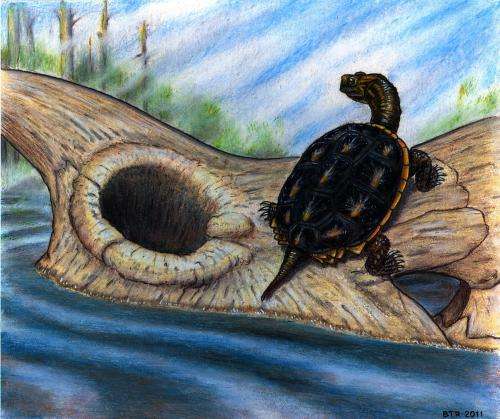
Reconstruction of the baenid turtle Boremys basking on a Triceratops dinosaur skull. Boremys was one of several turtles that survived the asteroid impact that killed the dinosaurs (other than birds) at the end of the Cretaceous Period. Illustration by Brian T. Roach, Yale Peabody Museum.

(PhysOrg.com) -- New fossil localities from North Dakota and Montana have produced the remains of a turtle that survived the 65 million-year-old meteorite impact that wiped out the dinosaurs. The resulting study, published in the latest issue of the Journal of Vertebrate Paleontology, suggests that Boremys, a turtle that belongs to a group known as the baenids (bay-een-ids) survived the extinction event unharmed. Baenids are a group of extinct river turtles native to North America that flourished from approximately 80 million to 42 million years ago.

The lead author, Tyler Lyson from Yale University, has been collecting turtles from the western United States for years, and immediately realized the importance of these new , "This find further confirms that turtles were not fazed by the meteorite that killed the 65 million years-ago."

The survival of turtles during this massive appears counterintuitive with what we know about other organisms. While other groups of animals show high rates of extinction at the /Paleocene (K/T) boundary 65-million-years ago, this new discovery provides more data indicating that turtles were largely unaffected by the meteorite impact. Lyson and colleagues found that if you just looked at turtles during this time, you would not even notice that one of the largest extinction events in Earth’s history had occurred.

The researchers recovered the new Boremys turtle remains from rocks in southwestern North Dakota and eastern Montana. These rock formations, known as the Hell Creek and Fort Union, respectively, have been actively collected for fossils by paleontologists for more than 100 years. This new study proves that even in well-searched localities, new fossil discoveries can still be uncovered. Co-author Dr. Walter Joyce acknowledged his surprise with the , "At first I did not believe Tyler when he told me that he had found Boremys in Paleocene deposits."
Tough turtles survive cretaceous meteorite impact
Enlarge

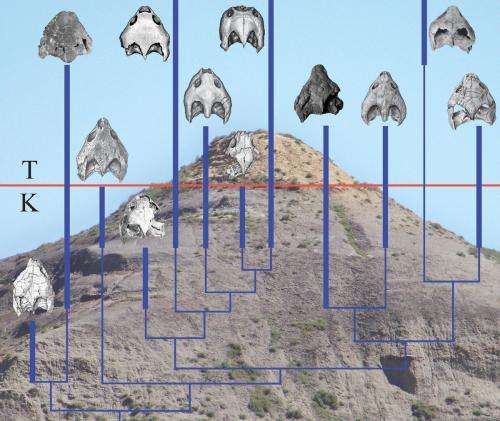
Diagram of the many types of turtles that survived the K/T extinction event. The skulls of these turtles are illustrated (as viewed from above) as are their fossil record (thick blue bars) and evolutionary relationships (thin lines connecting bars). The red line marks the extinction event, and is matched with the photographic of the geologic section in the background. The rocks below the red line were deposited during the Age of Dinosaurs (Mesozoic Era), whereas those above the line were deposited at the beginning of the Age of Mammals (Cenozoic Era). Note that eight different lineages of turtles survived the event, while only two went extinct at the event. Image courtesy of Erik Freeman.

Lyson and his co-authors believe that features of the shell of Boremys did not help its chances of preservation in the fossil record. The turtle had very thin shell bones relative to other baenids, and they remained unfused throughout the turtle’s life. These features likely led to its skeleton being scattered after death, making the chances of a whole shell being preserved very low. The authors also noted that the features of the shell were very similar to another turtle species living at the same time, which lead to initial misidentification.

With the discovery of this turtle, Lyson and his colleagues can now say that at least eight types of baenid turtles survived the that killed so many other animals.

More information: LYSON, T. R., W. G. JOYCE, G. E. KNAUSS, AND D. A. PEARSON. 2011. BOREMYS (TESTUDINES, BAENIDAE) FROM THE LATEST CRETACEOUS AND EARLY PALEOCENE OF NORTH DAKOTA: AN 11-MILLION-YEAR RANGE EXTENSION AND AN ADDITIONAL K/T SURVIVOR. JOURNAL OF VERTEBRATE PALEONTOLOGY 31(4):1-9. http://www.tandfon … vp20/current

Provided by Society of Vertebrate Paleontology

Filter


Move the slider to adjust rank threshold, so that you can hide some of the comments.


Display comments: newest first

jsa09
Jul 12, 2011

Rank: not rated yet
I wish they would stop calling tortoises by the name turtle. I was looking for a fresh water turtle and only found a standard tortoise.
Rank 4 /5 (1 vote)
Relevant PhysicsForums posts

More news stories

Change in developmental timing was crucial in the evolutionary shift from dinosaurs to birds: study

At first glance, it's hard to see how a common house sparrow and a Tyrannosaurus Rex might have anything in common. After all, one is a bird that weighs less than an ounce, and the other is a dinosaur that ...

Other Sciences / Archaeology & Fossils

created 35 minutes ago | popularity 5 / 5 (1) | comments 0 | with audio podcast

Social welfare cuts ultimately come with heavy price, researchers say

(Phys.org) -- Slashing government funding for Medicaid, food stamps and other programs that serve the poor – while politically popular with some lawmakers and many conservatives – may do more harm ...

Other Sciences / Social Sciences

created May 24, 2012 | popularity 4.3 / 5 (16) | comments 149

Ancient Bethlehem seal unearthed in Jerusalem

Israeli archaeologists have discovered a 2,700-year-old seal that bears the inscription "Bethlehem," the Israel Antiquities Authority announced Wednesday, in what experts believe to be the oldest artifact ...

Other Sciences / Archaeology & Fossils

created May 23, 2012 | popularity 3.5 / 5 (14) | comments 23

Oldest Jewish archaeological evidence on the Iberian Peninsula

German archaeologists of the Friedrich Schiller University Jena found one of the oldest archaeological evidence so far of Jewish Culture on the Iberian Peninsula at an excavation site in the south of Portugal, ...

Other Sciences / Archaeology & Fossils

created May 25, 2012 | popularity 4.3 / 5 (4) | comments 12

Dollars and sense: Why are some people morally against tax?

As the U.S. presidential election campaigns heat up, the economic debate is dominated by bailouts, austerity and, inevitably, taxation. Now a new study published in Symbolic Interaction asks why tax is such an important issue ...

Other Sciences / Social Sciences

created May 23, 2012 | popularity 3 / 5 (2) | comments 12


Computer model used to pinpoint prime materials for efficient carbon capture

When power plants begin capturing their carbon emissions to reduce greenhouse gases – and to most in the electric power industry, it's a question of when, not if – it will be an expensive undertaking.

'Unzipped' carbon nanotubes could help energize fuel cells, batteries

Multi-walled carbon nanotubes riddled with defects and impurities on the outside could replace some of the expensive platinum catalysts used in fuel cells and metal-air batteries, according to scientists at ...

T cells 'hunt' parasites like animal predators seek prey, study shows

By pairing an intimate knowledge of immune-system function with a deep understanding of statistical physics, a cross-disciplinary team at the University of Pennsylvania has arrived at a surprising finding: T cells use a movement ...

Manufacturing genes to attack flu virus

An international research team has manufactured a new protein that can combat deadly flu epidemics.

Yale study concludes public apathy over climate change unrelated to science literacy

Are members of the public divided about climate change because they don't understand the science behind it? If Americans knew more basic science and were more proficient in technical reasoning, would public consensus match ...

Same gene that stunts infants' growth also makes them grow too big: research

UCLA geneticists have identified the mutation responsible for IMAGe* syndrome, a rare disorder that stunts infants' growth. The twist? The mutation occurs on the same gene that causes Beckwith-Wiedemann syndrome, which makes ...