Strep infections responsible for groper deaths
July 20, 2011

Strep infections responsible for groper deaths

Enlarge

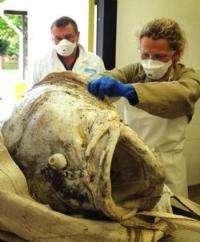
Groper death mystery: UQ researchers are conducting autopsies on a gropers that are found washed up along Queensland's coastline.

Researchers are in a race against time to save Queensland's protected groper fish, which are washing up dead along the beaches of Northern Queensland in increasing numbers.

Associate Professor Andy Barnes, from The University of Queensland's (UQ) School of Biological Sciences, has teamed up with Dr. Rachel Bowater from the State Veterinary Laboratory in Townsville and Dr's Nouri Ben Zakour and Scott Beatson from UQ's Australian Research Centre to find out what is causing the fish deaths.

Research indicates the species Streptococcus agalactiae is responsible for the death of the groper fish, although the underlying cause behind the infectious nature of this micro-organism is yet to be determined.

“We need a better understanding of the groper's immune system, where the bacteria come from, and how and why they cause diseases in gropers and other marine animals,” Dr. Barnes said.

“We are in the process of sequencing 20 complete genomes from strains of the bacteria from gropers and other marine animals and comparing them with those found in humans and other warm blooded animals,” he said.

“We expect the results to yield fresh insights into how these bacteria evolved to be pathogenic, giving us a chance to counteract the effects.”

Dr. Barnes said group B Streptococcus colonises the urogenital tract of a large number of the female human population, but is usually benign.

Since 2007, 91 gropers have been found dead along beaches in QLD, mainly around Cairns, Port Douglas and Townsville. Deaths have also been recorded from the Brisbane River in the south to Karumba in the Gulf of Carpentaria in the state's north.

Dr. Barnes said that as many of the deaths occurred in remote locations, obtaining diagnostic samples has been difficult, but the Streptococcus bacterium was isolated from more than 10 of these cases.

Gropers were spawned for the first time in captivity at the Northern Fishery Centre in Cairns and are now being reared in the aquarium at UQ's St Lucia campus as part of the investigation into the ongoing deaths.

The Queensland groper fish, a protected species, is one of the largest reef-dwelling fish in the world and grows up to 3m in length. Curious and tame by nature, they are a favourite among divers.

Provided by University of Queensland search and more info website


Rank not rated yet
Relevant PhysicsForums posts

More news stories

Manufacturing genes to attack flu virus

An international research team has manufactured a new protein that can combat deadly flu epidemics.

Biology / Biotechnology

created 34 minutes ago | popularity not rated yet | comments 0 | with audio podcast

Scientist: Evolution debate will soon be history

(AP) -- Richard Leakey predicts skepticism over evolution will soon be history. Not that the avowed atheist has any doubts himself.

Biology / Evolution

created 19 hours ago | popularity 3.3 / 5 (18) | comments 69

More plant species responding to global warming than previously thought

(Phys.org) -- Far more wild plant species may be responding to global warming than previous large-scale estimates have suggested.

Biology / Ecology

created May 22, 2012 | popularity 4.6 / 5 (14) | comments 18 | with audio podcast

Thousands of shellfish found dead in Peru

Thousands of crustaceans were found dead off the coast of Lima following the mystery mass death of dolphins and pelicans, the Peruvian Navy said Friday.

Biology / Ecology

created May 26, 2012 | popularity 4.8 / 5 (4) | comments 7

For monogamous sparrows, it doesn't pay to stray (but they do it anyway)

It's quite common for a female song sparrow to stray from her breeding partner and mate with the male next door, but a new study shows that sleeping around can be costly.

Biology / Plants & Animals

created May 22, 2012 | popularity 5 / 5 (2) | comments 7 | with audio podcast


Change in developmental timing was crucial in the evolutionary shift from dinosaurs to birds: study

At first glance, it's hard to see how a common house sparrow and a Tyrannosaurus Rex might have anything in common. After all, one is a bird that weighs less than an ounce, and the other is a dinosaur that ...

Computer model used to pinpoint prime materials for efficient carbon capture

When power plants begin capturing their carbon emissions to reduce greenhouse gases – and to most in the electric power industry, it's a question of when, not if – it will be an expensive undertaking.

'Unzipped' carbon nanotubes could help energize fuel cells, batteries

Multi-walled carbon nanotubes riddled with defects and impurities on the outside could replace some of the expensive platinum catalysts used in fuel cells and metal-air batteries, according to scientists at ...

T cells 'hunt' parasites like animal predators seek prey, study shows

By pairing an intimate knowledge of immune-system function with a deep understanding of statistical physics, a cross-disciplinary team at the University of Pennsylvania has arrived at a surprising finding: T cells use a movement ...

Yale study concludes public apathy over climate change unrelated to science literacy

Are members of the public divided about climate change because they don't understand the science behind it? If Americans knew more basic science and were more proficient in technical reasoning, would public consensus match ...

Same gene that stunts infants' growth also makes them grow too big: research

UCLA geneticists have identified the mutation responsible for IMAGe* syndrome, a rare disorder that stunts infants' growth. The twist? The mutation occurs on the same gene that causes Beckwith-Wiedemann syndrome, which makes ...