Soft memory device opens door to new biocompatible electronics (w/ Video)
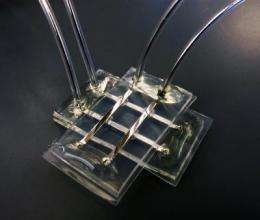
Conventional electronics are typically made of rigid, brittle materials and don't function well in a wet environment. "Our memory device is soft and pliable, and functions extremely well in wet environments -- similar to the human brain," says researcher Michael Dickey. Credit: Michael Dickey, North Carolina State University
Researchers from North Carolina State University have developed a memory device that is soft and functions well in wet environments opening the door to a new generation of biocompatible electronic devices.
"We've created a memory device with the physical properties of Jell-O," says Dr. Michael Dickey, an assistant professor of chemical and biomolecular engineering at NC State and co-author of a paper describing the research.
Conventional electronics are typically made of rigid, brittle materials and don't function well in a wet environment. "Our memory device is soft and pliable, and functions extremely well in wet environments similar to the human brain," Dickey says.
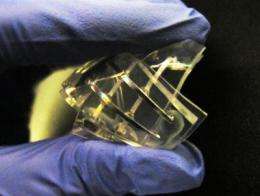
Researchers have created a memory device with the physical properties of Jell-O, and that functions well in wet environments. Credit: Michael Dickey, North Carolina State University
Prototypes of the device have not yet been optimized to hold significant amounts of memory, but work well in environments that would be hostile to traditional electronics. The devices are made using a liquid alloy of gallium and indium metals set into water-based gels, similar to gels used in biological research.The device's ability to function in wet environments, and the biocompatibility of the gels, mean that this technology holds promise for interfacing electronics with biological systems such as cells, enzymes or tissue. "These properties may be used for biological sensors or for medical monitoring," Dickey says.
This video is not supported by your browser at this time.
The individual components of the "mushy" memory device have two states: one that conducts electricity and one that does not. These two states can be used to represent the 1s and 0s used in binary language. Most conventional electronics use electrons to create these 1s and 0s in computer chips. The mushy memory device uses charged molecules called ions to do the same thing. Credit: Michael Dickey, North Carolina State University
The device functions much like so-called "memristors," which are vaunted as a possible next-generation memory technology. The individual components of the "mushy" memory device have two states: one that conducts electricity and one that does not. These two states can be used to represent the 1s and 0s used in binary language. Most conventional electronics use electrons to create these 1s and 0s in computer chips. The mushy memory device uses charged molecules called ions to do the same thing.In each of the memory device's circuits, the metal alloy is the circuit's electrode and sits on either side of a conductive piece of gel. When the alloy electrode is exposed to a positive charge it creates an oxidized skin that makes it resistive to electricity. We'll call that the 0. When the electrode is exposed to a negative charge, the oxidized skin disappears, and it becomes conducive to electricity. We'll call that the 1.
Normally, whenever a negative charge is applied to one side of the electrode, the positive charge would move to the other side and create another oxidized skin meaning the electrode would always be resistive. To solve that problem, the researchers "doped" one side of the gel slab with a polymer that prevents the formation of a stable oxidized skin. That way one electrode is always conducive giving the device the 1s and 0s it needs for electronic memory.
Provided by
North Carolina State University
-
From lemons to lemonade: Reaction uses carbon dioxide to make carbon-based semiconductor,
32 comments
-
Thioridazine kills cancer stem cells in human while avoiding toxic side-effects of conventional cancer treatments,
3 comments
-
SpaceX private rocket blasts off for space station (Update),
42 comments
-
Climate scientists say they have solved riddle of rising sea,
31 comments
-
SpaceX capsule has 'new car' smell, astronauts say (Update),
2 comments
-
Water flow question
41 minutes ago
-
[Drift velocity] Factors affecting velocity
3 hours ago
-
does cold gasoline have less energy
4 hours ago
-
distribution of molecules throughout the atmosphere
5 hours ago
-
The Global Positioning System !
7 hours ago
-
A Question relating Power
8 hours ago
- More from Physics Forums - General Physics
More news stories
In nanorod crystal growth, nanoparticles seen as artificial atoms
In the growth of crystals, do nanoparticles act as "artificial atoms" forming molecular-type building blocks that can assemble into complex structures? This is the contention of a major but controversial theory ...
May 24, 2012 |
4.8 / 5 (6) |
0
|
First direct observation of oriented attachment in nanocrystal growth
Berkeley Lab researchers have reported the first direct observation of nanoparticles undergoing oriented attachment, the critical step in biomineralization and the growth of nanocrystals. A better understanding ...
May 24, 2012 |
4.7 / 5 (3) |
0
|
Dopant gives graphene solar cells highest efficiency yet
(Phys.org) -- By taking advantage of graphenes favorable electrical and optical properties, and then adding an organic dopant, researchers have achieved the highest power conversion efficiency yet for ...
Synthetic nano-waste does not disappear
(Phys.org) -- Tiny particles of cerium oxide do not burn or change in the heat of a waste incineration plant. They remain intact on combustion residues or in the incineration system, as a new study by Swiss ...
Nanotechnology / Bio & Medicine
May 25, 2012 |
5 / 5 (2) |
1
|
'Metamaterials,' quantum dots show promise for new technologies
(Phys.org) -- Researchers are edging toward the creation of new optical technologies using "nanostructured metamaterials" capable of ultra-efficient transmission of light, with potential applications including ...
May 24, 2012 |
5 / 5 (7) |
1
|
Nvidia trumpets Tegra 3 phone design wins for 2012
(Phys.org) -- Nvidias competitive war paint has a name, Tegra 3. On the heels of Nvidia announcements about lowering costs of its Tegra 3 processors and Nvidia-enabled tablets running Android Ice Cream ...
Browser wars flare in mobile space
The browser wars are heating up again, but this time the fight is for dominance of the mobile Internet.
Scientist: Evolution debate will soon be history
(AP) -- Richard Leakey predicts skepticism over evolution will soon be history. Not that the avowed atheist has any doubts himself.
Dell tablet leak: 10.1-inch display, two-battery choice
(Phys.org) -- Headline after headline talks about vendors tablets in the wings as likely number-one contenders for the iPad. Such claims have justifiably been taken with a grain of salt, considering ...
Keep food safety in mind this memorial day weekend
(HealthDay) -- Picnics, parades and cookouts are as much a part of Memorial Day weekend as tributes to the United States' war veterans.
Social welfare cuts ultimately come with heavy price, researchers say
(Phys.org) -- Slashing government funding for Medicaid, food stamps and other programs that serve the poor while politically popular with some lawmakers and many conservatives may do more harm ...

Jul 15, 2011
Rank: not rated yet