With secondhand gene, 'freaky mouse' defeats common poison
July 21, 2011

'Freaky mouse' defeats common poison

Enlarge

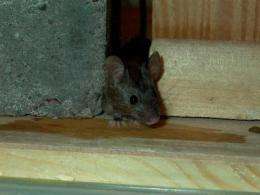
Rice University researchers found mice are adept at evolving traits that make them resistant to a particular rodent poison not only through point mutation but also through horizontal gene transfer. Credit: Stefan Endepols/Bayer CropScience AG

Over millennia, mice have thrived despite humanity's efforts to keep them at bay. A Rice University scientist argues some mice have found two ways to achieve a single goal -- resistance to common poison.

New research by Michael Kohn and colleagues, reported today in the online journal Current Biology, analyzes a genetic mutation that has given the ordinary European house mouse this extraordinary ability.

The gene in question, vkorc1, is present in all mammals and manages vitamin K. A mutation to vkorc1 makes mice resistant to warfarin, an anticoagulant used as a blood thinner in people as well as rodent poison.

Kohn, an associate professor of ecology and evolutionary biology at Rice, said the mice evolved to become poison-resistant following two distinct processes. In one, point mutation, genes adapt through spontaneous mutations during DNA replication. Algerian mice (Mus spretus), a desert-dwelling, seed-eating species, probably acquired the mutation this way to counter a vitamin K-deficient diet, Kohn said.

Evolution through point mutation is a textbook example of how populations adapt to new environments, he said. Because rodents reproduce so quickly, their adaptation to warfarin is one of the few that can be observed directly during the lifetimes of evolutionary geneticists.

The poisons were introduced in the early 1950s, and poison-resistant rodents began to appear in the 1960s.

The other process, horizontal gene transfer, is generally associated with microbes, not mammals, and has never been documented at the level of detail the new paper offers, Kohn said. Here, resistance seems to have been transferred directly from Algerian mice to European house mice (Mus musculus domesticus).

"A key element of this study is that we've caught evolution in the act," he said.

Mutated vkorc1 has been the subject of many studies, including one by Kohn that illustrated a downside all too familiar to humans, the risk of arterial calcification and osteoporosis.

A rodent pest-control specialist treating the basement of a German bakery found the first evidence that house mice had developed resistance to warfarin. "He said, 'I cannot kill these mice with bromadiolone,' a nasty version of warfarin," said Kohn, whose lab was asked to sequence mice for vkorc1. (He noted pest-control professionals have a variety of weapons to eliminate even warfarin-resistant species.)

Kohn reacted with disbelief when he looked at the sequences. "I said, 'This cannot be a common house mouse. What type of animal did you send me here?'"

Vkorc1 seemed out of place, he said. "The gene sequence was identical to Mus spretus, which looks similar to house mice but does not normally occur in Germany," he said. "We could see that a big chunk of their DNA looked like Mus spretus. But genetically, these obscure bromadiolone-resistant mice looked like ordinary house mice. This is a freaky mouse."

Kohn and colleagues speculated Algerian mice passed the resistant genome into house mice in Spain or North Africa deserts, where the species overlap geographically.

"In the very distant past, these mice wouldn't even meet," he said. "With the spread of agriculture thousands of years ago in the Fertile Crescent, humans brought mice with them -- unwillingly. That brought these two types of mice into contact, and they started doing their thing, hybridizing here and there."

Hybridization is usually an evolutionary dead end, because at least 50 percent of hybrid offspring mice are sterile. "Nature doesn't think hybrids are very useful unless something special happens, such as some sort of environmental change," Kohn said. "But on the rare occasion -- and I think we are the first to show this in an animal -- hybridization leads to a combination that is advantageous."

The sudden introduction of warfarin in the 1950s may have triggered the usually doomed hybrids to further adapt "by exploring the repertoire of mutations in the vkorc1 gene and also by experimenting with a copy of vkorc1 from Mus spretus," Kohn said.

"The fundamental question now is: Is this so difficult to accomplish that it only happened once, or is it so easy that it has happened on numerous occasions in numerous places?"

Kohn and his colleagues are in a unique position to see which version of resistance might prevail -- point mutation or gene transfer -- and whether mice will suffer the same arterial calcification as the mutant rats in Kohn's previous study.

"We may need to embrace the fact that animals are just as versatile as microbes and plants in developing new traits through hybridization," said Kohn, who expressed concern that humans' desire to kill a species only made the species stronger.

"The human factor in this study is quite clear," he said. "One of the gravest concerns to conservation of biodiversity is the inadvertent spread of invasive species across the globe. In this study, this test came in the form of our desire to extirpate so-called pest species with poisons, which we use to get rid of microbes, bugs, weeds and even some mammals."

More information: http://www.cell.co … 0960-9822(11)00716-0

Provided by Rice University search and more info website

4.3 /5 (3 votes)  

Filter


Move the slider to adjust rank threshold, so that you can hide some of the comments.


Display comments: newest first

Newbeak
Jul 21, 2011

Rank: not rated yet
Pretty soon,the only way to kill them will be to let loose mouse sized "terminator" robots to follow them home to their nests.
Isaacsname
Jul 21, 2011

Rank: not rated yet
HGT between mice ? Wow. Warfarin,... nothing's better than internally bleeding rodents everywhere,leaving trails of bloody mucus behind them before they crawl into their holes and die. And stink for weeks. Seriously can't believe people still use it. The stuff I used to see also looked identical to blue children's modeling clay, brilliant move.

Use electric traps, they can't evolve around that.
Shelgeyr
Jul 21, 2011

Rank: not rated yet
Hybridization is usually an evolutionary dead end, because at least 50 percent of hybrid offspring mice are sterile. "Nature doesn't think hybrids are very useful unless something special happens, such as some sort of environmental change,"


This is so wrong. The "at least 50% sterile" figure assumes random pairing between equal populations of species whose chromosome counts don't match, leading to offspring with half having an even number of chromosomes (virile), and half with an odd number (sterile). It is far more complex than that, with many more factors involved. Also, while most likely, how do they know that hybridization was how these mice acquired the gene? There are other vectors after all.

That said, I still want a Maltese Wolf - and that might not technically even be a hybrid!
Newbeak
Jul 21, 2011

Rank: not rated yet
Interesting,I didn't know they excreted bloody mucus before dying.I knew they died by internal hemmoraging,but not that.Electric traps are one solution,as are cats.
flicktheswitch
Jul 21, 2011

Rank: not rated yet
Nuke them from orbit... It's the only way to be sure. :O
Newbeak
Jul 21, 2011

Rank: not rated yet
How about swarming robots? It would just be a question of what to arm them with.Maybe .22 cal gatlings,just sayin..
Alburton
Jul 21, 2011

Rank: not rated yet
Killing-specialised swarming robots are the scariest shit ive heard in years!
Norezar
Jul 21, 2011

Rank: not rated yet
At least they're not feline "resistant."
Isaacsname
Jul 21, 2011

Rank: not rated yet
Interesting,I didn't know they excreted bloody mucus before dying.I knew they died by internal hemmoraging,but not that.Electric traps are one solution,as are cats.


I was doing some internships on various argricultural enterprises years back, we used it to clear out infestations.

They basically just crawl around for 2 or more days bleeding fluids, pretty nasty,imo.
Newbeak
Jul 21, 2011

Rank: not rated yet
Killing-specialised swarming robots are the scariest shit ive heard in years!

Seriously,swarming robots are worth considering.If robots to find buried victims in natural disasters work already,I don't see why a specialized swarm couldn't be turned loose to track down every mouse/rat in a defined area.The only question would be what to use to dispatch the rodents.
diva4d
Jul 22, 2011

Rank: 5 / 5 (1)
Killing-specialised swarming robots are the scariest shit ive heard in years!

Seriously,swarming robots are worth considering.If robots to find buried victims in natural disasters work already,I don't see why a specialized swarm couldn't be turned loose to track down every mouse/rat in a defined area.The only question would be what to use to dispatch the rodents.


Capture and process into catfood?
Telekinetic
Jul 22, 2011

Rank: not rated yet
If there's such a thing as karma for taking the lives of mice, I have a lot to answer to. I think a better idea would be to cross-breed mice with lemmings and supply them with a nice cliff.
MadLintElf
Jul 22, 2011

Rank: not rated yet
Roomba for Mice!

Newbeak
Jul 22, 2011

Rank: not rated yet


Capture and process into catfood?

Excellent idea.Only problem would be dragging them to a collection area.There would be no room onboard a robot small enough to enter rat/mouse burrows.
Waterdog
Jul 25, 2011

Rank: not rated yet
Who needs robots, I've got a good cat (and no mice or rats) They will never be resistant to Rex King of Cats. he's a killing machine.
Newbeak
Jul 25, 2011

Rank: not rated yet
Who needs robots, I've got a good cat (and no mice or rats) They will never be resistant to Rex King of Cats. he's a killing machine.

I agree.I had a cat that would kill anything smaller than himself.Problem is,the cat can't fit into rat holes.Robots could be designed to do that.
Rank 4.3 /5 (3 votes)
Relevant PhysicsForums posts

More news stories

Scientist: Evolution debate will soon be history

(AP) -- Richard Leakey predicts skepticism over evolution will soon be history. Not that the avowed atheist has any doubts himself.

Biology / Evolution

created 17 hours ago | popularity 3.3 / 5 (17) | comments 51

More plant species responding to global warming than previously thought

(Phys.org) -- Far more wild plant species may be responding to global warming than previous large-scale estimates have suggested.

Biology / Ecology

created May 22, 2012 | popularity 4.6 / 5 (14) | comments 18 | with audio podcast

Thousands of shellfish found dead in Peru

Thousands of crustaceans were found dead off the coast of Lima following the mystery mass death of dolphins and pelicans, the Peruvian Navy said Friday.

Biology / Ecology

created May 26, 2012 | popularity 4.8 / 5 (4) | comments 7

For monogamous sparrows, it doesn't pay to stray (but they do it anyway)

It's quite common for a female song sparrow to stray from her breeding partner and mate with the male next door, but a new study shows that sleeping around can be costly.

Biology / Plants & Animals

created May 22, 2012 | popularity 5 / 5 (2) | comments 7 | with audio podcast

Study uncovers secret to speedy burrowing by razor clams

(Phys.org) -- If you look at a razor burrowing clam sitting in a bucket, you’d never guess that it could burrow itself down into the soil, much less do it with any speed. Razor clams look like fat straws, ...

Biology / Plants & Animals

created May 25, 2012 | popularity 1 / 5 (1) | comments 3 | with audio podcast report


Nvidia trumpets Tegra 3 phone design wins for 2012

(Phys.org) -- Nvidia’s competitive war paint has a name, Tegra 3. On the heels of Nvidia announcements about lowering costs of its Tegra 3 processors and Nvidia-enabled tablets running Android Ice Cream ...

Browser wars flare in mobile space

The browser wars are heating up again, but this time the fight is for dominance of the mobile Internet.

Dell tablet leak: 10.1-inch display, two-battery choice

(Phys.org) -- Headline after headline talks about vendors’ tablets in the wings as likely number-one contenders for the iPad. Such claims have justifiably been taken with a grain of salt, considering ...

Keep food safety in mind this memorial day weekend

(HealthDay) -- Picnics, parades and cookouts are as much a part of Memorial Day weekend as tributes to the United States' war veterans.

Social welfare cuts ultimately come with heavy price, researchers say

(Phys.org) -- Slashing government funding for Medicaid, food stamps and other programs that serve the poor – while politically popular with some lawmakers and many conservatives – may do more harm ...

Is a classical electrodynamics law incompatible with special relativity?

(Phys.org) -- The laws of classical electromagnetism that were developed in the 19th century are the same laws that scientists use today. They include Maxwell’s four equations along with the Lorentz la ...