Safer skies: New algorithm could help prevent midair collisions
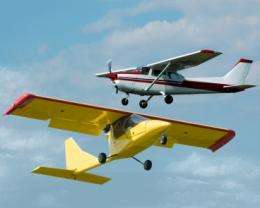
The Federal Aviation Administration (FAA) has mandated that by 2020, all commercial aircraft — and small aircraft flying near most airports — must be equipped with a new tracking system that broadcasts GPS data, providing more accurate location information than ground-based radar. In anticipation of the deadline, the FAA has also charged MIT researchers with leading an investigation of the system's limits and capacities.
In October, at the 30th Digital Avionics Systems Conference in Seattle, MIT researchers will present an early result of that investigation, a new algorithm that uses data from the tracking system to predict and prevent collisions between small aircraft. In the last 10 years alone, 112 small planes have been involved in midair collisions, and thousands more have reported close calls.
The chief challenge in designing a collision-detection algorithm, says Maxime Gariel, a postdoc in MIT's International Center for Air Transportation and lead author on the new paper, is limiting false alarms. "If half the time it's a false alert," Gariel says, "[people] are not going to listen to it, or they'll turn it off." At the same time, the algorithm has to have some room for error: While GPS is more accurate than radar tracking, it's not perfect; nor are the communications channels that planes would use to exchange location information. Moreover, any prediction of a plane's future position can be thrown off by unexpected changes of trajectory.
Puckish predictions
Much of the work on the new algorithm thus involved optimizing the trade-off between error tolerance and false alarms. Gariel and his collaborators — John Hansman, the T. Wilson (1953) Professor of Aeronautics and Astronautics and Engineering Systems, and Emilio Frazzoli, an associate professor of aeronautics and astronautics — adopted a two-tiered system of alerts: A moderate alert would warn pilots that their trajectories are converging, and a high alert would indicate a severe risk of collision.
Associated with each alert is a volume of space around each plane, which Gariel describes as a "hockey puck," that describes the plane's probable position given a certain GPS reading. (The volume is puck-shaped because planes tend to move vertically much more slowly than they do horizontally.) The hockey puck that corresponds to the high alert is smaller and of fixed size. The hockey puck that corresponds to the moderate alert is larger and fluctuates according to planes' trajectories.
For instance, if two planes are headed in the same direction, their moderate-alert hockey pucks are relatively small; but if they're headed toward each other, their hockey pucks are larger, since they'll have much less time to react to an impending collision. If an extrapolation from two planes' recent trajectories suggests that either set of hockey pucks will intersect, the system issues the corresponding alert.
To calculate the optimal puck sizes, Gariel used six months' worth of data from airports in the San Francisco area. But in testing the algorithm's utility, the researchers had the advantage of a very accurate computer model of air traffic created by researchers at MIT's Lincoln Laboratory. Based on more than eight months of data from all the aviation radar systems in the United States, the Lincoln Lab model generates random trajectories for hypothetical aircraft that accord very well with real-world statistics. Working together with Fabrice Kunzi, a graduate student in Hansman's group, Gariel and his colleagues tested their algorithm against the Lincoln Lab model and found that, indeed, it had a low false-alarm rate.
Model behavior
David Gray, the FAA's lead on the project, explains that while the agency will require small aircraft to broadcast their GPS coordinates by 2020, it hasn't yet mandated that they install equipment for receiving and processing such broadcasts. "One of the key things that we want to provide as part of this system is additional value to the general-aviation [small-plane] pilot," Gray says. "We hope it adds value and tips the scale in the direction of saying, 'Yes, this is something that I want.'"
Gray has not yet had the opportunity to review the MIT researchers' results in detail, but says that "from the limited data I've seen, it seems that the algorithms that they're looking at are performing better than the algorithms that are in existing systems that can be bought today." He points out, however, that the Lincoln Lab air-traffic model is based on radar data, and that small planes often fly below radar — particularly near airports, where nearly 60 percent of midair collisions take place. "They're using the model for the scenarios that it's applicable for," Gray says, "and I think that's going to be great. But for the scenarios that it's not applicable for, they're going to have to develop other scenarios for us to assess."
Indeed, Gariel and Kunzi are working to develop a new computer model that takes into account the standard flight paths that small aircraft tend to fall into near airports, to see if the collision-detection algorithm still performs as well. They're also hoping to begin testing the algorithm on real planes.
Provided by Massachusetts Institute of Technology


