Opportunity rover tops 20 miles of Mars driving
July 20, 2011 By Guy Webster

NASA's opportunity tops 20 miles of Mars driving

Enlarge

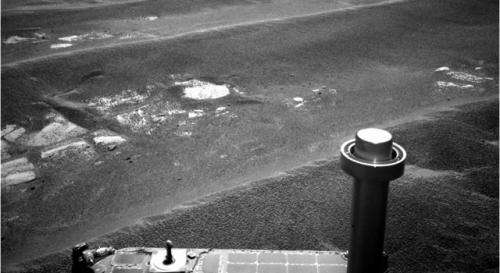
NASA's Mars Exploration Rover Opportunity used its navigation camera to record this view in the eastward driving direction after completing a drive on July 17, 2011, that took the rover's total driving distance on Mars beyond 20 miles. Credit: NASA/JPL-Caltech

(PhysOrg.com) -- More than seven years into what was planned as a three-month mission on Mars, NASA's Mars Exploration Rover Opportunity has driven more than 20 miles, which is more than 50 times the mission's original distance goal.

A drive of 407 feet (124 meters) completed on July 17 took Opportunity past the 20-mile mark (32.2 kilometers). It brought the to within a few drives of reaching the rim of Endeavour crater, the rover's team's long-term destination since mid-2008. Endeavour is about 14 miles (22 kilometers) in diameter, and its western rim exposes outcrops that record information older than any Opportunity has examined so far. The rover is now about eight-tenths of a mile (about 1.3 kilometers) from the site chosen for arriving at the rim.

"The numbers aren't really as important as the fact that driving so much farther than expected during this mission has put a series of exciting destinations within Opportunity's reach," said Alfonso Herrera, a rover mission manager at NASA's Jet Propulsion Laboratory, Pasadena, Calif. who has worked on the rover missions since before launch in 2003.

The latest drive included an autonomous hazard detection portion during which the rover paused at intervals to check for obstacles before proceeding.

Herrera said, "Autonomous hazard detection has added a significant portion of the driving distance over the past few months. It lets us squeeze 10 to 15 percent more distance into each drive."

The milestone-setting drive was on the 2,658th Martian day, or "sol," of the rover's exploration of Mars. Opportunity drove backward. Backward driving is a technique to extend the life of a motor in the right-front wheel that sometimes draws more current than the other five wheels' drive motors.

JPL's Bill Nelson, chief of the mission's engineering team, said, "Opportunity has an arthritic shoulder joint on her and is a little lame in the right front wheel, but she is otherwise doing remarkably well after seven years on Mars -- more like 70 in 'rover years.' The elevated right front wheel current is a concern, but a combination of heating and backwards driving has kept it in check over the past 2,000-plus sols."

Opportunity and its rover twin, Spirit, completed their three-month prime missions on Mars in April 2004. Both rovers continued for years of bonus, extended missions. Spirit finished communicating with Earth in March 2010. Both rovers have made important discoveries about wet environments on ancient that may have been favorable for supporting microbial life.

Provided by JPL/NASA search and more info website

Filter


Move the slider to adjust rank threshold, so that you can hide some of the comments.


Display comments: newest first

hb_
Jul 20, 2011

Rank: 1 / 5 (4)
It's great that the rover has traveled 50 times farther than for what it was designed. But, as speed goes, 20 miles in 7 years is hardly impressive. What is it that makes it so increadibly difficult to make a rower that can travel a few miles a week on solar power?
BradynStanaway
Jul 20, 2011

Rank: 5 / 5 (4)
"What is it that makes it so increadibly difficult to make a rower that can travel a few miles a week on solar power?"

The fact that its on another planet, with extreme weather/temperature differences.
conan1st
Jul 20, 2011

Rank: 5 / 5 (2)
"What is it that makes it so increadibly difficult to make a rower that can travel a few miles a week on solar power?"

the considerable lag/communications delay between jpl & the rover.
jscroft
Jul 20, 2011

Rank: 5 / 5 (2)
"What is it that makes it so increadibly difficult to make a rower that can travel a few miles a week on solar power?"

The impossibility of fixing the thing if they really screw it up.
Isaacsname
Jul 20, 2011

Rank: not rated yet
How about a windshield wiper on the panels ?
CapitalismPrevails
Jul 20, 2011

Rank: not rated yet
What is it that makes it so increadibly difficult to make a rower that can travel a few miles a week on solar power?


The fact that mars is farther from the Sun than Earth is. Therefor, the planet receives less sunlight.
dan42day
Jul 21, 2011

Rank: not rated yet
What is it that makes it so increadibly difficult to make a rower that can travel a few miles a week on solar power?


There are no roads on Mars, it is an unforgiving obstacle course. Combine that with the lag in communications mentioned above, and the lack of trustworthy automomous navigation systems (especially before 2003), and it becomes a little difficult. Even at these incredibly slow speeds,we've already lost one rover by getting it stuck.
Kafpauzo
Jul 21, 2011

Rank: not rated yet
What is it that makes it so increadibly difficult to make a rower that can travel a few miles a week on solar power?


Faster mechanical systems would also wear down more, they would deteriorate faster.

Although a higher speed would have a couple of advantages, still, speed is the least important factor among a huge lot of factors that must be considered for this kind of machine.
antialias_physorg
Jul 21, 2011

Rank: 5 / 5 (1)
Add tho that: What'sthe point of going faster? There are so many interesting things within a few centimeters of the rover - why should it head on over next hill at top speed?
(And as someone mentioned: what happens if you turn it on its side? At a cost of nearly a billion dollars for the whole mission NASA is right to ba a bit careful with its toys - imagine the press if they screwed it up just because someone wanted to zip accross the Martian landscape)
Faster mechanical systems would also wear down more, they would deteriorate faster.

That one is not really an argument. I think we can manufacture stuff that lasts 20 (or 100) miles without wearing out at most any speed.
TheGhostofOtto1923
Jul 24, 2011

Rank: not rated yet
Drivers on earth decide which way to go. They plot a course to safely get to a milestone. They go there, stop, look around, analyse what they see, and discuss the course to the next milestone. If they need to they scratch the dirt and do some science. They dont travel farther than they can see.

This is driving by committee which is located on another planet. These are not moon buggys.
barakn
Aug 21, 2011

Rank: 1 / 5 (1)
How about a windshield wiper on the panels ?

Because the dry dust would scratch the surface. A 100 micron particle could leave a path of destruction a 1000 times longer than its own width.
Rank 5 /5 (6 votes)
Relevant PhysicsForums posts
  • revamping general concept and cosmological principle
    createdMay 25, 2012
  • Transiting Exoplanet Light Curve
    createdMay 25, 2012
  • Math behind Theoretical Physics
    createdMay 24, 2012
  • Do we know whats at the center of galaxies yet?
    createdMay 23, 2012
  • Structure of the Milky Way?
    createdMay 20, 2012
  • What would it take to terraform Pluto and Charon?
    createdMay 19, 2012
  • More from Physics Forums - General Astronomy

More news stories

Sophisticated simulations predict future warming

The chances of our planet being hit by a global warming of 3 degrees Celsius by 2050 is as likely as it being hit by an increase of 1.4 degrees, new research shows. Presented in the journal Nature Geoscience, the British study ...

Space & Earth / Earth Sciences

created May 22, 2012 | popularity 4.4 / 5 (9) | comments 51

Kyoto Protocol architect 'frustrated' by climate dialogue

UN climate talks are going nowhere, as politicians dither or bicker while the pace of warming dangerously speeds up, one of the architects of the Kyoto Protocol told AFP.

Space & Earth / Environment

created May 23, 2012 | popularity 3.7 / 5 (7) | comments 39

Aliens don't want to eat us, says former SETI director

Alien life probably isn’t interested in having us for dinner, enslaving us or laying eggs in our bellies, according to a recent statement by former SETI director Jill Tarter.

Space & Earth / Space Exploration

created May 25, 2012 | popularity 4.4 / 5 (13) | comments 37

Dragon arrives at space station in historic 1st (Update 2)

The privately bankrolled Dragon capsule made a historic arrival at the International Space Station on Friday, triumphantly captured by astronauts wielding a giant robot arm.

Space & Earth / Space Exploration

created May 25, 2012 | popularity 5 / 5 (10) | comments 19

What's the big deal about private space launches?

(AP) -- The first private spaceship is headed to the International Space Station. Some questions and answers about the cargo mission by Space Exploration Technologies, known as SpaceX:

Space & Earth / Space Exploration

created May 22, 2012 | popularity 5 / 5 (6) | comments 35


Browser wars flare in mobile space

The browser wars are heating up again, but this time the fight is for dominance of the mobile Internet.

Nvidia trumpets Tegra 3 phone design wins for 2012

(Phys.org) -- Nvidia’s competitive war paint has a name, Tegra 3. On the heels of Nvidia announcements about lowering costs of its Tegra 3 processors and Nvidia-enabled tablets running Android Ice Cream ...

Scientist: Evolution debate will soon be history

(AP) -- Richard Leakey predicts skepticism over evolution will soon be history. Not that the avowed atheist has any doubts himself.

Dell tablet leak: 10.1-inch display, two-battery choice

(Phys.org) -- Headline after headline talks about vendors’ tablets in the wings as likely number-one contenders for the iPad. Such claims have justifiably been taken with a grain of salt, considering ...

Keep food safety in mind this memorial day weekend

(HealthDay) -- Picnics, parades and cookouts are as much a part of Memorial Day weekend as tributes to the United States' war veterans.

Social welfare cuts ultimately come with heavy price, researchers say

(Phys.org) -- Slashing government funding for Medicaid, food stamps and other programs that serve the poor – while politically popular with some lawmakers and many conservatives – may do more harm ...