NASA spacecraft to enter asteroid's orbit today
Jul 15, 2011 By Priscilla Vega, Jia-Rui Cook and Dwayne C. Brown
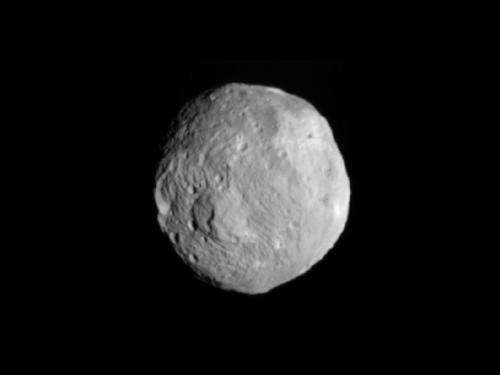
NASA's Dawn spacecraft obtained this image of the giant asteroid Vesta with its framing camera on July 9, 2011. Credit: NASA/JPL-Caltech/UCLA/MPS/DLR/IDA

Today, NASA's Dawn spacecraft will begin a prolonged encounter with the asteroid Vesta, making the mission the first to enter orbit around a main-belt asteroid.

The lies between the orbits of Mars and . Dawn will study Vesta for one year, and observations will help scientists understand the earliest chapter of our solar system's history.

As the spacecraft approaches Vesta, surface details are coming into focus, as seen in a recent image taken from a distance of about 26,000 miles (41,000 kilometers).

Engineers expect the spacecraft to be captured into orbit at approximately 10 p.m. PDT Friday, July 15 (1 a.m. EDT Saturday, July 16). They expect to hear from the spacecraft and confirm that it performed as planned during a scheduled communications pass that starts at approximately 11:30 p.m. PDT on Saturday, July 16 (2:30 a.m. EDT Sunday, July 17). When Vesta captures Dawn into its orbit, engineers estimate there will be approximately 9,900 miles (16,000 kilometers) between them. At that point, the spacecraft and asteroid will be approximately 117 million miles (188 million kilometers) from Earth.

"It has taken nearly four years to get to this point," said Robert Mase, Dawn project manager at NASA's Jet Propulsion Laboratory in Pasadena, Calif. "Our latest tests and check-outs show that Dawn is right on target and performing normally."

Engineers have been subtly shaping Dawn's for years to match Vesta's orbit around the sun. Unlike other missions, where dramatic propulsive burns put spacecraft into orbit around a planet, Dawn will ease up next to Vesta. Then the asteroid's gravity will capture the spacecraft into orbit. However, until Dawn nears Vesta and makes accurate measurements, the asteroid's mass and gravity will only be estimates. So the Dawn team will need a few days to refine the exact moment of orbit capture.

Launched in September 2007, Dawn will depart for its second destination, the dwarf planet Ceres, in July 2012. The spacecraft will be the first to two solar system destinations beyond Earth.

Dawn's mission to Vesta and Ceres is managed by JPL for NASA's Science Mission Directorate in Washington. Dawn is a project of the directorate's Discovery Program, which is managed by NASA's Marshall Space Flight Center in Huntsville, Ala. UCLA is responsible for overall Dawn mission science. Orbital Sciences Corp. of Dulles, Va., designed and built the spacecraft. The German Aerospace Center, the Max Planck Institute for Research, the Italian Space Agency and the Italian National Astrophysical Institute are part of the mission team.

Explore further: Field tests in Mojave Desert pave way for human exploration of small bodies

More information: www.nasa.gov/mission_pages/dawn/multimedia/dawn-image-070911.html

add to favorites email to friend print save as pdf

Related Stories

Dawn captures first image of nearing asteroid

May 11, 2011

(PhysOrg.com) -- NASA's Dawn spacecraft has obtained its first image of the giant asteroid Vesta, which will help fine-tune navigation during its approach. Dawn is expected to achieve orbit around Vesta on ...

Dawn moves closer to the asteroid belt

Sep 12, 2007

NASA's Dawn spacecraft has been positioned at Kennedy Space Center's launch pad 17B atop a Delta II rocket for its launch from Florida later this month.

Dawn Glides Into New Year

Nov 21, 2008

(PhysOrg.com) -- NASA's Dawn spacecraft shut down its ion propulsion system today as scheduled. The spacecraft is now gliding toward a Mars flyby in February of next year.

Dawn nears start of year-long stay at giant asteroid

Jun 24, 2011

(PhysOrg.com) -- NASA's Dawn spacecraft is on track to begin the first extended visit to a large asteroid. The mission expects to go into orbit around Vesta on July 16 and begin gathering science data in early ...

Dawn Enters Asteroid Belt -- For Good

Nov 16, 2009

(PhysOrg.com) -- NASA's Dawn spacecraft re-entered our solar system's asteroid belt today, Nov. 13, and this time it will stay there.

Recommended for you

Mars rover Opportunity examines clay clues in rock

19 hours ago

(Phys.org) —NASA's senior Mars rover, Opportunity, is driving to a new study area after a dramatic finish to 20 months on "Cape York" with examination of a rock intensely altered by water.

NASA's STEREO detects a CME from the sun

May 17, 2013

On 5:24 a.m. EDT on May 17, 2013, the sun erupted with an Earth-directed coronal mass ejection or CME, a solar phenomenon that can send billions of tons of solar particles into space that can reach Earth ...

Nine-year-old Mars rover passes 40-year-old record

May 17, 2013

While Apollo 17 astronauts Eugene Cernan and Harrison Schmitt visited Earth's moon for three days in December 1972, they drove their mission's Lunar Roving Vehicle 19.3 nautical miles (22.210 statute miles ...

Bright explosion on the Moon

May 17, 2013

For the past 8 years, NASA astronomers have been monitoring the Moon for signs of explosions caused by meteoroids hitting the lunar surface. "Lunar meteor showers" have turned out to be more common than anyone ...

User comments : 1

Adjust slider to filter visible comments by rank

Display comments: newest first

that_guy
not rated yet Jul 15, 2011
aww man, it just looks like a big gray rock!

More news stories

Galaxy's Ring of Fire

Johnny Cash may have preferred this galaxy's burning ring of fire to the one he sang about falling into in his popular song. The "starburst ring" seen at center in red and yellow hues is not the product of ...

Alaska volcano shoots ash 15,000 feet into the air

(AP)—One of Alaska's most restless volcanoes has shot an ash cloud 15,000 feet into the air in an ongoing eruption that has drawn attention from a nearby community but isn't expected to threaten air traffic.

Chinese, Indian airlines face EU pollution fines

Eight Chinese and two Indian airlines face fines of up to several million euros for not paying for their greenhouse gas emissions during flights within the bloc, the European Commission said on Friday.

US seizes Bitcoin operator accounts

US authorities seized the accounts of a Bitcoin digital currency exchange operator, claiming it was functioning as an "unlicensed money service business," court documents showed Friday.

Morocco to harness the wind in energy hunt

Morocco is ploughing ahead with a programme to boost wind energy production, particularly in the southern Tarfaya region, where Africa's largest wind farm is set to open in 2014.