Long-distance swims may cause polar bear problems
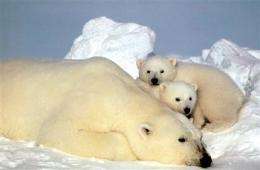
Polar bears forced to swim longer distances because of diminished sea ice off Alaska's coast may be paying a price in lost cubs or precious calories, according to a study by the U.S. Geological Survey.
The study reviewed data from female polar bears in the Chukchi and southern Beaufort seas that wore GPS collars and took swims of at least 50 kilometers - about 31 miles - between 2004 and 2009.
Eleven were mothers with cubs. In six cases, dependent cubs survived the swim when they were spotted again two months to a year later. But five cases, cubs could not be located after the long-distance swim.
USGS research zoologist George Durner said Tuesday that researchers cannot say for sure that the missing cubs drowned, but the evidence suggests long-distance swimming may be risky.
"For me, it raises my eyebrows to see the differences in mortality rates in cubs," he said. "I wish we had better information to see when the mortality was actually occurring. That would give us a lot more information, but we don't have that."
Cub survival rate was higher for bears that were not recorded taking long-distance swims.
"There were seven of those individuals from which we had a re-sighting, and only two of those had lost their cubs," Durner said.
Noting that the data was limited, Durner said mortalities connected to long-distance swimming were important.
"I think that's significant and it's something else for us to be watchful for, something else that may help to explain how changing sea ice conditions may be affecting polar bear populations," he said.
Diminished sea ice habitat was the reason cited by former Interior Department Secretary Dirk Kempthorne in 2008 for listing polar bears as a threatened species. According to the National Snow and Ice Data Center at the University of Colorado, the summer low for sea ice, measured each September, averaged 2.7 million square miles from 1979 to 2000. Sea ice in recent years has fallen far below that, including a record low 1.65 million square miles in summer 2007.
Pack ice used to remain relatively close to Alaska's shore. However in recent years, it has receded far off the relatively shallow continental shelf, the resource-rich habitat of ringed seals, the main prey of polar bears.
Polar bears use sea ice for hunting. Their most important feeding time is mid-spring to early summer, when ringed seal pups are born and weaned in snow lairs on sea ice.
Not all polar bears attempt long-distance swims. Some bears ride ice pack beyond the shallow, near-shore water as temperatures rise. Some bears spend summers on land. But some on pack ice, land or remnant ice, for reasons unknown, take a notion to begin swimming, and have been recorded paddling 100 miles or more.
One female bear tracked by global positioning system collar two years ago left a Beaufort Sea beach near Barrow, Alaska, and swam 426 miles over nine days without a break to pack ice. She walked or swam another 1,118 miles, eventually looping south back to Alaska soil a few miles from the Canada border. When Durner and other researchers recaptured her after two months, her body mass was reduced 22 percent to 389.4 pounds and her internal temperature had dropped. Her yearling cub had disappeared.
Her collar was one of 68 deployed on female bears between 2004 and 2009 in combination with satellite imagery of sea ice to identify female bears swimming long distances. Collars are not placed on male bears because they slide off their necks.
The USGS researchers identified 50 long-distance swims from 20 bears. Most swam from unconsolidated ice to the main pack ice.
Durner said researchers are seeing the bears pay a potential energetic cost for the marathon swims.
"Their movement rates are much higher when they're swimming than when they're walking on ice, which suggests higher energetic costs," he said. "And then there's the cost of being immersed in cold water rather than air, and that removes heat."
USGS researcher Anthony Pagano presented the findings of the unpublished study on Tuesday to the International Bear Association Conference in Ottawa, Canada.
©2011 The Associated Press. All rights reserved. This material may not be published, broadcast, rewritten or redistributed.


