Eye of Gaia: Billion-pixel camera to map Milky Way
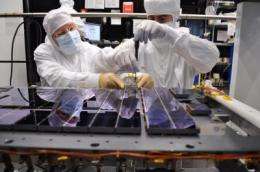
A total of 106 CCDs make up Gaia's focal plane. Technicians from Astrium France, the Gaia mission's prime contractor, are seen bolting and aligning the CCDs onto their support structure, at the company's facility in Toulouse. The structure (the gray plate underneath the CCDs) weighs about 20 kg and is made of silicon carbide, a material that provides remarkable thermal and mechanical stability. Gaia's CCDs are provided by e2v Technologies of Chelmsford, UK. Each CCD measures 4.7x6 cm, with a thickness of only a few tens of microns. Precisely fitted together on the support structure, the gap between adjacent CCD packages is about 1 mm. Credit: Astrium
The largest digital camera ever built for a space mission has been painstakingly mosaicked together from 106 separate electronic detectors. The resulting "billion-pixel array" will serve as the super-sensitive 'eye' of ESA's Galaxy-mapping Gaia mission.
While the naked human eye can see several thousand stars on a clear night, Gaia will map a billion stars within our own Milky Way Galaxy and its neighbours over the course of its five-year mission from 2013, charting their brightness and spectral characteristics along with their three-dimensional positions and motions.
In order to detect distant stars up to a million times fainter than the eye can see, Gaia will carry 106 charge coupled devices (CCDs), advanced versions of chips within standard digital cameras.
Developed for the mission by e2v Technologies of Chelmsford, UK, these rectangular detectors are a little smaller than a credit card, each one measuring 4.7x6 cm but thinner than a human hair.
The 0.5x1.0 m mosaic has been assembled at the Toulouse facility of Gaia prime contractor Astrium France.
Technicians spent much of May carefully fitting together each CCD package on the support structure, leaving only a 1 mm gap between them. Working in double shifts in strict cleanroom conditions, they added an average four CCDs per day, finally completing their task on 1 June.
"The mounting and precise alignment of the 106 CCDs is a key step in the assembly of the flight model focal plane assembly," said Philippe Garé, ESA's Gaia payload manager.
The completed mosaic is arranged in seven rows of CCDs. The main array comprises 102 detectors dedicated to star detection. Four others check the image quality of each telescope and the stability of the 106.5º angle between the two telescopes that Gaia uses to obtain stereo views of stars.
In order to increase the sensitivity of its detectors, the spacecraft will maintain their temperature of -110º Celsius.
Gaia's CCD support structure, like much of the rest of the spacecraft, is made of silicon carbide a ceramic like material, extraordinarily resistant to deforming under temperature changes.
First synthesised as a diamond substitute, SiC has the advantage of low weight: the entire support structure with its detectors is only 20 kg.
Gaia will operate at the EarthSun L2 Lagrange point, 1,5 million kilometers behind the earth, when looking from the sun, where Earth's orbital motion balances out gravitational forces to form a stable point in space. As the spinning Gaia's two telescopes sweep across the sky, the images of stars in each field of view will move across the focal plane array, divided into four fields variously dedicated to star mapping, position and motion, colour and intensity and spectrometry.
Scheduled for launch in 2013, Gaia's three-dimensional star map will help to reveal the composition, formation and evolution of the Milky Way, sampling 1% of our Galaxy's stars.
Gaia should also sample large numbers of other celestial bodies, from minor bodies in our own Solar System to more distant galaxies and quasars near the edge of the observable Universe.
Provided by
European Space Agency
-
From lemons to lemonade: Reaction uses carbon dioxide to make carbon-based semiconductor,
32 comments
-
Thioridazine kills cancer stem cells in human while avoiding toxic side-effects of conventional cancer treatments,
3 comments
-
SpaceX private rocket blasts off for space station (Update),
42 comments
-
Climate scientists say they have solved riddle of rising sea,
31 comments
-
SpaceX capsule has 'new car' smell, astronauts say (Update),
2 comments
-
revamping general concept and cosmological principle
May 25, 2012
-
Transiting Exoplanet Light Curve
May 25, 2012
-
Math behind Theoretical Physics
May 24, 2012
-
Do we know whats at the center of galaxies yet?
May 23, 2012
-
Structure of the Milky Way?
May 20, 2012
-
What would it take to terraform Pluto and Charon?
May 19, 2012
- More from Physics Forums - General Astronomy
More news stories
Sophisticated simulations predict future warming
The chances of our planet being hit by a global warming of 3 degrees Celsius by 2050 is as likely as it being hit by an increase of 1.4 degrees, new research shows. Presented in the journal Nature Geoscience, the British study ...
Space & Earth / Earth Sciences
May 22, 2012 |
4.4 / 5 (9) |
51
Kyoto Protocol architect 'frustrated' by climate dialogue
UN climate talks are going nowhere, as politicians dither or bicker while the pace of warming dangerously speeds up, one of the architects of the Kyoto Protocol told AFP.
May 23, 2012 |
3.7 / 5 (7) |
39
Dragon arrives at space station in historic 1st (Update 2)
The privately bankrolled Dragon capsule made a historic arrival at the International Space Station on Friday, triumphantly captured by astronauts wielding a giant robot arm.
Space & Earth / Space Exploration
May 25, 2012 |
5 / 5 (10) |
19
Aliens don't want to eat us, says former SETI director
Alien life probably isnt interested in having us for dinner, enslaving us or laying eggs in our bellies, according to a recent statement by former SETI director Jill Tarter.
Space & Earth / Space Exploration
May 25, 2012 |
4.4 / 5 (13) |
37
What's the big deal about private space launches?
(AP) -- The first private spaceship is headed to the International Space Station. Some questions and answers about the cargo mission by Space Exploration Technologies, known as SpaceX:
Space & Earth / Space Exploration
May 22, 2012 |
5 / 5 (6) |
32
Nvidia trumpets Tegra 3 phone design wins for 2012
(Phys.org) -- Nvidias competitive war paint has a name, Tegra 3. On the heels of Nvidia announcements about lowering costs of its Tegra 3 processors and Nvidia-enabled tablets running Android Ice Cream ...
Browser wars flare in mobile space
The browser wars are heating up again, but this time the fight is for dominance of the mobile Internet.
Scientist: Evolution debate will soon be history
(AP) -- Richard Leakey predicts skepticism over evolution will soon be history. Not that the avowed atheist has any doubts himself.
Dell tablet leak: 10.1-inch display, two-battery choice
(Phys.org) -- Headline after headline talks about vendors tablets in the wings as likely number-one contenders for the iPad. Such claims have justifiably been taken with a grain of salt, considering ...
Keep food safety in mind this memorial day weekend
(HealthDay) -- Picnics, parades and cookouts are as much a part of Memorial Day weekend as tributes to the United States' war veterans.
Social welfare cuts ultimately come with heavy price, researchers say
(Phys.org) -- Slashing government funding for Medicaid, food stamps and other programs that serve the poor while politically popular with some lawmakers and many conservatives may do more harm ...
Jul 06, 2011
Rank: 1.3 / 5 (3)
Jul 06, 2011
Rank: 1 / 5 (1)
Jul 06, 2011
Rank: 5 / 5 (1)
Jul 06, 2011
Rank: 5 / 5 (1)
The shared images from the two telescopes will help when it comes to very subtle effects--like the gravity of Jupiter and Saturn. (One set of images acts as a reference when sorting out distortions in the other image and vice-versa.) A lot of computation is required to get any useful information, but as long as you are planning ahead, might as well use it.
Jul 06, 2011
Rank: 2 / 5 (8)
That's great news!
If ESA has the money and the determination to perform honest science. That opportunity will soon vanish for ESA and other government research programs if integrity isn't restored to government-funded research/
Untrustworthy climate science is widely blamed for destroying Western economies, and the public is increasingly suspicious that government research funds will produce only more government propaganda.
See the unfolding story of IPCCs alteration of Forster & Gregorys climate results:
http://judithcurr...results/
With kind regards,
Oliver K. Manuel
Former NASA Principal
Investigator for Apollo
Jul 06, 2011
Rank: 3.6 / 5 (9)
No, untrustworthy climate change deniers and right wing-nut shills are destroying some Western economies.
Jul 07, 2011
Rank: not rated yet
Jul 07, 2011
Rank: 4.4 / 5 (7)
Jul 07, 2011
Rank: not rated yet
Jul 08, 2011
Rank: 5 / 5 (1)
As NASA is gutted and allowed to slowly decay into yet another US coldwar relic , ESA is where the future really seems to lie for serious astronomical research.
Jul 13, 2011
Rank: not rated yet
Don't play evil Sagan to Oliver's Velikovsky.
Jul 25, 2011
Rank: 5 / 5 (1)
Jul 31, 2011
Rank: not rated yet
wtf.
Aug 01, 2011
Rank: not rated yet
Aug 01, 2011
Rank: 0.7 / 5 (50)
Did you seriously just call Carl Sagan evil? You were being sarcastic, correct?