Efficacy of cool roofs varies from city to city
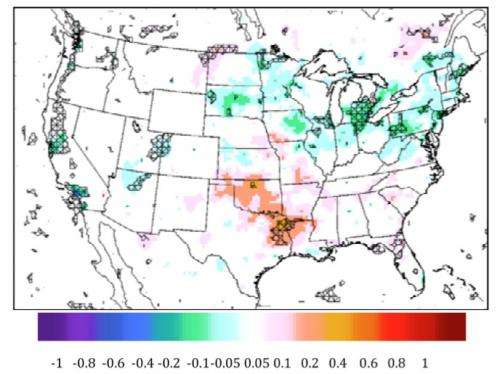
(PhysOrg.com) -- While cool roofs and pavements have been found to cool the planet by preventing energy from being radiated back into the atmosphere, previous studies have not accounted for atmospheric feedbacks that may result from changing the surface reflectivity of urban areas. A new study from Lawrence Berkeley National Laboratory (Berkeley Lab) breaks new ground by using a high-resolution model of the continental United States that incorporates land-surface feedback to probe the effects of deploying light-colored roads and rooftops.
Berkeley Lab researchers Dev Millstein and Surabi Menon found that atmospheric feedback—such as changes in cloud cover or precipitation—does have an important effect, resulting in different amounts of cooling in different cities, but that cool roofs and pavements are still beneficial for combating global warming. Their results were published in the journal Environmental Research Letters.
“Although further studies based on varying assumptions are required to validate our results, our modeling indicated cool roofs are not necessarily as effective in a city like Dallas as in a city like Los Angeles,” said Millstein, a postdoctoral fellow in the Atmospheric Sciences Department. “In places near Dallas and parts of the southeast, the absence of summer cooling is associated with less rainfall and more sun reaching the surface—fewer clouds and more sun, basically. Still, no major urban area saw any significant warming due to feedback effects.”
This study used the same assumptions as that of a previous Berkeley Lab study, in which the average albedo (solar reflectance) of all roofs was increased by 0.25 and of pavements by 0.15. However, the model used in this study had a higher degree of complexity than that used in previous studies of cool roofs thanks to continental scale, fine spatial resolution, feedback effects and more years of data. The researchers used the Weather Research and Forecasting model, with a domain that spans the continental United States and has a resolution of 25 square kilometers, allowing it to calculate changes in individual cities. It was run over a 12-year period using weather data from 1998 to 2009.
They then used the model to investigate an opposite scenario, darkening the albedo in southern California to simulate the installation of 1 terawatt of photovoltaic arrays in the Mojave Desert, enough capacity to power the entire country at noontime. Although such a deployment is several orders of magnitude larger than current solar developments in the United States, Millstein noted that a project of similar scale has been considered in the Sahara Desert to power Europe.
Again, the researchers found significant and consistent feedback effects to the solar arrays, including changes in wind patterns several hundred kilometers away. However any changes to climate at the continental scale were obscured by year-to-year variability. “Some years it decreased the amount of radiation reflected back to space and some years it increased, and that’s because we had the feedback effects,” Millstein said. “Without the feedback, you’d always see a penalty, or heating. That doesn’t mean it’s not there. We could see the benefits of cool roofs, but it’s not easy to see the penalties of desert-based photovoltaics.”
More reflective surfaces, such as cool roofs and pavements, reflect radiation back into the atmosphere and into space and thus help cool the planet in two ways. At the scale of individual cities, they can combat the urban heat island effect, and at a continental scale, they can combat global warming. Of course, in air-conditioned buildings, cool roofs can also help lower energy bills by decreasing the need for air conditioning.
On the local scale, this study validated previous studies finding California and the greater northeast of the U.S. as good candidates for cool roofs. Cities such as Los Angeles, Detroit and New York saw summer temperatures drop by 0.30 to 0.53 degrees Celsius. “Half a degree Celsius makes a big difference in terms of air quality,” Millstein said.
As for the southeast, some rural areas in Oklahoma, northern Texas and parts of Louisiana and Florida saw increases in temperature whereas cities either stayed the same or cooled slightly. But because temperature affects the chemistry of the atmosphere, causing higher ozone levels and more smog, cool roofs can still play an important role in improving air quality. “Even when you take feedback into account, cool roofs are still beneficial for most places,” Millstein said. “With the exceptions, there may be more study needed. The southeast is certainly not ruled out as a candidate for cool roofs.”
On the global or continental scale, the findings also confirmed the benefit of brightening roofs and pavements. “Even with the feedbacks from decreasing clouds in certain locations, we still had more reflection overall,” Millstein said.
For each square meter of cool roof surface deployed, the increased reflectivity is equivalent to offsetting 175 kilograms of carbon dioxide. For the continental U.S., it would achieve a one-time offset of 3.3 gigatons of CO2, or about half of total U.S. emissions in 2009.
The researchers’ next step will be to study the role of air pollution in weather patterns and investigate how photovoltaics and other forms of renewable energy may be used to reduce air pollution.
More information: “Regional climate consequences of large-scale cool roof and photovoltaic array deployment,” Environmental Research Letters iopscience.iop.org/1748-9326/6/3/034001/
Provided by Lawrence Berkeley National Laboratory


