The origin of comet material formed at high temperatures
Comets are icy bodies, yet they are made of materials formed at very high temperatures. Where do these materials come from? French researchers have now provided the physical explanation behind this phenomenon. They have demonstrated how these materials migrated from the hottest parts of the solar system to its outer regions before entering the composition of comets. Their results are published in the July 2011 issue of the journal Astronomy & Astrophysics.
On 15 January 2006, after an eight-year voyage, NASA's Stardust Mission (Discovery program) brought dust from Comet Wild 2 back to Earth. Comets are formed at very low temperatures (around 50 Kelvin, i.e. -223 C). However, analyses have revealed that Comet Wild 2 is made of crystalline silicates and CAIs (Calcium-Aluminium-rich Inclusions). Considering that the synthesis of these minerals requires very high temperatures (above 1 000 Kelvin or 727 C), how can this composition be explained?
A team from the Institut UTINAM1, in collaboration with researchers from the Institut de Physique de Rennes, the University of Duisburg-Essen (Germany) and the Laboratoire Astrophysique, Instrumentation et Modélisation, have provided the answer on the basis of a physical phenomenon called photophoresis. This force depends on two parameters: the intensity of solar radiation and gas pressure.
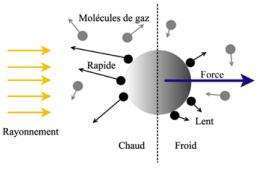
At the birth of the solar system, the comets were formed from the protoplanetary disk. Inside this disk, a mixture of solid grains ranging in size from a few microns to several centimeters was bathed in a dilute gas that let sunlight through. According to the researchers, photophoresis drove the particles towards the outer regions of the disk. Under the effect of solar radiation, one face of the grains was “hotter” than the other and the behavior of gas molecules on the surface of these grains was modified: on the “sunny” side, the gas molecules were more unstable and moved about more rapidly than on the “cold” side.
By causing a pressure difference, this imbalance moved the grains away from the Sun (see diagram below). Through digital simulations, the researchers have borne out this photophoresis phenomenon. They demonstrated that the grains of crystalline silicates formed in the inner, hot region of the protoplanetary disk near to the Sun migrated to its outer, cold region before playing a part in the formation of the comets. This novel physical explanation could account for the position of certain dust rings observed in protoplanetary disks and thus shed light on the conditions of planet formation.
More information: Photophoretic transport of hot minerals in the solar nebula - A. Moudens, et al. - Astronomy and Astrophysics, 531 July 2011
Provided by CNRS


