Baboons prefer dining with friends
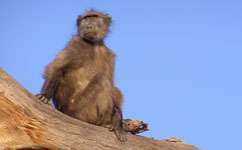
Mealtimes can be a fraught business for the wild baboons of the Namib Desert. There's little food about, which means they have to share. Unsurprisingly, skirmishes often break out.
Now researchers have discovered that dominant baboons are less likely to fight over food when they share it with baboons they have a close social bond with. And it turns out that the baboons they're closest to tend not to be relatives, but friends.
"We found that our baboons tended to associate with their closest friends when feeding," says Dr. Andrew King from the Royal Veterinary College in London, the study's lead author. "Since only a few baboons can fit into a tree to eat, a baboon with many friends is likely to get more food."
Orangutans, chimpanzees, and most other primates build alliances through grooming, sometimes spending up to 20 per cent of the day stroking and scratching each other. Indeed, primate experts often say that grooming is the social glue of primate life. They use it to reduce tension and stress, to build hierarchies, and not least, to get sex.
"Dominance is pretty stable in a baboon troop, and you tend to be stuck with the rank of your mother. But if you're born into a low rank, you can use grooming to get by," King explains.
Earlier studies on Japanese macaques had found that grooming 'promotes tolerance during foraging.' But this study and others like it tended to focus on pairs of monkeys.
But King was keen to understand how relationships between many members of a baboon troop influence social foraging patterns. So he followed 14 of the animals around all day every day for two seven-month chunks of time, recording a mind-boggling 5000 'foraging events.'
The troop he studied live on the edge of the Namib Desert as part of the Tsaobis Baboon Project run from the Zoological Society of London. "We had to study them during the dry season, which runs from May to December in the Namib Desert. When the rains come, we have to go home and wait until the following year" King says.
Earlier studies had shown that Japanese macaques are more likely to tolerate each other if they've become close through mutual grooming.
"Before now, people had analysed primate relationships by studying only pairs of individuals. But the method we used let us look at the bigger picture," he says.
King and his colleagues built complex networks which showed who dined with whom in the entire troop. "It's this approach that makes our study novel," he explains. The team is the first to look at social foraging in a big network.
They expected the baboons' preferred foraging partners would either be those they share strong social bonds with, or those they're closely related to, since both might reduce the chance of the diners fighting over food.
Female baboons tend to stay in the same troop into which they were born. But males usually transfer from another group. So you might expect that baboons would support their closest relations. One study in 2004 showed that closely-related baboons in a troop back each other up when it comes to social conflict for example.
In their networks, the researchers found more dominant animals in the middle, with the underlings on the periphery.
"We found a weak correlation between co-feeding and kinship in our study group, but a much stronger relationship between grooming and co-feeding," says King.
Males dominate in typical baboon troops, mostly because they're so much bigger than females: they decide who should eat with whom.
"But if a more subordinate baboon has invested time grooming the dominant male, the dominant male appears to much more tolerant of them," King says.
"Baboons try hard to avoid a fight, because it can be so costly. They have huge canines that can do a lot of damage," he adds.
More information: Andrew J. King, et al., The dining etiquette of desert baboons: the roles of social bonds, kinship, and dominance in co-feeding networks, American Journal of Primatology, Volume 73, Issue 8, pages 768-774, August 2011, Article first published online: 18 JAN 2011, DOI: 10.1002/ajp.20918
Source: PlanetEarth Online


