June 2, 2011 report
Worms from hell identified far below the Earth's surface
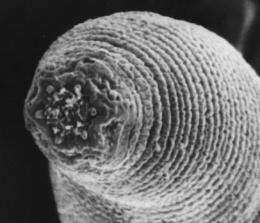
(PhysOrg.com) -- In a study published this week in Nature, researchers Gaetan Borgonie from Ghent University in Belgium and Tullis Onstott from Princeton University announced the discovery of new nematode species living kilometers below the earth in several South African mines. Nematodes had been previously found much closer to the surface, but this discovery of deep-dwelling nematodes, or roundworms, are the first multicellular organisms to ever be found at these depths.
Halicephalobus mesphisto was named after Mesphistopheles which is the literary nickname for the Devil. It was located in a mine some 1.3 km (0.8 miles) below the surface where the temperatures reach 37C (98.6F). This was believed to be a higher temperature than most nematodes could tolerate. H. mephisto measures 0.5mm and eats films of bacteria. It was found in the Beatrix gold mine some 240 kilometers southwest of Johannesburg.
The Driefontein mines revealed two more nematode species. Plectus aquatilis and another unkown species from the Monhysterid order were located at 0.9 km (0.55 miles) below the surface at a temperature of 24C (75.2F).
The most amazing discovery came from the Tau Tona mine where researchers discovered DNA from another unknown monhysterid. This DNA was recovered from some 3.6 km (2.24 miles) below the surface where temperatures reach 48C (118.4F).
In order to rule out contamination and the possibility these nematodes were from closer to the surface, Borgonie tested the water’s chemical composition that the nematode was collected in and found levels of oxygen, sulphur, and other chemicals that were expected to have come from the source location. He used carbon dating and determined that the water had been isolated from the earth’s surface for 3,000 to 12,000 years.
More information: Nematoda from the terrestrial deep subsurface of South Africa, Nature 474, 79–82 (02 June 2011) doi:10.1038/nature09974
Abstract
Since its discovery over two decades ago, the deep subsurface biosphere has been considered to be the realm of single-cell organisms, extending over three kilometres into the Earth’s crust and comprising a significant fraction of the global biosphere. The constraints of temperature, energy, dioxygen and space seemed to preclude the possibility of more-complex, multicellular organisms from surviving at these depths. Here we report species of the phylum Nematoda that have been detected in or recovered from 0.9–3.6-kilometre-deep fracture water in the deep mines of South Africa but have not been detected in the mining water. These subsurface nematodes, including a new species, Halicephalobus mephisto, tolerate high temperature, reproduce asexually and preferentially feed upon subsurface bacteria. Carbon-14 data indicate that the fracture water in which the nematodes reside is 3,000–12,000-year-old palaeometeoric water. Our data suggest that nematodes should be found in other deep hypoxic settings where temperature permits, and that they may control the microbial population density by grazing on fracture surface biofilm patches. Our results expand the known metazoan biosphere and demonstrate that deep ecosystems are more complex than previously accepted. The discovery of multicellular life in the deep subsurface of the Earth also has important implications for the search for subsurface life on other planets in our Solar System.
© 2010 PhysOrg.com


