When viruses infect bacteria
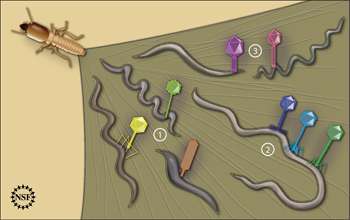
Virus-bacterium associations were examined in the natural environment of a termite's hindgut. Three general scenarios were seen. In the first (1) there was a one-to-one association: one type of virus matched one type of bacterium host. In the second (2) the host bacterium was associated with a diverse group of viruses, indicating perhaps a more ancient infection or a more susceptible host. In the third case (3) very similar viruses were seen infecting several different types of bacterial hosts. This study tested methods of examining virus-bacterium interactions in nature, rather than in vitro--from a culture. It opens a new door to understanding the diverse and highly populated world of viruses and bacteria that we know so little about. Credit: Zina Deretsky, National Science Foundation
(PhysOrg.com) -- Viruses are the most abundant parasites on Earth. Well known viruses, such as the flu virus, attack human hosts, while viruses such as the tobacco mosaic virus infect plant hosts.
More common, but less understood, are cases of viruses infecting bacteria known as bacteriophages, or phages. In part, this is due to the difficulty of culturing bacteria and viruses that have been cut off from their usual biological surroundings in a process called in vitro.
Researchers from the California Institute of Technology, funded in part by the National Science Foundation, were the first to use a clever technique to look at virus-bacterium interactions in vivo, that is, within an organism's normal state. The researchers report their results in the July 1st issue of the journal, Science.
As a test case, Rob Phillips and his team considered the interaction between viruses and bacteria in the hindgut, or posterior part, of a termite. Using new microfluidic technology, they were able to isolate single bacterial cells from the termite hindgut in six-nanoliter chambers on an array containing 765 such chambers.
They were then able to determine whether the chambers contained bacterial DNA, viral DNA or both. In the latter case, the researchers were able to statistically deduce whether the virus was specifically associated with the host--for example, by attaching to the host, shooting its DNA into the host, being incorporated into the host as a prophage (a viral genome inserted and integrated into the bacterial DNA), riding on a plasmid or by assembling new viruses within the host. And through this snapshot, the group recorded virus-bacterium associations.
Frequently there was a one-to-one virus-bacterium correspondence. However in some cases, the host was associated with a viral gene exhibiting marked diversity, suggesting possibly a more ancient infection, a more susceptible host or a phage replicating at a lower fidelity. By analyzing the bacteria and viruses based on their evolutionary development they were able to deduce that horizontal gene transfer, while it may be occurring, is not occurring at a rate high enough to randomize host-virus associations.
This study was by no means exhaustive. Many similar associations may still be found in the termite hindgut. And further inquiry may lead to a better understanding of the coevolution of a virus and its host. However, this was the first in vivo exercise, and it opens the doors of the field much wider than previously possible through in vitro culture alone.
Provided by
National Science Foundation
-
From lemons to lemonade: Reaction uses carbon dioxide to make carbon-based semiconductor,
32 comments
-
Thioridazine kills cancer stem cells in human while avoiding toxic side-effects of conventional cancer treatments,
3 comments
-
SpaceX private rocket blasts off for space station (Update),
42 comments
-
Climate scientists say they have solved riddle of rising sea,
31 comments
-
SpaceX capsule has 'new car' smell, astronauts say (Update),
2 comments
-
What would stain as translucent on light-coloured fabric?
14 hours ago
-
How do I identify different bacteria on culture plates?
May 26, 2012
-
Why Do Dogs do Strange things...
May 25, 2012
-
What does exophillic and endophillic mean in terms of mosquito and their control?
May 24, 2012
-
Semen stains glows under black lights (uv light)?
May 23, 2012
-
Question on Human Chromosome 2
May 23, 2012
- More from Physics Forums - Biology
More news stories
Scientist: Evolution debate will soon be history
(AP) -- Richard Leakey predicts skepticism over evolution will soon be history. Not that the avowed atheist has any doubts himself.
14 hours ago |
3.5 / 5 (14) |
33
More plant species responding to global warming than previously thought
(Phys.org) -- Far more wild plant species may be responding to global warming than previous large-scale estimates have suggested.
May 22, 2012 |
4.6 / 5 (14) |
18
|
Thousands of shellfish found dead in Peru
Thousands of crustaceans were found dead off the coast of Lima following the mystery mass death of dolphins and pelicans, the Peruvian Navy said Friday.
May 26, 2012 |
4.8 / 5 (4) |
7
For monogamous sparrows, it doesn't pay to stray (but they do it anyway)
It's quite common for a female song sparrow to stray from her breeding partner and mate with the male next door, but a new study shows that sleeping around can be costly.
May 22, 2012 |
5 / 5 (1) |
7
|
Study uncovers secret to speedy burrowing by razor clams
(Phys.org) -- If you look at a razor burrowing clam sitting in a bucket, youd never guess that it could burrow itself down into the soil, much less do it with any speed. Razor clams look like fat straws, ...
Nvidia trumpets Tegra 3 phone design wins for 2012
(Phys.org) -- Nvidias competitive war paint has a name, Tegra 3. On the heels of Nvidia announcements about lowering costs of its Tegra 3 processors and Nvidia-enabled tablets running Android Ice Cream ...
Browser wars flare in mobile space
The browser wars are heating up again, but this time the fight is for dominance of the mobile Internet.
Dell tablet leak: 10.1-inch display, two-battery choice
(Phys.org) -- Headline after headline talks about vendors tablets in the wings as likely number-one contenders for the iPad. Such claims have justifiably been taken with a grain of salt, considering ...
Keep food safety in mind this memorial day weekend
(HealthDay) -- Picnics, parades and cookouts are as much a part of Memorial Day weekend as tributes to the United States' war veterans.
Family history of Alzheimer's affects functional connectivity
(HealthDay) -- Cognitively normal individuals with a family history of late-onset Alzheimer's disease (AD) may display lower resting state functional connectivity in the default mode network (DMN) of the brain, ...
Social welfare cuts ultimately come with heavy price, researchers say
(Phys.org) -- Slashing government funding for Medicaid, food stamps and other programs that serve the poor while politically popular with some lawmakers and many conservatives may do more harm ...