Spectacular Hubble View of Centaurus A
Jun 16, 2011
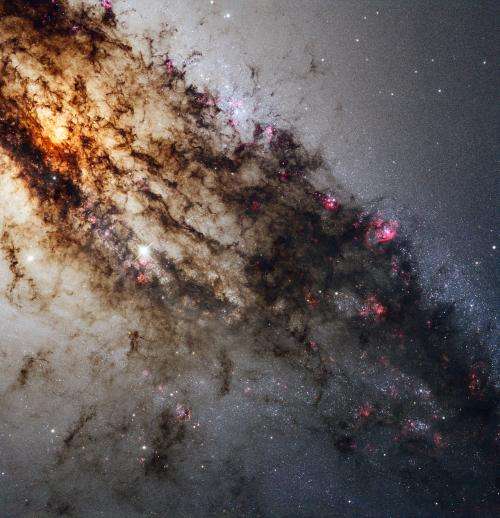
Centaurus A, also known as NGC 5128, is well known for its dramatic dusty lanes of dark material. Hubble’s new observations, using its most advanced instrument, the Wide Field Camera 3, are the most detailed ever made of this galaxy. They have been combined here in a multi-wavelength image which reveals never-before-seen detail in the dusty portion of the galaxy. As well as features in the visible spectrum, this composite shows ultraviolet light, which comes from young stars, and near-infrared light, which lets us glimpse some of the detail otherwise obscured by the dust. Credit: NASA, ESA, and the Hubble Heritage (STScI/AURA)-ESA/Hubble Collaboration. Acknowledgment: R. O’Connell (University of Virginia) and the WFC3 Scientific Oversight Committee

(PhysOrg.com) -- The NASA/ESA Hubble Space Telescope has produced a close-up view of the galaxy Centaurus A. Hubble’s out-of-this-world location and world-class Wide Field Camera 3 instrument reveal a dramatic picture of a dynamic galaxy in flux.

Centaurus A, also known as NGC 5128, is well known for its dramatic dusty lanes of dark material. Hubble’s observations, using its most advanced instrument, the Wide Field Camera 3, are the most detailed ever made of this galaxy. They have been combined here in a multi-wavelength image that reveals never-before-seen detail in the dusty portion of the galaxy.

As well as features in the visible spectrum, this composite shows ultraviolet light from young stars, and near-infrared light, which lets us glimpse some of the detail otherwise obscured by the dust.

The dark dust lane that crosses Centaurus A does not show an absence of stars, but rather a relative lack of starlight, as the opaque clouds block the visible light from reaching us. Hubble’s Wide Field Camera 3 has focussed on these dusty regions, which span from corner to corner in this image. Wider views from ground-based telescopes show this stripe crossing the entire galaxy.

Interesting features such as the warped shape of its disc of gas and dust (outside the view) hint that at some point in the past, Centaurus A collided and merged with another galaxy. The shockwaves of this event caused hydrogen gas to coalesce and sparked intense areas of star formation, as seen in its outlying regions and in red patches visible in this Hubble close-up.

The galaxy’s compact nucleus contains a highly active supermassive black hole at its centre. Powerful relativistic jets release vast amounts of radio and X-ray radiation — although these are invisible here as Hubble’s instruments are designed to study optical, ultraviolet and infrared wavelengths.

At just over 11 million light-years distant, Centaurus A is relatively nearby in astronomical terms. However, it is not only close, it is also bright. This makes it a very attractive target for amateur astronomers in the southern hemisphere, where it is visible. Stargazers can see the galaxy through binoculars, while larger amateur telescopes begin to unveil the distinctive dusty lanes.

However it is only with the capabilities of the that many of the features in this image become visible: as well as providing unparalleled clarity and resolution, Hubble’s position in orbit means that it can see ultraviolet wavelengths which are blocked by the atmosphere and so invisible from the ground.

Explore further: Researchers explain magnetic field misbehavior in solar flares

Related Stories

NGC 4696: A cosmic question mark

Aug 12, 2010

This picture, taken by Hubble's Advanced Camera for Surveys, is not just a beautiful snapshot of NGC 4696, the largest galaxy in the Centaurus Cluster (galaxy cluster Abell 3526). It is also an illustration ...

The two-faced whirlpool galaxy

Jan 14, 2011

(PhysOrg.com) -- These images by NASA's Hubble Space Telescope show off two dramatically different face-on views of the spiral galaxy M51, dubbed the Whirlpool Galaxy.

Image: Seeing Red

Jan 18, 2011

This image by the Hubble Space Telescope shows a dramatic view of the spiral galaxy M51, dubbed the Whirlpool Galaxy.

Galaxy NGC 4214: A star formation laboratory

May 12, 2011

(PhysOrg.com) -- Hubble’s newest camera has taken an image of galaxy NGC 4214. This galaxy glows brightly with young stars and gas clouds, and is an ideal laboratory to research star formation and evolution.

Two views of a lopsided galaxy (w/ video)

May 04, 2011

(PhysOrg.com) -- The Meathook Galaxy, or NGC 2442, has a dramatically lopsided shape. One spiral arm is tightly folded in on itself and host to a recent supernova, while the other, dotted with recent star ...

Recommended for you

Fragile mega-galaxy is missing link in history of cosmos

13 hours ago

Two hungry young galaxies that collided 11 billion years ago are rapidly forming a massive galaxy about 10 times the size of the Milky Way, according to UC Irvine-led research published Wednesday in the journal ...

Galaxy's Ring of Fire

May 18, 2013

Johnny Cash may have preferred this galaxy's burning ring of fire to the one he sang about falling into in his popular song. The "starburst ring" seen at center in red and yellow hues is not the product of ...

User comments : 2

Adjust slider to filter visible comments by rank

Display comments: newest first

neiorah
not rated yet Jun 16, 2011
I love all these detailed pictures of the universe. Can't wait for more :)
bishop
not rated yet Jun 17, 2011
Or getting there with a spaceship and an efficient propulsion engine ...

More news stories

Forecast for Titan: Wild weather could be ahead

(Phys.org) —Saturn's moon Titan might be in for some wild weather as it heads into its spring and summer, if two new models are correct. Scientists think that as the seasons change in Titan's northern hemisphere, ...

Theorists weigh in on where to hunt dark matter

(Phys.org) —Now that it looks like the hunt for the Higgs boson is over, particles of dark matter are at the top of the physics "Most Wanted" list. Dozens of experiments have been searching for them, but ...