Solar wind samples give insight into birth of solar system
June 23, 2011

Solar wind samples give insight into birth of solar system

Enlarge

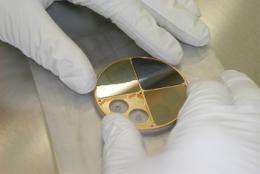
The Solar Wind Concentrator is a special instrument built by a team at Los Alamos National Laboratory to enhance the flow of solar wind onto a small target to make possible oxygen and nitrogen measurements. Shown here, the target section of the concentrator, which produced essential samples of nitrogen and oxygen.

(PhysOrg.com) -- Two papers in this week's issue of Science report the first oxygen and nitrogen isotopic measurements of the Sun, demonstrating that they are verydifferent from the same elements on Earth. These results were the top two priorities of NASA's Genesis mission, which was the first spacecraft to return from beyond the Moon, crashing in the Utah desert in 2004 after its parachute failed to deploy during re-entry.

Most of the Genesis payload consisted of fragile collectors, which had been exposed to the over a period of two years. Nearly all of these collectors were decimated during the crash. But the capsule also contained a special instrument built by a team at Los Alamos National Laboratory to enhance the flow of solar wind onto a small target to make possible oxygen and nitrogen measurements. The targets of this Solar Wind Concentrator survived the crash and eventually yielded today's solar secrets.

"Genesis is the biggest comeback mission since ," said Roger Wiens, a Los Alamos National Laboratory physicist and Genesis flight payload lead. "Everyone who saw the crash thought it was a terrible disaster, but instead the project has been fully successful, and the results are absolutely fascinating."

The results provide new clues to how the solar system was formed. Oxygen and nitrogen samples collected from various meteorites, as well as nitrogen sampled in and in the Jupiter atmosphere by the Galileo probe, vary significantly from that on Earth by cosmochemical standards: 38 percent for nitrogen and up to 7 percent for oxygen. With the first solar wind samples in hand, showing the early Sun's composition, scientists can begin the game of determining where Earth's different O and N came from.

"For nitrogen, Jupiter and the Sun look the same," said Wiens. "It tells us that the original gaseous component of the inner and was homogeneous for nitrogen, at least. So where did Earth gets its heavier from? Maybe it came here in the material comets are made of. Perhaps it was bonded with organic materials."

For oxygen, the evidence points toward a different astrophysical mechanism called photochemical self-shielding, which the authors believe modified the composition of space dust before it coalesced to form the planets, including Earth. According to the article, the Sun shows an enrichment of pure 16O relative to Earth instead of differences in 16O, 17O, and 18O that are proportional to their atomic weight or some other mixture that doesn't show exclusive enrichment of a single isotope. This unique arrangement strongly favors the self-shielding theory, in which solar UV radiation was responsible for uniformly enhancing the two rarer isotopes, 17O and 18O, in the terrestrial planets.

The Science papers are titled "A 15N-poor isotopic composition for the as shown by Genesis solar wind samples" and "The oxygen isotopic composition of the Sun inferred from captured solar wind." Wiens is among several collaborating authors on both papers, which together are cover stories for this issue. Other LANL coauthors, Beth Nordholt and Ron Moses, along with former LANL scientist Dan Reisenfeld, were all part of the team to develop and fly the Solar Wind Concentrator that provided the samples for the studies reported in Science.

And now that some of the particles flowing past Earth from the sun are in hand, "It's going to make a mission to a comet all the more interesting," Wiens said.

Provided by Los Alamos National Laboratory search and more info website

Filter


Move the slider to adjust rank threshold, so that you can hide some of the comments.


Display comments: newest first

Etreum
Jun 23, 2011

Rank: not rated yet
"This unique arrangement strongly favors the self-shielding theory, in which solar UV radiation was responsible for uniformly enhancing the two rarer isotopes, 17O and 18O, in the terrestrial planets."

...terrestrial planets?
aroc91
Jun 23, 2011

Rank: not rated yet
...terrestrial planets?


Planets mainly composed of silicate rocks and/or metals, i.e., not gas giants.
omatumr
Jun 23, 2011

Rank: 1 / 5 (7)
Do these results confirm or contradict 1975-1983 findings [1-6]:

a.) The solar system formed directly from heterogeneous debris of a single supernova

b.) The Sun reformed on the collapsed supernova core?

1. "Elemental and isotopic inhomogeneities in noble gases: The case for local synthesis of the chemical elements", Trans. Missouri Acad. Sci. 9, 104 122 (1975).

2. "Strange xenon, extinct superheavy elements and the solar neutrino puzzle", Science 195, 208-209 (1977).

3. "Isotopes of tellurium, xenon and krypton in the Allende meteorite retain record of nucleosynthesis", Nature 277, 615-620 (1979).

4. "Noble gas anomalies and synthesis of the chemical elements", Meteoritics 15, 117-138 (1980).

5. "Heterogeneity of isotopic and elemental compositions in meteorites: Evidence of local synthesis of the elements ", Geokhimiya (12) 1776-1801 (1981).

6. "Solar abundance of the elements", Meteoritics 18, 209-222 (1983).

With kind regards,
Oliver K. Manuel
Deesky
Jun 23, 2011

Rank: 4.3 / 5 (6)
Do these results confirm or contradict 1975-1983 findings [1-6]:

Who gives a crap! Findings from 36 years ago might as well be from the dark ages when it comes to astronomy and astrophysics. Not that your random, out of context one liners have any kind of point to make to begin with.
jibbles
Jun 24, 2011

Rank: not rated yet
oops my bad
Rank 5 /5 (8 votes)
Relevant PhysicsForums posts
  • revamping general concept and cosmological principle
    createdMay 25, 2012
  • Transiting Exoplanet Light Curve
    createdMay 25, 2012
  • Math behind Theoretical Physics
    createdMay 24, 2012
  • Do we know whats at the center of galaxies yet?
    createdMay 23, 2012
  • Structure of the Milky Way?
    createdMay 20, 2012
  • What would it take to terraform Pluto and Charon?
    createdMay 19, 2012
  • More from Physics Forums - General Astronomy

More news stories

Sophisticated simulations predict future warming

The chances of our planet being hit by a global warming of 3 degrees Celsius by 2050 is as likely as it being hit by an increase of 1.4 degrees, new research shows. Presented in the journal Nature Geoscience, the British study ...

Space & Earth / Earth Sciences

created May 22, 2012 | popularity 4.4 / 5 (9) | comments 51

Kyoto Protocol architect 'frustrated' by climate dialogue

UN climate talks are going nowhere, as politicians dither or bicker while the pace of warming dangerously speeds up, one of the architects of the Kyoto Protocol told AFP.

Space & Earth / Environment

created May 23, 2012 | popularity 3.7 / 5 (7) | comments 39

Aliens don't want to eat us, says former SETI director

Alien life probably isn’t interested in having us for dinner, enslaving us or laying eggs in our bellies, according to a recent statement by former SETI director Jill Tarter.

Space & Earth / Space Exploration

created May 25, 2012 | popularity 4.4 / 5 (13) | comments 37

Dragon arrives at space station in historic 1st (Update 2)

The privately bankrolled Dragon capsule made a historic arrival at the International Space Station on Friday, triumphantly captured by astronauts wielding a giant robot arm.

Space & Earth / Space Exploration

created May 25, 2012 | popularity 5 / 5 (10) | comments 19

What's the big deal about private space launches?

(AP) -- The first private spaceship is headed to the International Space Station. Some questions and answers about the cargo mission by Space Exploration Technologies, known as SpaceX:

Space & Earth / Space Exploration

created May 22, 2012 | popularity 5 / 5 (6) | comments 32


Nvidia trumpets Tegra 3 phone design wins for 2012

(Phys.org) -- Nvidia’s competitive war paint has a name, Tegra 3. On the heels of Nvidia announcements about lowering costs of its Tegra 3 processors and Nvidia-enabled tablets running Android Ice Cream ...

Browser wars flare in mobile space

The browser wars are heating up again, but this time the fight is for dominance of the mobile Internet.

Scientist: Evolution debate will soon be history

(AP) -- Richard Leakey predicts skepticism over evolution will soon be history. Not that the avowed atheist has any doubts himself.

Dell tablet leak: 10.1-inch display, two-battery choice

(Phys.org) -- Headline after headline talks about vendors’ tablets in the wings as likely number-one contenders for the iPad. Such claims have justifiably been taken with a grain of salt, considering ...

Keep food safety in mind this memorial day weekend

(HealthDay) -- Picnics, parades and cookouts are as much a part of Memorial Day weekend as tributes to the United States' war veterans.

Social welfare cuts ultimately come with heavy price, researchers say

(Phys.org) -- Slashing government funding for Medicaid, food stamps and other programs that serve the poor – while politically popular with some lawmakers and many conservatives – may do more harm ...