The heat is on for sodium-manganese oxide rechargeable batteries
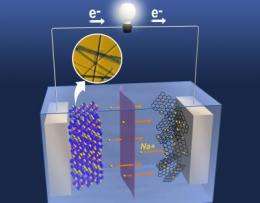
(PhysOrg.com) -- By adding the right amount of heat, researchers have developed a method that improves the electrical capacity and recharging lifetime of sodium ion rechargeable batteries, which could be a cheaper alternative for large-scale uses such as storing energy on the electrical grid.
To connect solar and wind energy sources to the electrical grid, grid managers require batteries that can store large amounts of energy created at the source. Lithium ion rechargeable batteries -- common in consumer electronics and electric vehicles -- perform well, but are too expensive for widespread use on the grid because many batteries will be needed, and they will likely need to be large. Sodium is the next best choice, but the sodium-sulfur batteries currently in use run at temperatures above 300 degrees Celsius, or three times the temperature of boiling water, making them less energy efficient and safe than batteries that run at ambient temperatures.
Battery developers want the best of both worlds -- to use both inexpensive sodium and use the type of electrodes found in lithium rechargeables. A team of scientists at the Department of Energy's Pacific Northwest National Laboratory and visiting researchers from Wuhan University in Wuhan, China used nanomaterials to make electrodes that can work with sodium, they reported June 3 online in the journal Advanced Materials.
"The sodium-ion battery works at room temperature and uses sodium ions, an ingredient in cooking salt. So it will be much cheaper and safer," said PNNL chemist Jun Liu, who co-led the study with Wuhan University chemist Yuliang Cao.
The electrodes in lithium rechargeables that interest researchers are made of manganese oxide. The atoms in this metal oxide form many holes and tunnels that lithium ions travel through when batteries are being charged or are in use. The free movement of lithium ions allows the battery to hold electricity or release it in a current. But simply replacing the lithium ions with sodium ions is problematic -- sodium ions are 70 percent bigger than lithium ions and don't fit in the crevices as well.
To find a way to make bigger holes in the manganese oxide, PNNL researchers went much much smaller. They turned to nanomaterials -- materials made on the nanometer-sized scale, or about a million times thinner than a dime -- that have surprising properties due to their smallness. For example, the short distances that sodium ions have to travel in nanowires might make the manganese oxide a better electrode in ways unrelated to the size of the tunnels..
To explore, the team mixed two different kinds of manganese oxide atomic building blocks -- one whose atoms arrange themselves in pyramids, and another one whose atoms form an octahedron, a diamond-like structure from two pyramids stuck together at their bases. They expected the final material to have large S-shaped tunnels and smaller five-sided tunnels through which the ions could flow.
After mixing, the team treated the materials with temperatures ranging from 450 to 900 degrees Celsius, then examined the materials and tested which treatment worked best. Using a scanning electron microscope, the team found that different temperatures created material of different quality. Treating the manganese oxide at 750 degrees Celsius created the best crystals: too low and the crystals appeared flakey, too high and the crystals turned into larger flat plates.
Zooming in even more using a transmission electron microscope at EMSL, DOE's Environmental Molecular Sciences Laboratory on PNNL's campus, the team saw that manganese oxide heated to 600 degrees had pockmarks in the nanowires that could impede the sodium ions, but the 750 degree-treated wires looked uniform and very crystalline.
But even the best-looking material is just window-dressing if it doesn't perform well. To find out if it lived up to its good looks, the PNNL-Wuhan team dipped the electrode material in electrolyte, the liquid containing sodium ions that will help the manganese oxide electrodes form a current. Then they charged and discharged the experimental battery cells repeatedly.
The team measured peak capacity at 128 milliAmp hours per gram of electrode material as the experimental battery cell discharged. This result surpassed earlier ones taken by other researchers, one of which achieved peak capacity of 80 milliAmp hours per gram for electrodes made from manganese oxide but with a different production method. The researchers think the lower capacity is due to sodium ions causing structural changes in that manganese oxide that do not occur or occur less frequently in the heat-treated nano-sized material.
In addition to high capacity, the material held up well to cycles of charging and discharging, as would occur in consumer use. Again, the material treated at 750 Celsius performed the best: after 100 cycles of charging-discharging, it lost only 7 percent of its capacity. Material treated at 600 Celsius or 900 Celsius lost about 37 percent and 25 percent, respectively.
Even after 1,000 cycles, the capacity of the 750 Celsius-treated electrodes only dropped about 23 percent. The researchers thought the material performed very well, retaining 77 percent of its initial capacity.
Last, the team charged the experimental cell at different speeds to determine how quickly it could take up electricity. The team found that the faster they charged it, the less electricity it could hold. This suggested to the team that the speed with which sodium ions could diffuse into the manganese oxide limited the battery cell's capacity -- when charged fast, the sodium ions couldn't enter the tunnels fast enough to fill them up.
To compensate for the slow sodium ions, the researchers suggest in the future they make even smaller nanowires to speed up charging and discharging. Grid batteries need fast charging so they can collect as much newly made energy coming from renewable sources as possible. And they need to discharge fast when demands shoots up as consumers turn on their air conditioners and television sets, and plug in their electric vehicles at home.
Such high performing batteries could take the heat off an already taxed electrical power grid.
More information: Yuliang Cao, Lifen Xiao, Wei Wang, Daiwon Choi, Zimin Nie, Jianguo Yu, Laxmikant V. Saraf, Zhenguo Yang and Jun Liu, Reversible Sodium Ion Insertion in Single Crystalline Manganese Oxide Nanowires with Long Cycle Life, Advanced Materials, June 3, 2011, DOI 10.1002/adma.201100904 ( dx.doi.org/10.1002/adma.201100904 ).
Provided by Pacific Northwest National Laboratory


