Rosetta's first glimpse of the comet
Jun 08, 2011
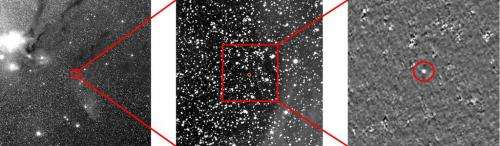
Left: Comet Churyumov-Gerasimenko is hidden within this sector of space, a crowded star field in the constellation Scorpius that is towards the center of our galaxy. The image was taken by OSIRIS's wide-angle camera. Middle: The narrow-angle camera allows for a closer look, and shows many background stars. Right: After refined steps of data processing the comet becomes visible. (Credits: ESA 2011 MPS for OSIRIS-Team MPS/UPD/LAM/IAA/RSSD/INTA/UPM/DASP/IDA)

Three years before its arrival the camera system on board the space probe Rosetta renders the first images of its destination.

Approximately 163 million kilometers still separate ESA's spacecraft Rosetta from comet Churyumov-Gerasimenko, its 2014 target. Despite this remarkable distance, scientists from the Max Planck Institute for Solar System Research (MPS) in Germany have succeeded in obtaining the first images of the remote destination using the onboard camera system OSIRIS. These pictures were generated during the tests performed by the team during the last weeks. After the successful completion of these tests, Rosetta will now start its almost three year hibernation period: In order to save energy on the last part of the way offering only little sunlight, all systems will be powered down.

This video is not supported by your browser at this time.

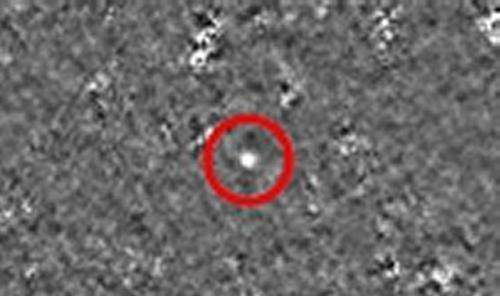
In these first images comet Churyumov-Gerasimenko appears as a single point of light covering only a few pixels. "But the pictures already give us a good idea of where we are headed", says Dr. Holger Sierks from MPS, OSIRIS Lead Investigator. "In addition, they are a remarkable proof of the camera's performance. We had not expected to be able to create first images from so far away".

Comet Churyumov-Gerasimenko is extremely faint. Its brightness is approximately a million times less then that of the faintest star that can be discerned from Earth with the . Astronomers studying the comet from Earth use the European Southern Observatory's Very Large Telescope in Chile, one of the world's most powerful telescopes with a main mirror diameter of eight meters. OSIRIS's mirror measures only approximately ten centimeters in diameter.
Credits: NASA/JPL-Caltech/UCLA/MPS/DLR/IDA

In order to make the comet visible despite these challenges, an exposure time of 13 hours was necessary. "All in all, we took 52 images with OSIRIS, each exposed for 15 minutes", explains Dr. Colin Snodgrass from MPS, responsible for data processing. Since within a period of a few hours the comet moves relative to the background of fixed stars, the first step was to align all of the and correct for this motion. After further refined steps of data processing (for example subtracting the fixed stars) the researchers were able to catch a first glimpse of their destination.

Before they get a chance at a second glimpse, it will, however, be a long wait. The systems on board Rosetta will be powered down today for approximately three years. In this way the solar panel powered spacecraft saves energy while it is far from the Sun - until it reawakens in the spring of 2014 and takes a next look at "its" comet.

The spacecraft has been en route to Churyumov-Gerasimenko since 2004. OSIRIS, the scientific camera system on board, was developed and built under the lead of the MPS in cooperation with a team bringing together members of six European countries. It consists of a wide- and a narrow-angle camera. The is operated by scientists from MPS.

Explore further: NASA head views progress on asteroid lasso mission

add to favorites email to friend print save as pdf

Related Stories

When is a comet not a comet? Rosetta finds out

Oct 14, 2010

(PhysOrg.com) -- It was a case of celestial hit and run. Two asteroids, both in the wrong place at the wrong time. The result: one big trail of debris and a case of mistaken identity. Now, however, ESA’s ...

First view of Earth as Rosetta approaches home

Nov 12, 2009

(PhysOrg.com) -- This spectacular image of our home planet was captured by the OSIRIS instrument on ESA's Rosetta comet chaser earlier today as the spacecraft approached Earth for the third and final swingby. ...

Fascinating images from a new world

Jul 14, 2010

The ESA space probe Rosetta flew past the Lutetia planetoid at around 6 p.m. CEST on Saturday. The OSIRIS camera system, built and developed under the direction of the Max Planck Institute for Solar System ...

Rosetta's final Earth boost

Nov 04, 2009

ESA's comet chaser Rosetta will swing by Earth for the last time on 13 November to pick up energy and begin the final leg of its 10-year journey to comet 67P/Churyumov-Gerasimenko. ESA's European Space Operations ...

Where comets emit dust

Apr 26, 2010

Studying comets can be quite dangerous - especially from close up. Because the tiny particles of dust emitted into space from the so-called active regions on a comet's surface can damage space probes.

Boosting the accuracy of Rosetta's Earth approach

Oct 19, 2007

Yesterday, 18 October at 18:06 CEST, the thrusters of ESA’s comet chaser, Rosetta, were fired in a planned, 42-second trajectory correction manoeuvre designed to 'fine tune' the spacecraft's approach to ...

Recommended for you

NASA head views progress on asteroid lasso mission

11 hours ago

Surrounded by engineers, NASA chief Charles Bolden inspected a prototype spacecraft engine that could power an audacious mission to lasso an asteroid and tow it closer to Earth for astronauts to explore.

Ecuador satellite collides with Russian space junk

11 hours ago

A small Ecuadoran satellite collided in orbit with the remains of a Russian rocket, but it is too soon to know how much damage it might have sustained, Quito's space agency said Thursday.

Forecast for Titan: Wild weather could be ahead

May 22, 2013

(Phys.org) —Saturn's moon Titan might be in for some wild weather as it heads into its spring and summer, if two new models are correct. Scientists think that as the seasons change in Titan's northern hemisphere, ...

SDO observes mid-level solar flare

May 22, 2013

UPDATE 16:30 p.m. EDT: The M7-class flare was also associated with a coronal mass ejection or CME, another solar phenomenon that can send billions of tons of particles into space. While this CME was not Ea ...

User comments : 0

More news stories

A hidden population of exotic neutron stars

(Phys.org) —Magnetars – the dense remains of dead stars that erupt sporadically with bursts of high-energy radiation - are some of the most extreme objects known in the Universe. A major campaign using ...

Hubble reveals the ring nebula's true shape

(Phys.org) —The Ring Nebula's distinctive shape makes it a popular illustration for astronomy books. But new observations by NASA's Hubble Space Telescope of the glowing gas shroud around an old, dying, ...

NASA head views progress on asteroid lasso mission

Surrounded by engineers, NASA chief Charles Bolden inspected a prototype spacecraft engine that could power an audacious mission to lasso an asteroid and tow it closer to Earth for astronauts to explore.

Controlling mood through the motions of mitochondria

(Medical Xpress)—Regulating the distribution of power in neurons is done by a system that makes the national electric grid look simple by comparison. Each neuron has several thousand mitochondria confined ...

A quantum simulator for magnetic materials

Physicists understand perfectly well why a fridge magnet sticks to certain metallic surfaces. But there are more exotic forms of magnetism whose properties remain unclear, despite decades of intense research. ...