Plovers tracked across the Pacific
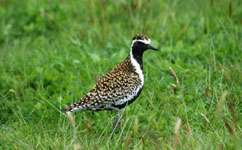
Scientists have monitored Pacific Golden Plovers for the first time as they migrate thousands of kilometres nonstop from Hawaii to Alaska in spring and back again in autumn.
The team also found the birds fly much more directly to their destinations than expected, suggesting they're even better navigators than previously assumed.
This kind of research is shedding unprecedented light on these hard-to-monitor creatures' behaviour; for instance, follow-up work is providing the first clues that Japan may be an important stopover for plovers as they head from South Pacific islands beyond Hawaii to breeding grounds in Alaska and Siberia.
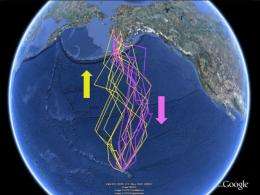
"We thought they might use the lengthy Hawaiian archipelago as a guide - that they would fly south until they reached an island somewhere in the chain and then travel along the archipelago until they got to their final destination," says Professor Wally Johnson, an ecologist at Montana State University and lead author of the paper, published in Wader Study Group Bulletin. "But it turns out that they take a far more direct route."
The researchers, based at Montana State University, Brigham Young University in Hawaii and the British Antarctic Survey (BAS), used geolocators, or data loggers, made by BAS. These minuscule devices are attached to bird's legs and work by measuring and recording light levels at regular intervals.
The team equipped 24 birds with loggers in Hawaii at their wintering grounds. After about six months, when the plovers had flown to Alaska and back again, the scientists recaptured them, removed their loggers and downloaded the data they contained. Special software turned this into an accurate record of where the plovers had been that could be plotted on Google Earth.
As well as more traditional methods to catch plovers, like setting up mist nets in their territories, the team pioneered the use of the 'Super Talon' net gun.
This was originally designed as a law enforcement tool, but it turns out to be a great way to capture wild birds without harming them. The researchers even found they could take unwary plovers by surprise with an unusual tactic of drive-by net-gunning.
Plovers are ideal subjects for this kind of research because they return to the same wintering territories every year, so scientists know exactly where to go to find a particular individual. "They're so strongly site-faithful that we can predict where they will be with almost 100 per cent accuracy," explains Johnson. "If they're alive, it's almost certain they will come back to the same place."
On their spring flight northwards, the birds averaged 63 kilometers per hour and covered around 4800 kilometres in about three days. They made the return trip in around four days.
Plovers are well-known as fast flyers, and in this study some birds reached incredible speeds, presumably with the wind behind them - for example, the ground speeds of three individuals ranged from 167 to an exceptional 185 kilometres per hour.
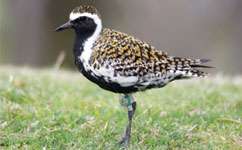
Johnson and his colleagues are now working on follow-up research applying similar methods to plovers that travel from places further south in the Pacific, like the Marshall Islands. So far, their findings suggest that these birds (unlike plovers wintering in Hawaii) stop over in the uplands and rice fields of Japan to fatten up while en route to their breeding grounds in Alaska and Siberia- a migratory link that hasn't previously been suspected.
"Japan seems to be a major stopover for them," Johnson says. "A lot of shorebirds stop in the Yellow Sea region between China and Korea, but very few golden plovers have been seen there. We knew they had to be going elsewhere, and now we think we know where."
The team also noted that extended periods of 'noise', in which the geolocator registers very little light, probably show periods when the birds are on their nests incubating and hence keeping the devices shaded. These noise patterns could potentially be used to estimate hatching success rates in various species that nest in remote areas.
This story is republished courtesy of Planet Earth online, a free, companion website to the award-winning magazine Planet Earth published and funded by the Natural Environment Research Council (NERC).
More information: Tracking the Migrations of Pacific Golden-Plovers (Pluvialis fulva) between Hawaii and Alaska: New insight on flight performance, breeding ground destinations, and nesting from birds carrying light level geolocators. OW Johnson, et al. Wader Study Group Bulletin. 118, 1, 2011.
Provided by PlanetEarth Online


