N.Z. inventor readies 'jetski for the skies'
June 7, 2011 by Neil Sands
The jetpack, which has taken 30 years to develop, is expected to be commercially available in the next 18 months.
Whizzing around with your own personal jetpack may sound like the stuff of science fiction, but New Zealand inventor Glenn Martin aims to have his "jetski for the skies" on the market within 18 months.
After 30 years of painstaking development, Martin's jetpack last month soared 1,500 metres (5,000 feet) above the South Island's Canterbury Plains as its creator watched anxiously from a helicopter hovering nearby.
The May 21 flight, featuring a remote-controlled jetpack carrying a dummy pilot, was a milestone in Martin's dream of building the world's first practical jetpack.
"The first people using these in cities will be medical personnel doing emergency response," he said.
"Then you'll see people putting camera mounts on them for traffic reporting and it will eventually evolve into people just flying for fun or going to work."
Inspired by childhood television shows such as "Thunderbirds" and "Lost in Space", Martin set out in the early 1980s to create a jetpack suitable for everyday use by ordinary people with no specialist pilot training.
"I've wanted one from the age of five and was disappointed they weren't available and thought 'if it's not around, you've got to make it'," he told AFP at his factory in Christchurch industrial estate.
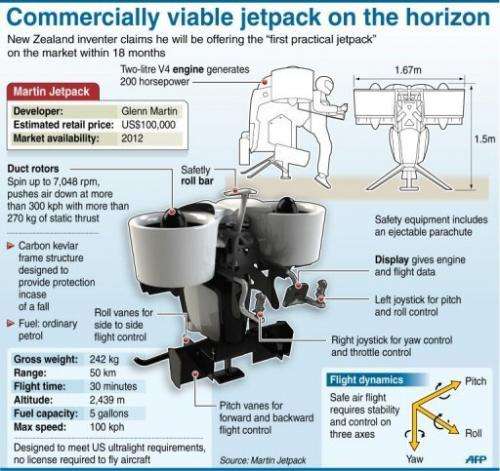
He said large commercial customers should be flying the jetpack, which is still undergoing final testing, by the end of the year and he hoped to make it publicly available in 2012 at a cost of about $US100,000.
Time magazine named Martin's creation as one of the world's most anticipated inventions late last year but he is acutely aware that the quest for a working jetpack has been littered with failure.
Probably the best known is the Bell Rocket Belt, which featured in the James Bond movie "Thunderball", but could only fly for 30 seconds and is now gathering dust at the Smithsonian Institution in the United States.
Swiss pilot Yves Rossey has also developed a jet-powered wing that straps to his back, although using it involves leaping from a flying plane.
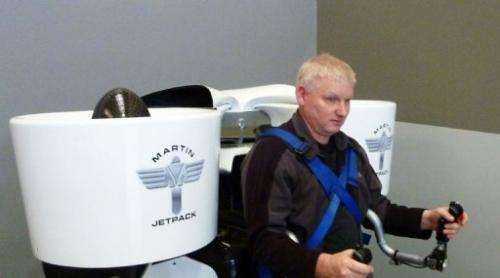
Martin's jetpack -- which Time likened to two enormous leaf blowers welded together -- is much larger than its predecessors, consisting of a pair of cylinders containing propulsion fans attached to a free-standing carbon-fibre frame.
The pilot backs into the frame, straps himself in and controls the wingless jetpack with two joysticks
Inspired by childhood television shows such as "Thunderbirds" and "Lost in Space", Glenn Martin (pictured) set out in the early 1980s to create a jetpack suitable for everyday use by ordinary people with no specialist pilot training.
Powered by a two-litre V4 engine generating about 200 horsepower, the concept as explained by Martin is simple: "If you shoot enough air down fast enough, then you'll go up."Fine-tuning details to turn the idea into a safe, workable flying machine has taken decades.
After numerous prototypes, the model that Martin hopes to put into production is designed to meet US ultralight standards, weighing less than 115 kilograms (254 pounds) and carrying a 20 litre (4.5 gallon) fuel tank.
That theoretically gives it a 30 minute flight time and a range of 50 kilometres (31 miles), although he said work was already underway on versions with extended capabilities.
Martin says flying the machine can be mastered in less than an hour. It has a rocket-propelled parachute if anything goes wrong.
Importantly, Martin said it runs off ordinary petrol "so you can fly into your local gas station, fill her up, grab a pie and a Coke and then fly off".
That vision may take some time to come to fruition, as current US laws bar ultralights from flying over built up areas, but Martin said it would eventually become reality.
He said he had been stunned by the international reaction since the jetpack made a public debut with a brief flight at a US airshow in 2008.
What began as a dream of creating a fun invention for adrenaline junkies -- the jetski of the skies -- has transformed into a project he believes could match the helicopter in revolutionising aviation.
"We've been approached by I think five different militaries (and) about six different governments," he said, declining to name potential clients for confidentiality reasons.
"People are looking at using this in border patrol around a lot of the sensitive borders in the world.
"We've got one large search and rescue organisation that wants 500 for after earthquakes and tsunamis and those sorts of things, where the roads are beaten up and you're struggling to get helicopters down."
After 30 years during which he mortgaged his house and became weary of being seen as "the crazy guy in the workshop", Martin now employs a core of eight staff in his factory and is confident of commercial success.
"If you've got a small team you can achieve something, if you've got a team of 2,000, it can be difficult," he said.
"All of the great innovations in aviation have been done by a small team of people, starting back with the Wright brothers, who did it in their bicycle shop in Dayton Ohio."
(c) 2011 AFP
-
From lemons to lemonade: Reaction uses carbon dioxide to make carbon-based semiconductor,
32 comments
-
Thioridazine kills cancer stem cells in human while avoiding toxic side-effects of conventional cancer treatments,
3 comments
-
SpaceX private rocket blasts off for space station (Update),
42 comments
-
Climate scientists say they have solved riddle of rising sea,
31 comments
-
SpaceX capsule has 'new car' smell, astronauts say (Update),
2 comments
-
Need a rigid insulation material???
11 hours ago
-
magnets or EMF in car bumpers to protect from fender bender
May 26, 2012
-
length of wire in a coil of known dimensions?
May 25, 2012
-
India Engineering Powerhouse
May 25, 2012
-
electromagnet core dereference between hard and soft iron
May 25, 2012
-
Measuring water pressure in an open tank
May 24, 2012
- More from Physics Forums - General Engineering
More news stories
Browser wars flare in mobile space
The browser wars are heating up again, but this time the fight is for dominance of the mobile Internet.
3 hours ago |
5 / 5 (1) |
2
Probability of contamination from severe nuclear reactor accidents is higher than expected: study
Catastrophic nuclear accidents such as the core meltdowns in Chernobyl and Fukushima are more likely to happen than previously assumed. Based on the operating hours of all civil nuclear reactors and the number ...
Technology / Energy & Green Tech
May 22, 2012 |
3.6 / 5 (21) |
56
|
SpotterRF debuts Radar Backpack Kit (w/ Video)
(Phys.org) -- SpotterRF has announced a special radar backpack kit designed to enhance situational awareness for soldiers on the ground. The company says its special radar is designed for warfighters as part ...
HyperSolar shows dirty water no barrier to power world
(Phys.org) -- The Santa Barbara, California, company, HyperSolar, is set to transparently share the ups and downs of its research experiences toward the companys ultimate vision, successfully producing ...
Tesla to launch electric sedan in US on June 22
Tesla Motors said Tuesday it would begin deliveries of "the world's first premium electric sedan" on June 22, slightly ahead of schedule.
Technology / Energy & Green Tech
May 22, 2012 |
4.5 / 5 (11) |
18
Nvidia trumpets Tegra 3 phone design wins for 2012
(Phys.org) -- Nvidias competitive war paint has a name, Tegra 3. On the heels of Nvidia announcements about lowering costs of its Tegra 3 processors and Nvidia-enabled tablets running Android Ice Cream ...
Scientist: Evolution debate will soon be history
(AP) -- Richard Leakey predicts skepticism over evolution will soon be history. Not that the avowed atheist has any doubts himself.
Dell tablet leak: 10.1-inch display, two-battery choice
(Phys.org) -- Headline after headline talks about vendors tablets in the wings as likely number-one contenders for the iPad. Such claims have justifiably been taken with a grain of salt, considering ...
Keep food safety in mind this memorial day weekend
(HealthDay) -- Picnics, parades and cookouts are as much a part of Memorial Day weekend as tributes to the United States' war veterans.
Family history of Alzheimer's affects functional connectivity
(HealthDay) -- Cognitively normal individuals with a family history of late-onset Alzheimer's disease (AD) may display lower resting state functional connectivity in the default mode network (DMN) of the brain, ...
Social welfare cuts ultimately come with heavy price, researchers say
(Phys.org) -- Slashing government funding for Medicaid, food stamps and other programs that serve the poor while politically popular with some lawmakers and many conservatives may do more harm ...

Jun 07, 2011
Rank: 1 / 5 (1)
Jun 07, 2011
Rank: not rated yet
Technically, this is a ducted-fan mini-helicopter rather than that mega-scary 'rocket belt' beloved of stunt-men...
Jun 07, 2011
Rank: not rated yet
Jun 07, 2011
Rank: not rated yet
Jun 07, 2011
Rank: not rated yet
you need to allow java script in your browser to get the video to work.
Jun 07, 2011
Rank: not rated yet
Not bad.
Jun 07, 2011
Rank: not rated yet
Jun 07, 2011
Rank: 5 / 5 (4)
Jun 07, 2011
Rank: not rated yet
If no one has flown it, how does he know?
Jun 07, 2011
Rank: not rated yet
Jun 07, 2011
Rank: not rated yet
Jun 08, 2011
Rank: not rated yet
www.youtube.com/w...mx71DqfQ
Or if he can make his electric and noiseless.
Some kind of failsafe for the take off/landing altitudes where the parachute is useless would be nice. Something like an airbag that surrounds you.
Super construction materials like graphene, along with better batteries would allow superior designs.
Jun 08, 2011
Rank: not rated yet
That's not possible as batteries require the addition of too much weight and not enough longevity. Batteries just aren't developed enough to consider their use.
Jun 08, 2011
Rank: 5 / 5 (2)
I have to agree.It crossed my mind someone would suggest that,but as you said,it would make for a very short flight time with current battery technology.
However,the proposed Puffin aircraft would probably work for short flights right now,as it's props create lift by their aerodynamic shape,and the thing transitions to horizontal flight,as opposed to the much more inefficient jet pack that flies due to the reaction mass of air expelled from the engine cowlings.
Jun 12, 2011
Rank: not rated yet
Look at the Segway. Perfectly safe, functional and can't fall from the sky and kill people yet it isn't allowed hardly anywhere.
Jun 13, 2011
Rank: 1 / 5 (2)
Get rid of the person driving the thing and replace him with a computer and you might just have something that someone somewhere might sometimes use to do something unusual, or something.
Kaplah!
Jun 13, 2011
Rank: 1 / 5 (2)
If he could make it edible it would be even better for things like disaster relief.
Just make the entire thing out of licorice, candy drops and magic pixie dust.
Jun 13, 2011
Rank: 1 / 5 (2)
whomever
Where are the grocery bag holders?
Here is a much better idea for personal mobility...
http://www.youtub...=related
Jun 14, 2011
Rank: not rated yet
Jun 15, 2011
Rank: not rated yet
Jun 16, 2011
Rank: not rated yet
Yes,I have heard of this concept before,and it is brilliant in IMHO. It occurred to me that it could be built much more economically than a conventional monorail system.I found a FAQ section on the official Shweeb site: http://shweeb.com...m=faq#f1