Neag math duo decodes language barriers to math reasoning
(PhysOrg.com) -- It all started with the fear and loathing Strand 25 brings to some math classrooms in the state.
Strand 25 is the part of the benchmark Connecticut Mastery Test that presents what were once known as “word” or “thought” problems. Now they’re known as “open-ended, non-routine” problems with a lot of language involved. Similar problems appear on the state high school standardized exam, the Connecticut Academic Performance Test. And they present particular issues for students who are challenged with fluency in English.
“Teachers are sometimes told, ‘Don’t even bother trying to teach Strand 25,’” Neag math educator Megan Staples says.
Staples and Neag colleague Mary Truxaw, both assistant professors in mathematics education in the Neag School of Education, arrived at UConn about the same time with a similar interest in language as the “invisible curriculum” in mathematics and higher order thinking. They started with research on the topic with the help of four participating Hartford teachers in the summer of 2007.
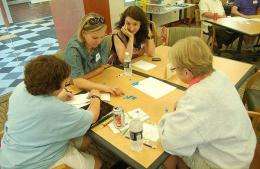
In the second year, supported by a state grant, they expanded the work into a professional development project with 23 teachers at Batchelder, Kennelly, and Bulkeley public schools in Hartford and the private Watkinson School to link language goals to the content goals in their math lesson plans. Teachers also met bimonthly in teams during the school year to support one another and develop the lessons.
That project was known as ACCESS, or Academic Content and Communications Equals Student Success, and Staples and Truxaw were co-directors. The project that Staples and Truxaw seeded continued unofficially (without funding) during the 2009-10 school year, and is alive in a similar form in 2010-11 through Neag’s Integrated Bachelor’s/Master’s Teacher Education Program at Batchelder School.
Grappling with academic language
Many of the students in Hartford schools are fluent in English socially but not academically. “You think kids get it because they say socially appropriate things but they still may not be able to justify, they still might not be able to understand the academic language,” Truxaw says.
The researchers point out that it takes about seven years for an English learner to become academically fluent, but students are eligible for state-supported English language programs only for 30 months.
Language concerns are not about vocabulary per se but often about subtle differences in colloquial speech. For instance, in doing math comparisons, the difference between the phrases “at least” and “the least” can be huge. A problem asking students to combine packages of hot dog buns to come up with at least 40 buns for a picnic can be confusing.
“They will aim for exactly 40 but not realize you could have slightly more than 40,” Truxaw says. Prepositions and articles make a huge difference, she adds.
One technique for a student struggling with explaining a math concept is to give him or her a “language frame,” such as, “I know the answer is correct/incorrect because …” Truxaw says. “A language frame is not doing the math for them but it’s giving them a little scaffolding to explain what they did.”
Carl Lager, a noted researcher at the University of California, Santa Barbara, says math, and particularly algebra, is where push comes to shove for the English learner struggling to close the achievement gap. “No other mathematics content filters out English learners faster than algebra,” he wrote in 2004. “Algebra allows students to move from concrete to abstract thinking.”
A professional model
Truxaw and Staples adopted three pillars that cropped up in their reading during the development of the project: centralize justification in the classroom, develop academic language, and make rigorous content accessible to all.
Then they applied a professional model that incorporates language and content goals in the lesson. This strategy is “good for anybody who may not have the academic language,” Truxaw says. “I find I’m doing that in my university lessons now, partly to model but partly because you need the vocabulary and you need to make sense of it and impact the language that’s there.”
Adds Staples, “We learned that we could make an important impact so that, if you deliberately attend to language, students can make progress on these open-ended responses.”
Staples notes that, especially with new federal Common Core standards for math going into effect in 2014, there is much work ahead in the area of expressing mathematical reasoning. “I still feel like we’re at the beginning of it. You have a whole bunch of people working on language, but they don’t get close enough to content. And then you have this group of people who are so close to content, they aren’t steeped in the language. We need more work on the intersection.”
Tom DeFranco, dean of the Neag School, whose field is mathematics, says much research has been done to help K-12 students improve their problem solving, but by applying this newer research on math discourse to the classroom, “Drs. Staples and Truxaw are providing teachers effective instructional routines and strategies that will help their students be successful problem solvers.”
Staples and Truxaw also say that sustaining collaboration among teachers related to specific classroom work was a huge benefit. The collaboration was often magical, says Truxaw. Better teaching resulted and so did increased mutual respect. “When there are not enough hours in their day, to figure out ways to make that happen is really powerful,” she adds.
William Conroy, a 2007 graduate of the IB/M program who is now a third-grade teacher at Batchelder, participated in the ACCESS project. He agrees, and would like to be able to pursue a more complete training.
Conroy’s biggest realization from the project was that all the students could be reached through the lesson plans. “We were able to create polished lessons that were able to focus on how the kids could justify their answers and how they could have a deep understanding of math concepts, as opposed to our teaching the skill discretely,” he says.
Truxaw and Staples, along with Professor Fabiana Cardetti in the math department, have applied for a state Department of Higher Education grant as part of their math leadership work to train teachers who support other teachers in the classroom. The two researchers have published and presented their work widely in the past two years.
Provided by University of Connecticut


