NASA details achievements of Lunar Reconnaissance Orbiter
June 21, 2011

NASA details achievements of lunar spacecraft

Enlarge

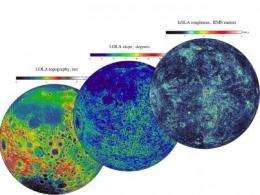
LOLA data give us three complementary views of the near side of the moon: the contours of the landscape, or topography (left), along with new maps of the surface slope values (middle) and the roughness of the topography (right). All three views are centered on the relatively young impact crater Tycho, with the Orientale basin on the left side. The slope magnitude indicates the steepness of terrain, while roughness indicates the presence of large blocks, both of which are important for surface operations. Credit: NASA/Goddard/Massachusetts Institute of Technology

NASA has declared full mission success for the Lunar Reconnaissance Orbiter (LRO). As a result of the mission, LRO has changed our view of the entire moon and brought it into sharper focus with unprecedented detail.

NASA's Exploration Systems Mission Directorate (ESMD) operated the spacecraft and its instruments during the one-year . Now that the final data from the instruments have been added to the agency's Planetary Data System, the mission has completed the full success requirements. The data system, which is publicly available, archives data from past and present as well as and laboratory data.

The rich new portrait rendered by LRO's seven instruments is the result of more than 192 terabytes of data, images and maps, the equivalent of nearly 41,000 typical DVDs.

"LRO is now in the very capable hands of NASA's Science Mission Directorate, with ongoing, near continuous acquisition of ," said Douglas Cooke, associate administrator of ESMD at NASA Headquarters in Washington. "Exploration will be well served by the LRO science mission, just as the LRO exploration mission has benefited lunar science."

The primary objective of the mission was to enable safe and effective exploration of the moon. "We needed to leverage the very best the science community had to offer," said Michael Wargo, chief lunar scientist of ESMD. "And by doing that, we've fundamentally changed our scientific understanding of the moon."

The most precise and complete to date of the moon's complex, heavily cratered landscape have been created from more than four billion measurements, which are still coming in, taken by LRO's Lunar Orbiter (LOLA). LOLA has taken more than 100 times more measurements than all previous lunar instruments of its kind combined, opening up a world of possibilities for future exploration and for science.

The Camera (LROC) revealed stunning details after imaging nearly 5.7 million square kilometers of the moon's surface during the mission's exploration phase. That is roughly the same amount of land as all contiguous states west of the Mississippi River. Though earlier missions also imaged the moon, what sets LROC apart is its ability to image with surface pixels that are only 1.5 feet in size, small enough to distinguish details never before possible.

"With this resolution, LRO could easily spot a picnic table on the moon," said LRO's Project Scientist Richard Vondrak of NASA's Goddard Space Flight Center in Greenbelt, Md.

While studying the Hermite crater near the moon's north pole, LRO's Diviner Lunar Radiometer Experiment found the coldest recorded spot in the solar system, with a temperature of minus 415 degrees Fahrenheit (minus 248 degrees Celsius or 25 kelvins).

To further explore these regions, LRO's Lyman Alpha Mapping Project, which can "see" in the dark, is imaging the shaded areas, while LOLA's precise measurements map solar illumination. This work has provided new insight into the shadowed regions and also revealed areas that receive nearly continuous sun. Because sunlight itself is a resource on the moon, knowing there are areas that get sun for approximately 243 days a year and never have a period of total darkness for more than 24 hours is extremely valuable.

Complementing those efforts are both the Lunar Exploration Neutron Detector (LEND) and the Miniature Radio Frequency advanced radar, which are searching for deposits of water ice. LEND also seeks hydrogen, which could be used potentially as fuel. LRO's Cosmic Ray Telescope for the Effects of Radiation is studying the lunar radiation environment, which is important to keep astronauts healthy and safe.

LRO launched aboard an Atlas V rocket from Cape Canaveral, Fla., on June 18, 2009.

More information: http://www.nasa.gov/LRO

Provided by NASA's Goddard Space Flight Center search and more info website

Filter


Move the slider to adjust rank threshold, so that you can hide some of the comments.


Display comments: newest first

LKD
Jun 22, 2011

Rank: not rated yet
Anyone know where the archives of this are available? I was interested in seeing a high resolution image of the Apolo landers and sites.
LKD
Jun 22, 2011

Rank: not rated yet
Well found one. All I can say is wow at the clarity.
http://www.nasa.g...411a.jpg
http://www.nasa.g...llo.html
ACW
Jun 22, 2011

Rank: not rated yet
Thanks
Rank 5 /5 (1 vote)
Relevant PhysicsForums posts
  • revamping general concept and cosmological principle
    createdMay 25, 2012
  • Transiting Exoplanet Light Curve
    createdMay 25, 2012
  • Math behind Theoretical Physics
    createdMay 24, 2012
  • Do we know whats at the center of galaxies yet?
    createdMay 23, 2012
  • Structure of the Milky Way?
    createdMay 20, 2012
  • What would it take to terraform Pluto and Charon?
    createdMay 19, 2012
  • More from Physics Forums - General Astronomy

More news stories

SpaceX capsule has 'new car' smell, astronauts say (Update)

SpaceX's Dragon cargo vessel smells like a new car, said astronauts at the International Space Station after opening the hatches Saturday following the spacecraft's landmark mission to the orbiting lab.

Space & Earth / Space Exploration

created 23 hours ago | popularity 4.5 / 5 (21) | comments 2

Australia hails surprise super-telescope decision

Australia has hailed a surprise decision giving it a role in a radio telescope project aimed at revolutionising astronomy, vowing to draw on its decades of experience in space science.

Space & Earth / Astronomy

created 23 hours ago | popularity 5 / 5 (4) | comments 3

Astronomers seize last chance in lifetime for Venus Transit

Astronomers are gearing for one the rarest events in the Solar System: an alignment of Earth, Venus and the Sun that will not be seen for another 105 years.

Space & Earth / Astronomy

created 23 hours ago | popularity 5 / 5 (3) | comments 2

Astronauts enter world's 1st private supply ship

(AP) -- Space station astronauts floated into the Dragon on Saturday, a day after its heralded arrival as the world's first commercial supply ship.

Space & Earth / Space Exploration

created 23 hours ago | popularity 5 / 5 (6) | comments 0

Sophisticated simulations predict future warming

The chances of our planet being hit by a global warming of 3 degrees Celsius by 2050 is as likely as it being hit by an increase of 1.4 degrees, new research shows. Presented in the journal Nature Geoscience, the British study ...

Space & Earth / Earth Sciences

created May 22, 2012 | popularity 4.4 / 5 (9) | comments 51


Nvidia trumpets Tegra 3 phone design wins for 2012

(Phys.org) -- Nvidia’s competitive war paint has a name, Tegra 3. On the heels of Nvidia announcements about lowering costs of its Tegra 3 processors and Nvidia-enabled tablets running Android Ice Cream ...

Browser wars flare in mobile space

The browser wars are heating up again, but this time the fight is for dominance of the mobile Internet.

Scientist: Evolution debate will soon be history

(AP) -- Richard Leakey predicts skepticism over evolution will soon be history. Not that the avowed atheist has any doubts himself.

Dell tablet leak: 10.1-inch display, two-battery choice

(Phys.org) -- Headline after headline talks about vendors’ tablets in the wings as likely number-one contenders for the iPad. Such claims have justifiably been taken with a grain of salt, considering ...

SpotterRF debuts Radar Backpack Kit (w/ Video)

(Phys.org) -- SpotterRF has announced a special radar backpack kit designed to enhance situational awareness for soldiers on the ground. The company says its special radar is designed for warfighters as part ...

Thousands of shellfish found dead in Peru

Thousands of crustaceans were found dead off the coast of Lima following the mystery mass death of dolphins and pelicans, the Peruvian Navy said Friday.