NASA sees Arabian Sea tropical depression 1A fading
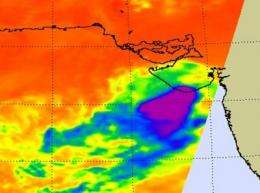
The low pressure system called System 98A was renamed tropical depression 1A over the weekend, and its strengthening was short-lived, just as it appears on NASA satellite imagery.
NASA's Aqua satellite passed over Tropical Depression 1A on June 11 at 21:29 UTC (5:29 p.m. EDT) as it still sat off of India's west-central coast. The Atmospheric Infrared Sounder (AIRS) instrument did see some strong thunderstorms in the depression at that time, that brought heavy rainfall to region near the Gir Forest National Park and Wildlife Sanctuary National Park in Bhojde, Gujarat, India.
By June 12 at 0600 UTC (2 a.m. EDT), the Joint Typhoon Warning Center issued their final advisory on Tropical Depression 1A, which only lasted as a tropical depression for about one day. At that time, the depression was about 315 nautical miles southeast of Karachi, Pakistan near 20.7 North and 70.5 East. It was moving northwestward near 6 knots (7 mph /11 kmh) and maximum sustained winds were near 30 knots (34 mph/55 kmh).
Tropical Depression 1A moved in a north-northwestward motion off the coasts of Maharashtra and south Gujarat and then move crossed the province of Saurashtra.
By Sunday, June 12, 2011 at 8:09 p.m. EDT, a weather reporter in the city of Mahabaleshwar in the Indian state of Maharashtra contacted NASA's Hurricane page and noted that the "system developed into a Tropical cyclone for a short time over Saurashtra, Gujarat, India. It seems to fading away now."
The center remnant low continued to move north-northwest staying in the Arabian Sea and just of the India coastline on June 12, and was expected to dissipate quickly. Satellite imagery from June 13 showed no organization and mostly scattered and disorganized clouds in the area where the remnant low was located.
Provided by NASA's Goddard Space Flight Center


