Mystery of Ohio's Fort Recovery solved by students
Jun 21, 2011
Mystery of Ohio's Fort Recovery solved by students
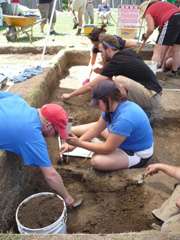
Ball State students from a field study in Fort Recovery, Ohio, dig along the east-west palisade of the fort, which played a major role during the Indian battles that raged during the late 1700s and early 1800s in west central Ohio. (Photo provided)

Obscured for more than two centuries lost under several feet of dirt and clay, the original site of historically important Fort Recovery was recently discovered following months of sleuthing by a team from Ball State University.

In the last few weeks, faculty and students involved in an immersive discovered the location of the east-west palisade of Fort Recovery, which was built in 1793 — during the height of the Indian battles that raged at that time in west central Ohio.

Fifteen anthropology and history students made the find during a five-week field study in Fort Recovery, a historic 1,300-person community located between Fort Wayne, Ind., and Dayton, Ohio.

Mark Groover, an anthropology professor who led the student field study project, said the discovery was similar to a good detective story with lots of clues that had to be put together.

Uncovering the fort's location came early in the spring when Ball State archeologist Chris Keller, a Fort Recovery native, found the trench by using ground-penetrating radar at one of three possible sites.

"I would say this is a pretty significant find for the community as well as our students," Groover said. "The residents knew the fort was somewhere in the vicinity but didn't know the precise location.

"In fact, when we found the trench that was the site for the original wall, we were amazed it was pretty much out in the open — in a small grassy alley not far from Fort Recovery State Museum. But it was up to our students to put all the information together in order to find the place to start the dig."

During the excavation of the site, several artifacts from the late 1700s and early 1800s were found, including shells, scissors, lantern hardware and the middle bracket of a 1766 Charleville musket. The artifacts will be analyzed by Ball State and then returned for display at the museum.

Groover said the site is historically significant because it marked the end of Indian control of that part of what was then the Northwest Territory. A confederacy of Indian warriors defeated a 1,600-man army under Maj. Gen. Arthur St. Clair at this site along the Wabash River in 1791, and the fort was constructed two years later as American forces reoccupied the area.

Possibly the largest-ever assemblage of Indian warriors east of the Mississippi River attacked the fort in 1794 but were driven away by its defenders.

The field study was funded, in part, by a Battlefield Protection Grant from the U.S. Park Service. The will create a technical report of the findings for the Fort Recovery Museums and the Ohio Historical Society, which owns and manages the property. Another Ball State student group is also conducting a study of the military battle, which should conclude late this year.

Explore further: Actor Johnny Depp immortalized in ancient fossil find

Provided by Ball State University

4 /5 (1 vote)
add to favorites email to friend print save as pdf

Related Stories

Archaeologists discover Roman fort

Jan 31, 2008

University of Exeter archaeologists have discovered a Roman fort in South East Cornwall. Dating back to the first century AD, this is only the third Roman fort ever to have been found in the county. The team believes its ...

Racism not an issue in firing of NBA coaches, study

May 13, 2008

Race is not a factor in the firing of NBA coaches, although white coaches with losing records had somewhat longer tenures before being fired than African-American coaches with more losses than wins, a new study shows.

Fluoride demand creating shortages

Nov 30, 2007

A fluoride shortage in the United States and Canada forced Fort Worth, Texas, to go almost two months without putting any in the public drinking water supply.

Recommended for you

Tiny ancient bandicoot shines light on future

3 hours ago

(Phys.org) —A 20 million-year-old fossil skull identified as a 'pocket-sized' ancestor of the bandicoot will give insights into the future of Australia's modern endangered animals.

The eloquence of the otoliths

May 16, 2013

Fish fossils that are about 23 million years old give unprecedented insight into the evolutionary history of the gobioid order, one of the most species-rich groups among the modern bony fishes.

Light cast on lifestyle and diet of first New Zealanders

May 16, 2013

(Phys.org) —A University of Otago-led multidisciplinary team of scientists have shed new light on the diet, lifestyles and movements of the first New Zealanders by analysing isotopes from their bones and teeth.

User comments : 0

More news stories

Relaxed tourists share more

Tourists set on relaxing and socialising when they reach their holiday destination tend to do little advance research on the internet before making their trip, but are more likely to share travel information and photos on ...

Tiny ancient bandicoot shines light on future

(Phys.org) —A 20 million-year-old fossil skull identified as a 'pocket-sized' ancestor of the bandicoot will give insights into the future of Australia's modern endangered animals.

Daylight Saving Time spurs drop in crime rate

(Phys.org) —Researchers are no longer in the dark about when criminals are most likely to attack. William & Mary economist Nicholas Sanders teamed up with the University of Virginia's Jennifer Doleac to study the connection ...

Computer model predicts when viruses become infectious

A new computer model could help scientists predict when a particular strain of avian influenza might become infectious from bird to human, according to a report to be published in the International Journal Data Mining an ...

Anabolic steroids may affect future mental health

There is a link between use of anabolic-androgenic steroids and reduced mental health later in life. This is the main conclusion of a new study on elite male strength athletes that researchers from the University of Gothenburg ...