Discovering lost salmon at sea
June 23, 2011

Discovering lost salmon at sea

Enlarge

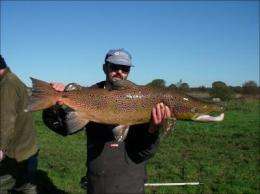
Co-author William Beaumont of the Game and Wildlife Conservation Trust holds a large male salmon. Credit: (Credit: © Anton Ibbotson)

Where Atlantic salmon feed in the ocean has been a long-standing mystery, but new research led by the University of Southampton shows that marine location can be recovered from the chemistry of fish scales. Surprisingly, salmon from different British rivers migrate to feed in separate places, and may respond differently to environmental change.

Numbers of Atlantic salmon have declined across their range since the early 1970s, and most researchers believe that conditions experienced at sea are largely to blame. Unfortunately, identifying where salmon go to feed in the huge expanse of the North Atlantic is difficult as attaching artificial tags to fish is expensive. A paper published this week in Scientific Reports shows that fish carry natural records of feeding location hidden in the chemistry of their scales.

The chemistry of reflects the composition of food and water in the area where they live and feed, and can act as a natural tag. Using this idea, the Southampton team, working with scientists from the Centre for Environment, Fisheries and Aquaculture Science (Cefas), the Game and Trust (GWCT) and the National Oceanography Centre (NOC), looked at the contained in historical records of scales of . The scales grew while the salmon were feeding at sea, so the values of the scales reflect the values of their diet in the feeding grounds. The team compared the scale values through time with satellite records of across the North Atlantic. The locations of sea where the time series match best are most likely to be the areas where the fish have been feeding.

"As every single salmon contains the natural chemical tag, we can now see where fish from individual rivers go to feed in the Atlantic," lead author Dr Kirsteen MacKenzie said. "Interestingly, we found that salmon born in two areas of the British Isles swim to feeding grounds that are far apart, and experience very different conditions while at sea". Co-author Dr Clive Trueman continued: "This information allows for better management of individual fish populations by monitoring both environmental conditions and fishing efforts in the areas where they feed". "Our technique can also be used to aid conservation of animals such as turtles, seabirds and tuna, and identify the best areas for marine protection measures," added Dr MacKenzie.

Provided by National Oceanography Centre, Southampton


Rank not rated yet
Relevant PhysicsForums posts

More news stories

Scientist: Evolution debate will soon be history

(AP) -- Richard Leakey predicts skepticism over evolution will soon be history. Not that the avowed atheist has any doubts himself.

Biology / Evolution

created 13 hours ago | popularity 3.5 / 5 (11) | comments 30

Thousands of shellfish found dead in Peru

Thousands of crustaceans were found dead off the coast of Lima following the mystery mass death of dolphins and pelicans, the Peruvian Navy said Friday.

Biology / Ecology

created 23 hours ago | popularity 4.8 / 5 (4) | comments 7

More plant species responding to global warming than previously thought

(Phys.org) -- Far more wild plant species may be responding to global warming than previous large-scale estimates have suggested.

Biology / Ecology

created May 22, 2012 | popularity 4.6 / 5 (14) | comments 18 | with audio podcast

For monogamous sparrows, it doesn't pay to stray (but they do it anyway)

It's quite common for a female song sparrow to stray from her breeding partner and mate with the male next door, but a new study shows that sleeping around can be costly.

Biology / Plants & Animals

created May 22, 2012 | popularity 5 / 5 (1) | comments 7 | with audio podcast

Study uncovers secret to speedy burrowing by razor clams

(Phys.org) -- If you look at a razor burrowing clam sitting in a bucket, you’d never guess that it could burrow itself down into the soil, much less do it with any speed. Razor clams look like fat straws, ...

Biology / Plants & Animals

created May 25, 2012 | popularity 1 / 5 (1) | comments 3 | with audio podcast report


Nvidia trumpets Tegra 3 phone design wins for 2012

(Phys.org) -- Nvidia’s competitive war paint has a name, Tegra 3. On the heels of Nvidia announcements about lowering costs of its Tegra 3 processors and Nvidia-enabled tablets running Android Ice Cream ...

Browser wars flare in mobile space

The browser wars are heating up again, but this time the fight is for dominance of the mobile Internet.

Dell tablet leak: 10.1-inch display, two-battery choice

(Phys.org) -- Headline after headline talks about vendors’ tablets in the wings as likely number-one contenders for the iPad. Such claims have justifiably been taken with a grain of salt, considering ...

SpotterRF debuts Radar Backpack Kit (w/ Video)

(Phys.org) -- SpotterRF has announced a special radar backpack kit designed to enhance situational awareness for soldiers on the ground. The company says its special radar is designed for warfighters as part ...

SpaceX capsule has 'new car' smell, astronauts say (Update)

SpaceX's Dragon cargo vessel smells like a new car, said astronauts at the International Space Station after opening the hatches Saturday following the spacecraft's landmark mission to the orbiting lab.

Australia hails surprise super-telescope decision

Australia has hailed a surprise decision giving it a role in a radio telescope project aimed at revolutionising astronomy, vowing to draw on its decades of experience in space science.